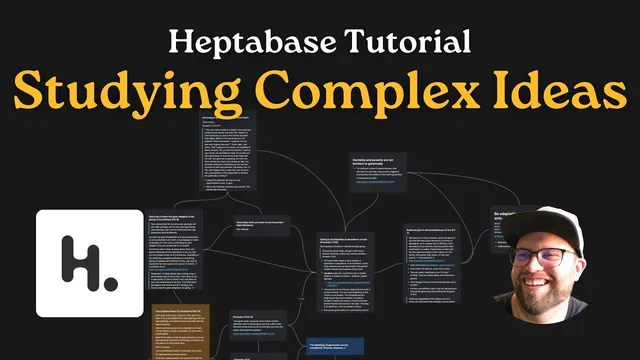
How I study complex literature (Heptabase Tutorial, note-taking method)
Based on Greg Wheeler's video on YouTube. If you like this content, support the original creators by watching, liking and subscribing to their content.
Create a dedicated card for the exact source passage so every later connection has a clear origin.
Briefing
Complex study improves when time is built into the process and notes are organized as connected “source” ideas rather than isolated facts. The method centers on studying a dense text—here, 2 Corinthians 9:6–15 on the “cheerful giver”—by creating a dedicated card for the exact source passage, then letting related passages and word-level meanings branch out from that anchor. Strategic breaks between study sessions matter because the mind keeps working while the reader is away; connections that didn’t appear on day one surface on day two after a gap of a day or two.
On the first day, the study begins with a single passage card placed on a Heptabase whiteboard titled “On the Bountiful life” (the heart of a giver). From there, the reader uses Bible cross-references embedded in a translation (English Standard Version) to pull in related verses—specifically Proverbs 11:24–25 and Proverbs 22:9. Each related verse gets its own card, and visual links are drawn back to the source card so the relationships are visible at a glance. Heptabase’s search and metadata features then reinforce context: if a proverb card appears later in another whiteboard, the card library and info panel reveal where the idea originated and what it connects to.
The study also shifts from themes to language. Proverbs 22:9 becomes a focal point because the phrase “bountiful eye” feels richer than a surface-level translation like “generous.” The reader looks up the Hebrew meaning of “bountiful” using Blue Letter Bible, recording definitions inside the Proverbs 22:9 card. That word-level work reframes the concept: “bountiful” is treated as “good kind or benign,” and the “eye” is interpreted figuratively as mental and spiritual faculties—so the blessing is tied to an inner disposition, not merely an outward act.
From there, the method expands through pattern recognition across multiple proverbs. Proverbs 19:17 is added as another related statement about generosity, and the reader observes a recurring structure: “whoever” (anyone) who follows these principles receives blessing. A new blue card is created to capture this generalization—“the blessings of generosity are not conditional”—and it is linked back to the supporting proverb cards. The result is a growing knowledge graph where each new insight retains its “birthplace” and can be extended years later.
On day two, the reader returns to the same Proverbs 22:9 card but pivots to the second half of the verse: “for he shares his bread with the poor.” The word “shares” triggers a new note distinguishing outward behavior from inward posture—sharing as the outward expression of caring. That insight then connects to a broader theme from earlier notes about being fruitful rather than merely productive (“fruit of the spirit”). The process demonstrates how rabbit trails can be productive: a single word leads to a chain of linked ideas across books (2 Corinthians, Proverbs) and even across time, because earlier notes can “bubble up” when new context makes them relevant.
Cornell Notes
The study method treats complex literature as a network of connected ideas anchored to exact source passages. A dedicated “source” card (e.g., 2 Corinthians 9:6–15) becomes the starting point for cross-references, word studies, and thematic generalizations, with every new card linked back to where the idea began. Strategic breaks between sessions help the mind generate connections that don’t show up immediately. Returning to earlier cards later can shift the focus from one phrase to another (e.g., “bountiful eye” to “shares his bread”), producing new insights that link to older notes such as “fruit of the spirit.” The payoff is context that persists over time: cards retain their origin and connections, enabling future expansion.
Why start with a single “source text” card instead of collecting notes randomly?
How do breaks change what connections appear during study?
What role does word-level research play in building deeper understanding?
How does the method turn multiple verses into a general principle?
What makes “rabbit trails” productive rather than distracting?
How does Heptabase support context over time?
Review Questions
- When studying a complex passage, what is the first card created, and how does it function as an “anchor” for later connections?
- Describe one example of how focusing on a different word in the same proverb led to a new insight and a new linked card.
- How do strategic breaks and Heptabase’s search/metadata features work together to preserve context and enable future expansion?
Key Points
- 1
Create a dedicated card for the exact source passage so every later connection has a clear origin.
- 2
Use cross-references to add related verse cards, then draw links back to the source to keep the idea trail visible.
- 3
Schedule breaks between study sessions; time away helps the mind generate new connections when returning to the same material.
- 4
Do word-level research (including original-language meanings) and store definitions directly inside the relevant card to refine interpretation.
- 5
Follow curiosity into “rabbit trails,” but convert each detour into a new card linked to the existing network.
- 6
Look for recurring patterns across multiple cards (e.g., shared “whoever” language) to turn verse-level observations into general principles.
- 7
Rely on Heptabase search and metadata so cards retain context and can be extended months or years later.