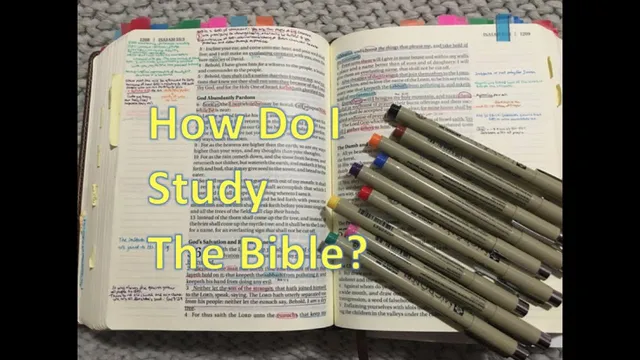
How I study the Bible
Based on Bible Notetaking with Katie 's video on YouTube. If you like this content, support the original creators by watching, liking and subscribing to their content.
Use wide margins, tabs, sticky notes, and inserted pages so key themes can be marked without needing perfect handwriting or full understanding immediately.
Briefing
A structured, color-coded note system—paired with cross-translation reading and symbol tracking—turns Bible study from a vague exercise into a searchable map of themes, promises, and repeated imagery. The core idea is simple: when a reader doesn’t fully understand a passage, they don’t have to stall. Instead, they mark it as a “placeholder” (tabs, sticky notes, or symbols) so the meaning can be revisited later as other parts of Scripture start to connect.
The method starts with a margin-friendly Bible and a willingness to keep notes messy at first. Using a KJV Journal award Bible large Prince Thomas Nelson, the reader relies on wide margins to insert custom pages and visuals—like a page created for Daniel 7’s “Beast” material, supported by pictures and targeted notes. The approach is practical: information can live on inserted pages, while the Bible text stays readable. When a phrase sparks confusion—such as “adore the Temple of the Lord between the porch and the Altar” in Ezekiel—the reader adds the related cross-reference (including Joel 2:17) directly where it matters, even if the deeper meaning isn’t fully understood yet.
A second layer focuses on “linking” key doctrines across the Bible. When a verse feels important, the reader uses prominent sticky notes to create quick retrieval points. A major example is Isaiah 42:21 (“the Lord is well pleased… he will magnify the law and make it honorable”), which becomes a tool for responding to claims that Jesus “did away with the Sabbath.” The study logic is that Jesus’ Sabbath actions are framed as honoring and magnifying God’s law rather than abolishing it—so the verse is kept ready for later discussion.
To build understanding without getting overwhelmed, the reader uses two reading plans. One is an audio-style overview running in the background (for familiarity and pattern recognition). The other is a deep-dive routine: listening to the New King James Version while reading the King James Version, then writing differences on top. If meaning still isn’t clear, the reader consults additional translations via BibleHub.com and then drills down further using Strong’s numbers to define specific words (for instance, “adamant” in Ezekiel 3:9, traced to a term associated with hardness and “a thorn… from its keenness for scratching a gem”). That word study then feeds into a larger theme: the “Seal of God” and the “mark of the beast,” with the reader interpreting “forehead” and “hands” as connected to thoughts and actions.
Color-coding and symbols make the system scalable. The reader circles and colors verses by category (e.g., Seal of God, Antichrist, Satan, mark of the beast) and plans a more organized rainbow layout for future note-taking. Symbols like “S” for Satan and “A” for Antichrist help locate verses quickly, while tabs and lettered notes track which passages belong to which theme.
Finally, the study method emphasizes repeated biblical symbolism—especially connections between Old Testament sanctuary imagery and New Testament fulfillment. A detailed example is Revelation’s use of sanctuary elements: “seven golden candlesticks,” “table of showbread,” and “altar of incense” are treated as structured, time-spanning imagery rooted in Exodus and Leviticus. The takeaway is that Scripture’s patterns aren’t random; they’re meant to be noticed, linked, and revisited—so even difficult books like Job or symbol-heavy sections like Revelation become manageable through targeted study aids and cross-references.
Cornell Notes
The study approach centers on building a Bible “map” using tabs, sticky notes, inserted pages, and especially color-coding. When a passage is unclear, it’s marked as a placeholder rather than left behind, so later reading can supply context. The reader deepens understanding by comparing the King James Version with the New King James Version, then checking other translations and using BibleHub.com and Strong’s numbers for word-level clarity (e.g., Ezekiel 3:9 “adamant”). Themes and symbols—like the “Seal of God” and sanctuary imagery—are tracked across books so repeated motifs (Old Testament to New Testament, and into Revelation) become easier to find and explain.
How does the reader handle passages that are confusing or not fully understood yet?
What role do cross-translation comparisons play in the study routine?
How does the “Seal of God” theme get tracked and connected to specific Bible details?
Why does the reader emphasize repeated biblical symbols rather than treating each passage as isolated?
How does sanctuary imagery function as a framework for understanding Revelation?
What practical steps reduce overwhelm when starting this kind of study system?
Review Questions
- What specific tools does the reader use when a verse is important but not yet understood, and how do those tools help later retrieval?
- How does comparing KJV and NKJV (plus other translations and Strong’s numbers) change the way the reader interprets difficult wording?
- Give one example of a repeated symbol (such as the cup or sanctuary imagery) and explain how the reader connects it across multiple Bible books.
Key Points
- 1
Use wide margins, tabs, sticky notes, and inserted pages so key themes can be marked without needing perfect handwriting or full understanding immediately.
- 2
Treat unclear passages as placeholders; mark them for later so new reading can supply context rather than forcing instant comprehension.
- 3
Run two reading tracks: an audio overview for familiarity and a close-dive routine that compares KJV and NKJV line-by-line.
- 4
When wording is unclear, consult additional translations and use BibleHub.com with Strong’s numbers to define key terms at the word level.
- 5
Build doctrine and theme retrieval systems with color-coding, circles, and category symbols (e.g., separate colors for Seal of God, mark of the beast, Antichrist, Satan).
- 6
Track repeated biblical symbols across testaments—like the “cup” motif or sanctuary elements—to see structured connections rather than isolated stories.
- 7
For symbol-heavy books like Revelation, use sanctuary-based frameworks (candlesticks, showbread, incense) anchored in Exodus and Leviticus to reduce overwhelm.