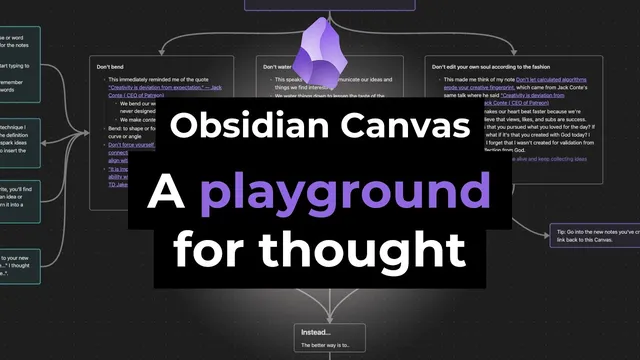
How I use Obsidian Canvas to distill and connect ideas (note-taking tips)
Based on Greg Wheeler's video on YouTube. If you like this content, support the original creators by watching, liking and subscribing to their content.
Start with one resonant quote or idea, then split it into separate canvas cards for the key phrases.
Briefing
A single quote becomes a network of connected ideas when it’s broken into resonant words, definitions, and personal reactions on an Obsidian Canvas—turning “note-taking” into a deliberate distillation process. The core workflow starts with one idea (often a line that hits hard), then splits it into separate cards for key phrases like “don’t bend,” “don’t water it down,” “don’t edit your soul,” “rather,” and “follow your most intense obsessions… mercilessly.” Each card acts like a sticky note on a whiteboard, letting ideas be teased apart without forcing them immediately into a permanent system.
The method hinges on two moves: search what the words trigger, and keep writing until something worth saving appears. For “don’t bend,” the process begins by bolding the phrase to focus attention, then jotting bullet-point associations that the phrase immediately evokes. That association leads to existing notes—found quickly using Obsidian’s double brackets—and to a definition of “bent” (to shape or force something into a curve). From there, the definition is inserted into a new thought: don’t force yourself into reading, highlighting, connecting, or creating work that doesn’t match a “creative fingerprint.” The workflow also encourages “follow the word trail”: look up definitions and synonyms (and sometimes antonyms) to spark additional angles, then decide which fragments deserve to be saved as notes.
As new notes form, the canvas becomes a hub for linking. The creator ties ideas together by linking related quotes and thoughts so they appear connected in Obsidian’s graph view—highlighting how relationships didn’t exist before the quote was dissected. A key instruction is to avoid premature judgment: keep writing even when something feels like it “doesn’t fit.” More material tends to surface, and only later does the best pieces get converted into notes that can live inside the canvas.
The quote’s other phrases generate similarly specific threads. “Don’t water it down” becomes a reflection on communication and withholding—followed by a reframing about the “waves” created by honest ideas, plus references to avoiding “wandering generalities” and rejecting “lukewarm” thinking. “Don’t edit your soul according to the fashion” turns into concerns about algorithms eroding creativity, and a spiritual reorientation toward what makes someone come alive rather than chasing validation. “Rather” is treated as a pivot toward a better way, while “follow your most intense obsessions” is linked to diligence—described through a Hebrew definition meaning sharp-pointed focus, plus the idea that diligence is a person you become, not just a skill.
The payoff is both cognitive and practical: each day’s single quote can produce a “constellation” of new connections, strengthening mental pathways as well as note relationships. The takeaway is simple—pick one line or even one word that resonates, pull it into a canvas, tease out definitions and associations, keep writing in bullets, and link what matters so the system (and the mind) grows a web of ideas over time.
Cornell Notes
The workflow turns one powerful quote into a web of linked notes by dissecting it into resonant words and phrases on an Obsidian Canvas. Each card holds a phrase like “don’t bend” or “don’t water it down,” and the process starts with bullet-point associations, then adds definitions and synonyms to spark new angles. Existing notes are pulled in using double brackets, while newly formed insights are saved as notes and connected so they appear in graph view. The method emphasizes staying in motion—keep writing and avoid editing too early—so the best ideas emerge naturally. Over repeated use, the approach builds both a growing knowledge network and stronger “pathways” in the mind.
Why split a quote into separate canvas cards instead of writing one long note?
How does “don’t bend” turn into actionable ideas rather than just interpretation?
What does “follow the word trail” mean in practice?
How do new notes become connected in Obsidian?
What’s the role of “don’t edit yourself” during the canvas process?
How does the quote’s “follow your most intense obsessions… mercilessly” connect to diligence?
Review Questions
- When a phrase triggers a memory, what two actions does the workflow recommend to turn that trigger into a usable note?
- How does the canvas approach change what gets saved into a PKM system compared with writing a single linear summary?
- What is the purpose of graph view in this process, and what does it reveal about connections created during the exercise?
Key Points
- 1
Start with one resonant quote or idea, then split it into separate canvas cards for the key phrases.
- 2
Use bullet points to capture immediate associations before searching your vault for supporting notes.
- 3
Pull in existing notes quickly with double brackets, using keywords or distinctive words from the phrase.
- 4
Strengthen each card by adding definitions and synonyms (the “word trail”) to generate new angles.
- 5
Keep writing without self-editing; convert only the best fragments into notes once they emerge.
- 6
Link new notes to related ideas so graph view shows a growing network of connections.
- 7
Repeat the process daily with one line or even one word to build both mental and note-based pathways over time.