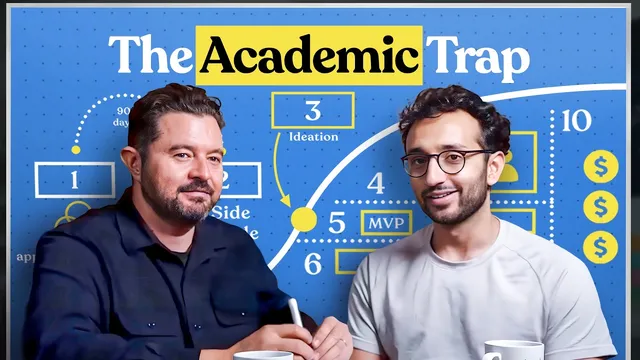
How I Would Build A Business in 2026 (If I had to start over)
Based on Ali Abdaal's video on YouTube. If you like this content, support the original creators by watching, liking and subscribing to their content.
Most people have concepts but lack knowledge of how businesses generate leads, sell, retain customers, and iterate—so “no idea” is often a business-mechanics problem.
Briefing
A practical roadmap for starting a business from scratch in 2026 hinges on one central shift: most people don’t lack “ideas,” they lack understanding of how businesses actually run—and that gap can be closed through apprenticeship-style learning, fast experiments, and deliberate business design. The message is blunt about risk: entrepreneurship is often framed as a high-failure gamble, but the real dynamic is asymmetrical risk—small, cheap tests can be run quickly, while the upside can be large if one experiment hits.
The first major lesson targets a common misconception formed by schooling. Traditional education trains people to follow schedules, seek permission, and deliver perfect answers once—traits that map poorly to entrepreneurship, which rewards iteration, imperfect early launches, and taking initiative. The transcript traces this mismatch to how modern schooling was shaped by industrialization and factory/office needs, not by building independent ventures. Even childhood behavior is used as evidence: kids naturally negotiate, sell lemonade, and trade chores for money, but those instincts get suppressed and later have to be relearned.
From there comes a mindset shift: “business in a box” is treated as the enemy of entrepreneurship. The desire to be told what to do is framed as job-seeking behavior, not founder behavior. Entrepreneurs are described as “shot callers” responsible for the beginning and the end of a process—defining vision, systems, and commercialization—while the middle can be delegated to employees and increasingly to AI. That division matters because it clarifies what cannot be outsourced: deciding what to build, when to stop, and how to turn work into value.
The transcript then challenges the job-versus-business security narrative. Jobs provide a smooth start—paychecks quickly and reliance on existing brands and systems—but can end abruptly through restructuring, leaving people to re-enter a shrinking labor market. Businesses are portrayed as rough at first and smoother later: no paycheck early, but potential for equity, brand value, and acquisition outcomes. The “90% fail” statistic is disputed as mythology, with the argument that business closures, mergers, and acquisitions don’t equal total failure, and that cheap experiments cap downside.
A key practical anchor is the concept of a lifestyle business: a deliberately sized company designed for fun, freedom, and flexibility rather than endless growth. The transcript argues that today’s internet, AI, social media, and cloud tools make this kind of “beautiful little” business feasible in ways that weren’t realistic for earlier generations.
To turn aspiration into execution, the roadmap emphasizes learning by doing through a “7-6-6 apprenticeship.” Instead of taking a leap, aspiring founders spend six months working directly under an operator of a profitable small business—specifically one with seven-figure revenue and six-figure profit—doing whatever tasks are necessary to get close to lead generation, sales, customer retention, and product development. The goal is derisking: protecting family, time, and money while gaining self-awareness, commercial understanding, and access to resources.
Finally, the transcript reframes opportunity selection. The “best idea” matters less than execution and fit: founder opportunity fit comes from origin, mission, and vision, plus identifying pain, prize, and payment. Pricing strategy is treated as counterintuitive—markets aren’t uniformly broke, and the highest willingness-to-pay segment can dominate outcomes. Selling to affluent customers is presented as a design choice for lifestyle businesses, not a moral stance, and the transcript recommends starting with a balanced model: roughly 10–100 customers paying $1,000–$10,000 (or up to $20,000) each, which is positioned as the easiest bridge from job to business without the fragility of single-client dependence or the difficulty of extreme volume models.
Cornell Notes
The core claim is that starting a business is less about having a “good idea” and more about learning how businesses work—then running cheap experiments to reduce risk. School and corporate careers train people to seek permission, follow schedules, and deliver perfect answers, but entrepreneurship requires initiative, iteration, and decision-making at the start and end of a process. A lifestyle business is framed as a deliberately sized company designed for fun, freedom, and flexibility, made feasible by internet and AI tools. Learning is recommended through a “7-6-6 apprenticeship”: spend six months working under a profitable small-business founder (7-figure revenue, 6-figure profit) to gain real lead-gen, sales, and customer-development skills. Opportunity selection should focus on founder opportunity fit and on pain, prize, and payment—especially targeting willingness-to-pay segments that can make pricing work.
Why does the transcript treat “I don’t have an idea” as a misunderstanding?
What is the “entrepreneur mindset shift,” and how does AI change the division of labor?
How does the transcript challenge the idea that business is overwhelmingly risky?
What does “lifestyle business” mean, and why is it presented as newly feasible?
How does the “7-6-6 apprenticeship” work as a risk-reduction strategy?
What framework is used to pick better business opportunities?
Review Questions
- What traits taught by school are described as misaligned with entrepreneurship, and what entrepreneurial behaviors replace them?
- How does the transcript justify asymmetrical risk, and what does it say about the “90% fail” statistic?
- Why does the transcript recommend a “7-6-6 apprenticeship” instead of a leap of faith, and what should the apprentice prioritize learning?
Key Points
- 1
Most people have concepts but lack knowledge of how businesses generate leads, sell, retain customers, and iterate—so “no idea” is often a business-mechanics problem.
- 2
Entrepreneurship requires “shot calling” at the beginning and end of a process; employees and AI can handle much of the middle once direction is clear.
- 3
Job security is portrayed as temporary; restructuring can abruptly end employment, while business equity and brand value can create longer-term options.
- 4
Business risk is reframed as asymmetrical: cheap, fast experiments can cap downside while leaving room for large upside.
- 5
Lifestyle businesses are intentionally sized for fun, freedom, and flexibility, made practical by internet, AI, and cloud tools.
- 6
The “7-6-6 apprenticeship” derisks starting by placing aspiring founders inside a profitable small business for six months to learn real execution.
- 7
Opportunity selection should follow pain–prize–payment and founder opportunity fit (origin, mission, vision), with attention to who actually has budget to pay.