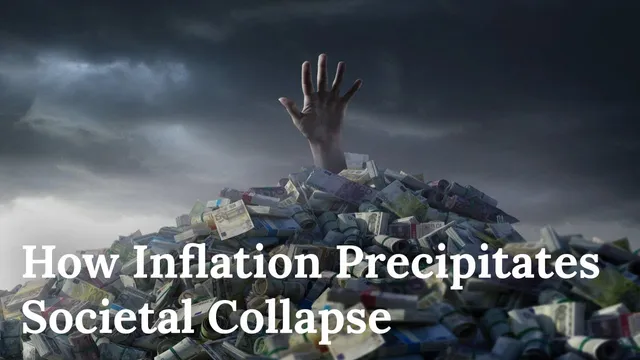
How Inflation Precipitates Societal Collapse
Based on Academy of Ideas's video on YouTube. If you like this content, support the original creators by watching, liking and subscribing to their content.
Monetary inflation is treated as the primary cause of price inflation: new money enters the market before goods increase.
Briefing
Monetary inflation—creating new money through the state or central banks—can set off a chain reaction that destroys trust in money, breaks economic coordination, and ultimately undermines political order. The core claim is that inflation’s damage is not limited to higher prices: it redistributes income toward those who receive new money first, erodes the state’s fiscal capacity, and can culminate in financial catastrophe and societal collapse.
The argument begins by distinguishing price inflation from monetary inflation. Higher prices are treated as a downstream effect of “new money pumped into the market,” not as the essence of the problem. Ludwig von Mises is used to frame inflation as the injection of additional money chasing an unchanged quantity of goods. That injection rarely enters the economy evenly. Early recipients—often politically connected—spend before prices fully adjust, gaining purchasing power at the expense of later recipients whose incomes lag behind rising costs.
Rome provides the historical case study. After Augustus halted territorial expansion following defeat in 9 A.D., the state faced revenue shortfalls. With tax increases politically constrained, emperors turned to a familiar workaround: debasing and clipping coinage. The denarius was diluted with cheaper metals like copper and reduced in size, producing excess precious metal that funded state spending, covered debts, and enriched insiders without openly raising taxes. The mechanism is presented as the same logic as modern paper or digital money expansion: increase the money supply, trigger price inflation, and use the timing gap between debasement and public recognition to finance government obligations.
As debasement deepened, the state tried to preserve an illusion of prosperity even as currency value collapsed. By around 200 A.D., the denarius reportedly fell to about half its original silver content, and prices became impossible to ignore. Harold Mattingly’s description of Rome “moving steadily in the direction of bankruptcy” is paired with Joseph Tainter’s account of later desperation: when money became too worthless to function, taxes were collected in usable supplies or bullion to avoid accepting the state’s own failing coin.
The social consequences escalated quickly. Otto Friedrich is quoted to capture the systemic collapse: if money becomes worthless, government and society lose their shared standards. Between 235 and 284 A.D., unpaid or underpaid forces contributed to instability—military deserters pillaged rural areas, barbarians sacked towns, crops were destroyed, and people were enslaved. Political fragmentation followed, with frequent emperor turnover, executions, and civil wars.
Attempts to manage the symptoms worsened the crisis. In 301 A.D., Diocletian imposed price controls on essentials like wheat, but the policy produced shortages and damaged trade; “sheer necessity” led to repeal. Hyper-inflation then accelerated in the early 4th century, with dramatic price jumps for wheat and steep declines in coin value. Commoners’ savings were wiped out, tax enforcement turned coercive, and families sold assets or children into slavery. Farmers became dependent on the next harvest and, under famine or raids, often fled to cities with grain stores.
By the 5th century, the peasantry’s decimation reduced the empire’s ability to sustain itself. The advantage of empire declined so sharply that some peasants became apathetic or joined invaders, leaving Rome unable to afford the problem of its own existence. The concluding prescription is political: remove money creation from government and central banks and rely on market-based money formed through voluntary exchange, consistent with Mises’s view that money is what people generally accept and use—not what authorities declare.
Cornell Notes
The central claim is that monetary inflation—expanding the money supply by governments or central banks—does more than raise prices. New money enters unevenly, first benefiting politically connected recipients before prices fully adjust, creating a redistribution of income. Rome illustrates the mechanism: after revenue problems, emperors debased and clipped the denarius, using the timing gap to pay debts without raising taxes. As coin credibility collapsed, the state lost the ability to collect taxes in money, resorted to forced labor and in-kind payments, and social order deteriorated amid desertion, civil war, and barbarian raids. Attempts like Diocletian’s price controls intensified shortages, and hyper-inflation eventually helped make Roman rule unsustainable.
How does monetary inflation differ from price inflation, and why does that distinction matter?
Why does inflation redistribute income, and who tends to benefit first?
What was Rome’s “debasing and clipping” policy, and how did it function like modern money printing?
How did Rome’s monetary breakdown affect government capacity and tax collection?
Why did Diocletian’s price controls worsen the crisis?
What sequence of events links hyper-inflation to social disorder in late Rome?
Review Questions
- What mechanisms make monetary inflation more than a price-level problem in the transcript’s framework?
- How did the timing of new money injections contribute to winners and losers during inflation?
- Which policies besides debasement—such as Diocletian’s price controls—are described as accelerating shortages and instability?
Key Points
- 1
Monetary inflation is treated as the primary cause of price inflation: new money enters the market before goods increase.
- 2
Inflation redistributes income toward early recipients, often politically connected, because prices adjust with a lag.
- 3
Rome’s debasement and clipping of the denarius is presented as a historical analogue to modern paper or digital money expansion.
- 4
When currency credibility collapses, the state’s ability to collect taxes and fund operations breaks down, pushing it toward in-kind payments and coercion.
- 5
Price controls during inflation can intensify shortages and damage trade by preventing market-clearing prices.
- 6
Hyper-inflation can trigger social breakdown through depleted savings, forced tax collection, slavery sales, and rural flight.
- 7
A proposed safeguard is removing money creation from government and central banks and relying on market-based money formed through voluntary exchange.