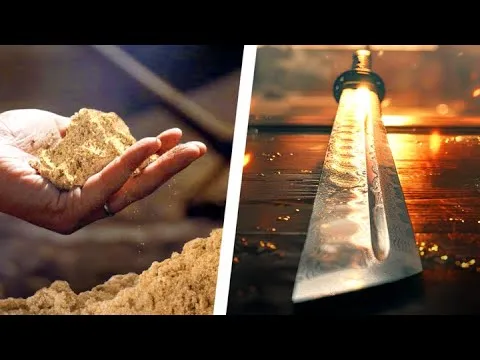
How Japanese Masters Turn Sand Into Swords
Based on Veritasium's video on YouTube. If you like this content, support the original creators by watching, liking and subscribing to their content.
Japan’s best sword steel depends on the Tatara method, a traditional smelting process run on a single night each year in Shimane province.
Briefing
Japanese swordmaking is presented as a tightly linked chain of chemistry, materials engineering, and craftsmanship—starting with iron-rich sand and ending with a blade whose microstructure produces both extreme hardness at the edge and controlled flexibility along the spine. The core finding is that the iconic curved katana isn’t just a cultural artifact or a matter of “skill”; it’s the predictable result of how carbon is distributed and locked into steel during folding, quenching, and heat treatment.
The process begins with the Tatara method, a traditional smelting practice carried out in Shimane province on a single night each year. Ceremonial prayers precede the fire, and workers feed the furnace for roughly 24 hours. The key input is iron sand—Japan’s volcanic geology leaves the country short on banded iron formations, so swordsmiths concentrate iron by exploiting density differences in river sand. Iron oxides settle where water flow changes, and deliberate river diversions increase the concentration, producing sand with about 80% iron oxides by weight. Heating these oxides above roughly 1,250°C breaks their bonds with oxygen, yielding iron that becomes useful only after carbon is added via charcoal. The result is steel, not because of a single “heat trick,” but because carbon and iron form a stronger alloy than either element alone.
Smelting reaches about 1,500°C—just below iron’s melting point—so the iron doesn’t fully liquefy; instead, it clumps while impurities form slag and collect at the bottom. After hours of adding charcoal and iron sand, workers remove slag in stages, with prayers marking major steps. The smelt produces a block containing steel, iron, and slag, but only about one-third is high enough quality for swordmaking. That steel is then sorted by quality and carbon content, a skill tied to certification exams, before being sent to swordsmiths.
Forging turns the steel into a blade through repeated heating, flattening, and folding. Folding spreads impurities and creates a layered grain structure, while also setting up the steel’s directionality for combat stresses. Carbon content is then engineered across the blade: high-carbon steel at the edge for hardness and edge retention, and lower-carbon steel at the spine for toughness and flex. The blade’s curve is traced to metallurgy—during quenching, clay thickness controls cooling rates. The spine cools slowly, allowing carbon to escape and form ferrite and cementite (perlite), while the thin edge clay forces rapid cooling that traps carbon into martensite. Martensite’s tetragonal lattice makes the edge extremely hard and causes it to expand relative to the spine, producing the katana’s backward curve. The boundary between these steel types appears as hamon, the “edge pattern.”
Even after forging, the work isn’t over: quenching can shatter roughly one-third of blades, and polishing with whetstones can take up to a month. The final product is treated as both weapon and art—an outcome framed as the payoff of centuries of trial-and-error craftsmanship grounded in repeatable physical and chemical principles.
Cornell Notes
Japanese swordmaking is portrayed as a materials pipeline: concentrate iron from sand, smelt it into steel using the Tatara method, then engineer carbon distribution so the edge becomes martensite while the spine becomes perlite. River-based iron sand enrichment can reach about 80% iron oxide, and charcoal supplies carbon so iron turns into steel rather than staying soft. Forging relies on repeated flattening and folding to spread impurities and build a layered grain, while different carbon steels are welded together for edge hardness and spine flexibility. Clay-coated quenching controls cooling rates—thin clay on the edge traps carbon to form martensite (hard, brittle), while thick clay on the spine cools slowly to form perlite (softer, ductile). The resulting hardness gradient creates the katana’s curve and the visible hamon edge pattern.
Why does Japan rely on iron-sand concentration rather than abundant traditional iron ore deposits?
What is the Tatara method, and why does it matter for the quality of steel used in top swords?
How does folding change the steel beyond simply reshaping it?
How do swordsmiths engineer hardness and flexibility using carbon content?
What metallurgical mechanism produces the katana’s curve and the hamon edge pattern?
Why is quenching so risky, and what happens after it?
Review Questions
- How does river flow and mineral density help concentrate iron oxides into iron sand suitable for high-quality steel?
- Describe how clay thickness during quenching leads to different steel microstructures at the edge versus the spine.
- Why does folding both spread impurities and influence the blade’s grain and combat performance?
Key Points
- 1
Japan’s best sword steel depends on the Tatara method, a traditional smelting process run on a single night each year in Shimane province.
- 2
Iron sand is concentrated by exploiting density differences: iron oxides settle in river bends and flow-change zones, and river diversions can boost concentration.
- 3
Charcoal is essential not just for heat but for chemistry—carbon from charcoal combines with iron to create steel, since pure iron is too soft.
- 4
Smelting reaches about 1,500°C, producing a clumped iron/steel mass while impurities melt into slag that must be removed in stages.
- 5
Forging uses repeated flattening and folding to spread impurities and build a layered grain, while welding different carbon steels tailors edge hardness and spine flexibility.
- 6
Quenching with clay coatings creates the katana’s curve and hamon: thin clay cools fast to form martensite at the edge, while thick clay cools slowly to form perlite at the spine.
- 7
Polishing is labor-intensive—hand sharpening with whetstones can take up to a month per sword, and quenching shatters roughly one-third of blades.