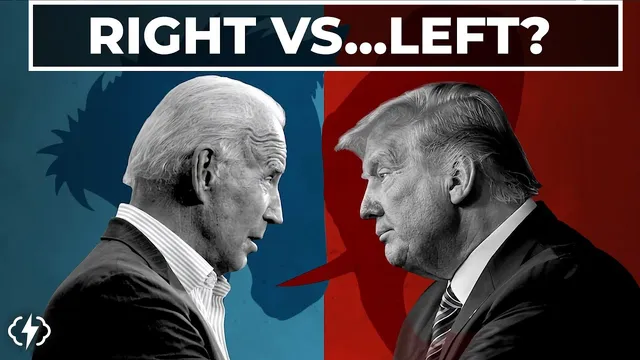
How Left Is The American Left...And Why Didn't Socialism Catch On Here?
Based on Second Thought's video on YouTube. If you like this content, support the original creators by watching, liking and subscribing to their content.
The U.S. Democratic Party is described as center-right when compared to other Western democracies, because “left” and “right” are relative labels that shift over time.
Briefing
Socialism never took root in the United States in the way it did across parts of Western Europe because American politics and institutions repeatedly pushed left-wing organizing into the margins—while capitalism proved unusually adaptable when challenged. Even with a real socialist current today, the country’s two-party system, the long aftershocks of the Red Scare, and repeated organizational failures combined to prevent a durable, reformist or revolutionary socialist party from emerging as a governing alternative.
The first step is clarifying what “left” means in America. In practice, the elected American left is largely the Democratic Party, which is often labeled “center-left” in casual terms. But when voting records and political rhetoric are compared to other Western democracies, Democrats land closer to center-right—an outcome tied to how relative the labels “left” and “right” are. What counts as radical shifts as parties win and mainstream their goals. In that comparative frame, policies that look “mainstream left” in Europe—reining in capitalism, expanding public services, strengthening workers’ rights—can appear far more radical in the U.S. For example, the British Conservative Party’s 2017 manifesto includes commitments to workers’ protections, industrial strategy, and government’s role in public services—positions that would be hard to sell as “right-wing” in the American context. Meanwhile, the UK Labour Party’s proposals, including support for nationalized healthcare, net-zero targets by the 2030s, and nationalization of key industries, sit well within European mainstream left politics and only barely qualify as socialism by U.S. standards.
That international mismatch matters because it helps explain why European-style social democracy could become electorally normal while American “economic democracy” remained politically constrained. The U.S. has a substantial socialist movement—Democratic Socialists of America (DSA) and the CPUSA have seen recruitment gains, socialism polls well among younger voters, and socialist ideas have influenced some local politics. Historically, socialist parties won elections in the early 20th century, and Eugene V. Debs drew about 6% of the national vote in a presidential election. Yet no socialist party achieved the sustained national presence seen elsewhere.
A major structural driver is the electoral system: the Electoral College plus first-past-the-post voting makes third parties act as spoilers and keeps power concentrated in two parties. In that environment, voters tend to choose the least disliked option, and Democrats and Republicans can assume they will govern unless they make a catastrophic mistake. Even when Democrats contain left-leaning factions, the party can limit who gets to run on its ticket.
But voting rules alone don’t explain everything. The Red Scare poisoned the language of socialism, communism, and anarchism through propaganda, crackdowns, imprisonment, and union busting—turning socialist organizing into something framed as un-American and even morally corrupt. The result is a cultural reflex that brands mild social policies as “socialism,” keeping broad support from consolidating.
Finally, organizational failures repeatedly undermined socialist efforts: inconsistent strategy, difficulty unifying supporters under one banner, and struggles to win legitimacy in a hostile environment. Historian Eric Foner is cited as emphasizing these constraints, while the broader conclusion is that capitalism has repeatedly adapted—shifting from factory floors to white-collar corporatism and onward to the gig economy and new forms of consumerism. The upshot is not that socialism is impossible, but that it faces a tougher landscape in the U.S. The argument ends with a call for long-term organizing: educate, counter propaganda, support people under current conditions, and prepare for a future opening when capitalism falters enough to make change politically feasible.
Cornell Notes
The U.S. left has not produced a durable socialist governing alternative the way some European countries have, largely because American politics and culture make socialist organizing harder to sustain. Democrats are often treated as “center-left,” but relative comparisons to other Western democracies place them closer to center-right, reflecting how shifting definitions of left and right distort expectations. Structural incentives from the Electoral College and first-past-the-post voting keep power in two parties and make third parties act as spoilers. The Red Scare further stigmatized socialism and weakened labor organizing through repression and propaganda. Even when socialist movements gained traction at times—such as early 20th-century electoral successes—organizational fragmentation and capitalism’s ability to adapt prevented socialism from replacing capitalism.
Why does the transcript claim Democrats look “center-right” when compared internationally?
What role does the U.S. electoral system play in preventing socialist parties from taking root?
How did the Red Scare affect socialist organizing beyond elections?
What does the transcript say about socialist success in the U.S. historically—was it completely absent?
Why does the transcript argue capitalism remains resilient even when left parties gain ground elsewhere?
Review Questions
- What does the transcript mean by “left” and “right” being relative, and how does it use international comparisons to support that claim?
- How do the Electoral College and first-past-the-post voting system interact with third-party politics in the transcript’s explanation?
- Which three factors does the transcript combine to explain why socialism didn’t become a major governing force in the U.S., and how does each one limit left organizing?
Key Points
- 1
The U.S. Democratic Party is described as center-right when compared to other Western democracies, because “left” and “right” are relative labels that shift over time.
- 2
The Electoral College and first-past-the-post voting system structurally favors two parties and makes third parties act as spoilers.
- 3
The Red Scare is presented as a long-lasting cultural and organizational barrier that stigmatized socialism and weakened labor organizing through repression.
- 4
Modern socialist organizing exists in the U.S. (including DSA and CPUSA growth), but it has not produced a durable national governing alternative.
- 5
Historical socialist electoral moments—such as Eugene V. Debs’s ~6% presidential vote—did not translate into sustained reformist or revolutionary party dominance.
- 6
Organizational failures and difficulty building unified legitimacy are cited as reasons socialist projects struggled to survive in a hostile environment.
- 7
Capitalism is portrayed as highly adaptable, evolving its economic and political forms to absorb or neutralize socialist challenges.