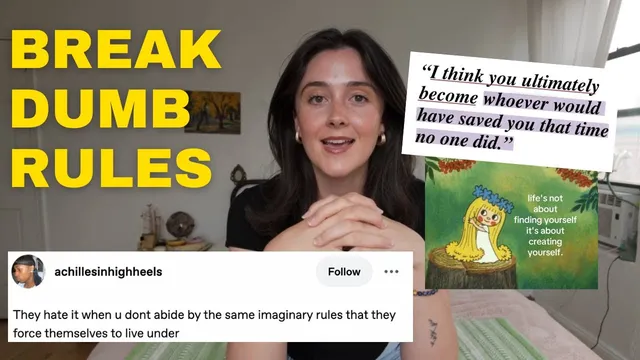
How Life Changes When You Realize the Rules are Made Up
Based on Anna Howard's video on YouTube. If you like this content, support the original creators by watching, liking and subscribing to their content.
Agency is defined as autonomy (choosing goals from within) plus efficacy (willingness and ability to pursue them).
Briefing
Agency—defined as the blend of autonomy (setting your own goals) and efficacy (having the drive to pursue them)—is presented as a learnable skill that can be lost, regained, and practiced unevenly across life. The central claim is that many people are trained to treat problems as unsolvable and to outsource decisions to “experts,” defaults, or other people, which quietly turns injustice and personal setbacks into permanent fate. That loss of agency matters because it doesn’t just affect individual confidence; it shapes whether communities mobilize or surrender to fear.
The episode opens with a personal framing: small life changes (a haircut, a new camera) become a gateway into a bigger question about why people feel stuck. Henrik Carlson’s definition of agency anchors the discussion. Autonomy means digging inside to formulate goals that may look strange to others. Efficacy means believing reality can be manipulated—through effort, learning, and problem-solving—rather than assuming certain problems can’t be solved. Against a backdrop of doom messaging that encourages passivity, the host argues that “we’re cooked” narratives are convenient because they discourage imagination, collective problem-solving, and the willingness to act.
A key emotional pivot comes from Glennon Doyle’s Untamed: no one else can know what someone should do because each life is an “unprecedented experiment.” From there, the episode treats agency as something that can be cultivated. Julian Smith’s “The Flinch” is used to challenge fixed identity: preferences and habits aren’t destiny, and people can change what they want about themselves. The practical takeaway is that agency grows when people stop waiting for directions and start running experiments.
The discussion then narrows to “selective agency”—the idea that people aren’t uniformly high or low agency everywhere. Kate Hall’s concept appears through a story about being stalked: the victim’s low-agency state made the problem feel unsolvable, even though help quickly made it manageable. The host extends this into a three-theater model—work, relationships, and relationship to self—arguing that one arena often lags behind. A second telltale sign of low agency is “needing more information,” which becomes a trap when it delays action. Learning is framed as downstream of doing, reinforced by Tommy Dixon’s “Do What You Can’t,” and illustrated with the host’s own vlogging practice: watching tutorials didn’t build skill until filming and editing forced real learning.
Agency also becomes communal and relational. The host highlights how certain people (like her father, described as calm and methodical) model problem-solving without drama, while other relationships can dampen initiative. Carlson’s essay adds a “question defaults” principle: agency means treating standard ways of doing things as only one option, then asking for the simplest next step or the shortest path to a goal.
The episode’s most provocative section introduces “anarchy calisthenics,” drawn from James C. Scott via a community example: people practice breaking “dumb rules” of minor consequence so they can later break “big rules” when moral stakes rise. A personal story follows from Chattanooga, where an “illegal” bench campaign led to rapid city action and sparked broader bench initiatives.
Finally, the host connects agency to large-scale injustice, especially Palestine, arguing that despair can feel comforting because it provides certainty. Greta Thunberg and the Freedom Flotilla Coalition are cited as examples of sustained moral fortitude. The episode ends with concrete everyday actions—calling representatives, donating, protesting, boycotting, and even the possibility of a general strike—plus a reminder to invest in relationships and information diets that don’t strip people of their ability to steer their own lives.
Cornell Notes
Agency is framed as a learnable combination of autonomy (choosing goals from inside oneself) and efficacy (willingness and ability to pursue those goals by engaging reality). People often show “selective agency,” feeling capable in some areas of life while becoming stuck in others—especially when they’re under-resourced, overwhelmed, or waiting for the “right” information. Learning is described as downstream of doing: action creates the feedback needed to understand and improve. Agency is also communal—relationships can either strengthen problem-solving or quietly reinforce helplessness. The episode argues that breaking “dumb rules” through “anarchy calisthenics” builds the moral muscle needed to challenge major injustices when they arise.
How does the episode define agency, and why does that definition matter for everyday decision-making?
What does “selective agency” mean, and how does it show up in real life?
Why does the episode treat “needing more information” as a potential trap?
How do relationships influence agency, according to the episode?
What is “anarchy calisthenics,” and what purpose does it serve?
How does the episode connect agency to large-scale political despair?
Review Questions
- Which two capacities make up the episode’s definition of agency, and how would you apply both to a problem you’re currently avoiding?
- Identify one area of your life where you suspect “selective agency” is low. What would be the smallest next step that turns learning into action?
- What does “anarchy calisthenics” train for, and how could you practice breaking “dumb rules” without putting yourself at physical risk?
Key Points
- 1
Agency is defined as autonomy (choosing goals from within) plus efficacy (willingness and ability to pursue them).
- 2
Doom messaging can function like a trap: it encourages people to treat injustice and problems as unsolvable rather than actionable.
- 3
People often have “selective agency,” feeling stuck in one life arena while acting effectively in others.
- 4
Endless information-gathering can become avoidance; learning improves when practice and trial come first.
- 5
Agency grows through relationships: some people strengthen problem-solving, while fear-heavy inputs and discouraging dynamics weaken it.
- 6
“Anarchy calisthenics” frames moral courage as a trained skill—practicing small rule-breaking to build the fortitude to challenge major injustices later.
- 7
Collective agency matters for large-scale crises, so everyday actions (calls, donations, protests, boycotts) are positioned as ways to keep steering rather than surrendering to despair.