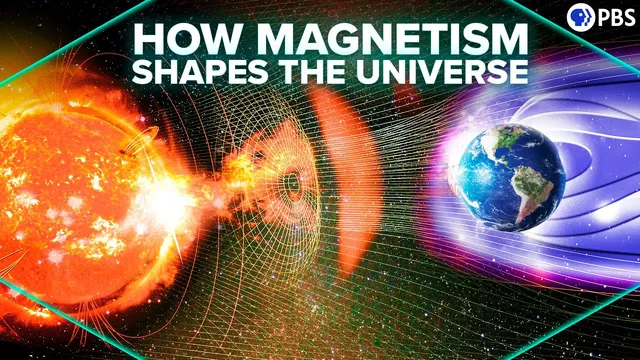
How Magnetism Shapes The Universe
Based on PBS Space Time's video on YouTube. If you like this content, support the original creators by watching, liking and subscribing to their content.
Magnetic fields arise from moving charges and can accumulate on enormous scales, making magnetism a major driver of cosmic structure.
Briefing
Magnetic fields reach far beyond compasses and auroras: they help shape how stars form, how galaxies evolve, and how the most energetic particles in the universe get accelerated. Starting from the simple fact that a compass needle spins near Earth’s magnetic north, the discussion follows magnetic field lines outward—first through the Sun’s twisted plasma, then across the heliosphere, and finally into the Milky Way—showing that magnetism is both widespread and dynamically influential on cosmic scales.
Magnetism is framed as one half of electromagnetism, distinct from gravity because it can “add up” over enormous distances. Magnetic fields arise when electric charges move—so even electrically neutral matter can generate magnetism if charges move in opposite directions. Field lines form concentric loops around moving charges, and charged particles experience a force perpendicular to both their motion and the field lines, causing them to spiral along those lines. When currents or aligned electron spins create dipoles, those dipoles tend to align with other dipoles—an interaction that underlies how compasses work.
From Earth, the field is not isolated. Most of Earth’s dipole loops back, but some lines connect to the larger magnetic environment of the solar system and beyond. One field line is traced to the Sun, where plasma-driven currents generate a dipole field that becomes twisted as the Sun rotates faster toward the equator. Over time, crossing field lines tangle and store enormous magnetic energy. When pressure builds, field lines snap and reconnect, launching high-energy particles into space as coronal mass ejections that join the solar wind. Those outflows can be followed as a giant magnetic “tornado” through the solar system until the heliopause—about four times the distance to Pluto—marks the boundary of the Sun’s influence in the galaxy.
Beyond the heliosphere, mapping magnetic fields becomes harder, so astronomers use indirect “natural compasses.” Dust grains in the interstellar medium align with the Milky Way’s magnetic field, and the resulting polarization patterns in scattered light reveal the field’s direction. The Planck mission produced high-detail maps using polarization of the cosmic microwave background. Another method relies on Faraday rotation: magnetized electrons rotate the polarization of linearly polarized radio waves by slowing one circular polarization more than the other. Observations of pulsars and radio sources use this effect to chart the Milky Way’s magnetic structure, including fields threaded along spiral arms where dense gas confines charged plasma.
Where do these galactic fields come from? Large-scale dynamos can amplify weak seed fields into ordered, powerful ones. Earth’s dynamo is driven by Coriolis-induced helical flows in swirling magma; the Milky Way likely relies on differential rotation in its disk, helical flows, and supernova activity that both seeds magnetic fields and helps sustain the dynamo. Once established, magnetism feeds back into galaxy evolution: it helps clouds shed angular momentum to collapse into stars, compresses gas during supernova-driven shocks to trigger star formation, and constrains outflows into “galactic fountains” that recycle material. Magnetic fields also accelerate particles to cosmic-ray energies—especially near active galactic nuclei, where intense fields around supermassive black holes can launch jets and inflate radio lobes that carry magnetism into intergalactic space.
In closing, magnetism is portrayed as a complicated but essential ingredient of cosmic structure—hard to model compared with gravity, yet crucial for understanding why the universe looks the way it does and how it keeps producing high-energy phenomena.
Cornell Notes
Magnetic fields are generated by moving charges and can accumulate on cosmic scales, making them central to how galaxies and stars form. Field lines guide charged particles into spirals and tend to align dipoles, which is why compasses work. Tracing those lines from Earth to the Sun shows how twisting, reconnection, and coronal mass ejections inject energetic particles into the solar system, reaching the heliopause. In the Milky Way, astronomers map magnetism using polarized light from aligned dust (Planck) and using Faraday rotation of radio waves from pulsars and other sources. Galactic dynamos—powered by differential rotation, helical flows, and supernova activity—amplify magnetic fields that then regulate star formation, outflows, cosmic rays, and even jet formation near supermassive black holes.
Why can magnetism influence large-scale structure more than gravity’s “simple” field picture suggests?
How does the Sun’s magnetic field become twisted and why does that matter for what escapes into space?
What is the heliopause and how is its shape inferred?
How do astronomers map the Milky Way’s magnetic field when they can’t place a compass there?
What conditions allow large-scale magnetic fields to grow inside galaxies?
How do galactic magnetic fields affect star formation and outflows?
Review Questions
- What physical mechanism produces magnetic fields in neutral matter, and how does that connect to why magnetism can accumulate on large scales?
- Compare the two observational strategies for mapping galactic magnetic fields: dust polarization versus Faraday rotation. What does each method measure?
- Explain how a galactic dynamo could amplify weak seed magnetic fields, and list the roles of differential rotation and supernova activity.
Key Points
- 1
Magnetic fields arise from moving charges and can accumulate on enormous scales, making magnetism a major driver of cosmic structure.
- 2
Charged particles spiral along magnetic field lines because the magnetic force acts perpendicular to both motion and field direction.
- 3
The Sun’s differential rotation twists magnetic field lines, and reconnection events launch coronal mass ejections that inject high-energy particles into the solar system.
- 4
The heliopause marks the boundary of the heliosphere; its teardrop shape is linked to the Sun’s motion through the galaxy and was measured using IBEX.
- 5
The Milky Way’s magnetic field can be mapped using polarized light from aligned interstellar dust (Planck) and using Faraday rotation of radio waves from sources like pulsars.
- 6
Galactic magnetic fields likely grow through dynamos powered by differential rotation, helical flows, and supernova-driven turbulence that provides seed fields.
- 7
Once established, magnetic fields regulate star formation, constrain outflows into galactic fountains, accelerate cosmic rays, and help launch powerful jets near active galactic nuclei.