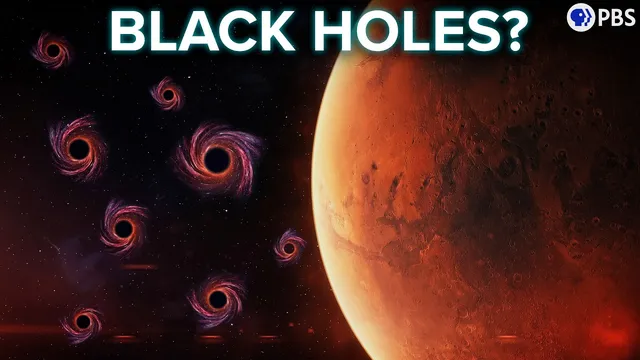
How Many Black Holes Are In The Solar System?
Based on PBS Space Time's video on YouTube. If you like this content, support the original creators by watching, liking and subscribing to their content.
Microlensing surveys have ruled out PBHs as the dominant dark matter over broad mass ranges, leaving the asteroid-mass window (10^17–10^23 g) as a key under-explored possibility.
Briefing
Dark matter may be detectable without particle detectors or telescopes—by treating the solar system itself as a giant “primordial black hole” (PBH) detector. The key idea is that if dark matter consists largely of PBHs in the “asteroid-mass” range (about 10^17 to 10^23 grams), then many of these tiny black holes would pass through the solar system over time. Even though they’d be invisible and exert only minuscule gravitational effects, those effects could accumulate into measurable deviations in planetary orbits, especially Mars.
The search for dark matter has repeatedly failed to find a credible particle explanation, despite decades of experiments and increasingly sensitive underground detectors. Early hypotheses that dark matter might be made of ordinary compact objects—like brown dwarfs, neutron stars, or black holes—were narrowed as astronomers constrained the allowed mass ranges. Gravitational lensing surveys, including OGLE’s microlensing results toward the Magellanic Clouds, have ruled out large swaths of PBH masses as the dominant dark matter component, from roughly half the Moon’s mass up to about 1% of the Sun’s mass. That leaves a comparatively wide, under-explored window: asteroid-mass PBHs, smaller than 0.1% of the Moon’s mass.
If PBHs fill that remaining window, their abundance would be high enough that flybys should be frequent. At the low end (~10^17 g), there could be roughly one PBH somewhere in the inner solar system at present; at the high end (~10^23 g), one might pass through the solar system about every century. For intermediate masses, encounters would occur on timescales ranging from months to decades. Unlike stellar-mass black holes—whose passage would be catastrophic for planetary systems—asteroid-mass PBHs would behave more like an interstellar asteroid in terms of overall impact: almost nothing happens immediately, but “tiny isn’t zero.” Over years, parts-per-trillion changes in orbital parameters could become detectable.
The proposed method relies on two capabilities: extremely accurate orbit prediction and extremely precise distance measurement. Planetary motion is governed by gravity, so with known initial conditions, computers can forecast where planets should be. The limiting factor is measuring distances precisely enough to notice small deviations. Instead of direct ranging, astronomers time light signals. Earth–Moon distance is measured to about 1 mm using lunar retroreflectors, but the Moon’s proximity makes it harder to treat as a single point because Earth and Moon gravitationally distort each other. Mars is the better target: for roughly 20 years, multiple spacecraft have orbited Mars, enabling a robust, continuously updated “distance to Mars” through signal travel times and triangulation.
The challenge is separating a PBH’s subtle gravitational signature from the solar system’s many other perturbations—asteroids, comets, and known bodies. Any asteroid with comparable mass would need to be modeled, since its influence could mask the effect. The advantage is that asteroid-mass objects in the relevant range are largely tracked, and PBH flybys would also differ in geometry: solar system objects tend to move in the plane of the planets at relatively low speeds, while PBHs would arrive faster and from more varied angles, potentially changing orbital inclinations.
Two detection strategies follow. First, researchers can reanalyze existing, high-precision Mars data (about 20 years) for signatures consistent with past PBH flybys, using large-scale simulations that test many possible flyby masses and trajectories against the observed orbital evolution. Second, future monitoring could catch a new deviation within a few years and attempt to identify the culprit: a real asteroid could be imaged with large telescopes, while a PBH would remain invisible. In that scenario, “discovering dark matter by observing nothing” becomes a realistic possibility—turning the solar system into a detector for an otherwise elusive component of the universe.
Cornell Notes
The most promising remaining dark-matter option after lensing constraints is primordial black holes (PBHs) in the asteroid-mass range (10^17–10^23 g). If PBHs make up dark matter, many would pass through the solar system over months to centuries, leaving tiny but cumulative gravitational effects on planetary orbits—especially Mars. The method depends on predicting planetary motion from gravity and measuring Earth–Mars distance with high precision using Mars-orbiting spacecraft and light-time ranging. Researchers would then search past Mars orbital data for unexplained deviations consistent with PBH flybys, using simulations that include known solar-system perturbers. Future deviations could be tracked and distinguished from asteroids because an asteroid should be observable, while a PBH would not.
Why did dark-matter searches shift away from compact objects like black holes, and what mass range is still open?
How often would asteroid-mass PBHs pass through the solar system if they make up dark matter?
Why wouldn’t an asteroid-mass PBH cause dramatic changes to planets the way a stellar black hole would?
What makes Mars a better “detector” than the Moon for this purpose?
How can researchers tell whether an orbital deviation comes from a PBH rather than an interstellar asteroid?
What two-stage detection plan is proposed using existing and future data?
Review Questions
- What observational constraints from microlensing narrow the viable PBH dark-matter mass window to the asteroid-mass range?
- Why do the proposed detection methods rely on both precise orbital prediction and light-time distance measurements rather than direct imaging?
- How do PBH flyby geometry and expected abundance help distinguish PBH signatures from extrasolar asteroids?
Key Points
- 1
Microlensing surveys have ruled out PBHs as the dominant dark matter over broad mass ranges, leaving the asteroid-mass window (10^17–10^23 g) as a key under-explored possibility.
- 2
If PBHs make up dark matter in that window, their abundance implies frequent solar-system flybys—ranging from months to centuries depending on mass.
- 3
Asteroid-mass PBHs would be invisible and non-catastrophic in the short term, but their tiny gravitational effects could accumulate into measurable orbital deviations over years.
- 4
Mars is favored over the Moon because long-term, high-precision distance tracking is enabled by multiple spacecraft in Martian orbit and because Mars can be treated more cleanly as a distant reference point.
- 5
Separating PBH signals from solar-system noise requires modeling gravitational perturbations from known asteroids and comets, since comparable-mass objects could mask the effect.
- 6
A practical test uses simulations of Mars’ orbital history to search for past deviations consistent with PBH flybys, then uses future monitoring to attempt to identify the perturber.
- 7
If a future perturber can’t be imaged as an asteroid, the remaining explanation could be a PBH—making “detecting dark matter by observing nothing” feasible.