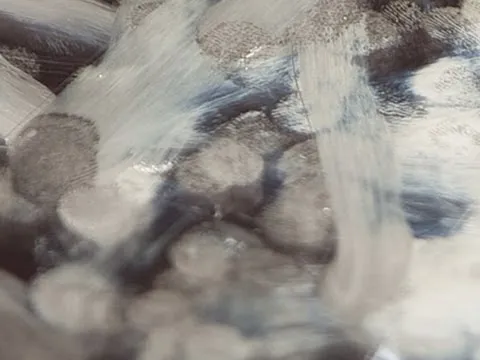
How Many Calories are on a Smudgy Screen?
Based on Vsauce's video on YouTube. If you like this content, support the original creators by watching, liking and subscribing to their content.
Friction ridges on palms and soles transfer natural skin oils and proteins to surfaces, creating latent fingerprints and visible screen smudges.
Briefing
Smudgy screens aren’t just annoying—they can carry enough biological residue to be estimated in calories. Fingerprints form because friction ridges on palms and soles act like a stamp, transferring natural skin oils and proteins onto surfaces even when hands look clean. Those residues build up into the hazy film that makes phone screens look dirty. Using basic nutrition math, the residue on an iPhone 5 screen is estimated at roughly 2 calories if completely licked off. Scaling up, licking 245 smudgy iPhone 5 screens would amount to about the same calories as eating a Big Mac—an intentionally absurd comparison meant to quantify something normally treated as purely visual grime.
The discussion then pivots from “what’s on the screen?” to “what’s on us?” Fingerprint patterns—loops, arches, and whorls—are largely genetic, but the fine details are shaped during fetal development by the specific conditions around the dividing cells that form skin. That’s why identical twins can still end up with different fingerprints, and why cloning wouldn’t produce matching prints: each clone would develop its own unique ridge pattern.
Biology explains why fingerprints persist. Skin has two main layers: the epidermis and the dermis. New skin cells are generated in the basal layer of the epidermis and migrate outward, where they die and flatten into the outer “horny layer.” The arrangement of that outer layer stays consistent because it’s determined by the basal layer beneath. As a result, fingerprints can be sanded or cut off temporarily, but they regrow to the original pattern.
The episode also tackles why humans have friction ridges at all. Not all mammals do, so the feature likely serves functions beyond identification. Friction ridges improve tactile sensing, reportedly allowing humans to detect subtle textures about 100 times better than without them. Their directional patterns—loops, arches, and swirls—help the brain interpret texture movement from a single touch. The ridges also aid gripping and climbing, especially for mammals that handle wet or slippery surfaces.
Finally, the transcript addresses fingerprint reliability and ways they can disappear. Fingerprint matching methods vary and carry different probabilities of false matches, meaning identification isn’t infallible. Some rare genetic conditions can remove fingerprints; adermatoglyphia is described as affecting only a handful of extended families worldwide and having no other side effects. Another practical factor is age: fingerprints of children can evaporate or disappear faster than those of adults, attributed to lower amounts of heavy, waxy oils after puberty. The overall takeaway is that fingerprints are both biologically meaningful and chemically measurable—even when they’re just smudges on glass.
Cornell Notes
Friction ridges on human skin transfer oils and proteins to surfaces, creating latent fingerprints and the smudgy film that builds up on screens. The residue on an iPhone 5 is estimated at about 2 calories if completely licked, and 245 such screens would total roughly the calories of a Big Mac. Fingerprint patterns are largely genetic, but the fine details form during fetal development, so identical twins (and clones) still get different prints. Fingerprints persist because the basal layer of the epidermis continually regenerates the outer “horny layer” in the same pattern. Friction ridges likely evolved to improve texture sensing and grip, while fingerprint matching can still produce errors due to different modeling approaches and false-match probabilities.
Why do fingerprints appear on surfaces even when hands look clean?
How does the transcript estimate calories from a smudgy phone screen?
What determines the overall fingerprint pattern versus the tiny details?
Why do fingerprints regrow after being sanded or cut off?
What functions do friction ridges serve beyond leaving identifiable marks?
How can fingerprints disappear or become unreliable?
Review Questions
- What biological process in the epidermis keeps fingerprint patterns from changing permanently when the outer layer is removed?
- How does the transcript connect ridge pattern direction (loops/arches/swirls) to improved texture detection?
- What factors—genetic conditions, age-related oil differences, and matching-model error rates—can affect whether fingerprints are present or reliably matched?
Key Points
- 1
Friction ridges on palms and soles transfer natural skin oils and proteins to surfaces, creating latent fingerprints and visible screen smudges.
- 2
A rough calorie estimate treats smudgy iPhone 5 residue as about 2 calories if fully licked, with 245 screens comparable to a Big Mac.
- 3
Fingerprint pattern types (loops, arches, whorls) are largely genetic, but the fine minutiae are shaped by specific fetal developmental conditions.
- 4
Fingerprints persist because the basal layer of the epidermis regenerates the outer “horny layer” in the same arrangement.
- 5
Friction ridges likely evolved to improve tactile sensitivity to subtle textures and to enhance grip, especially on wet surfaces.
- 6
Fingerprint matching can fail in practice because different modeling approaches carry different false-match probabilities.
- 7
Rare genetic conditions like adermatoglyphia can remove fingerprints, and children’s prints can fade faster due to lower amounts of heavy, waxy oils.