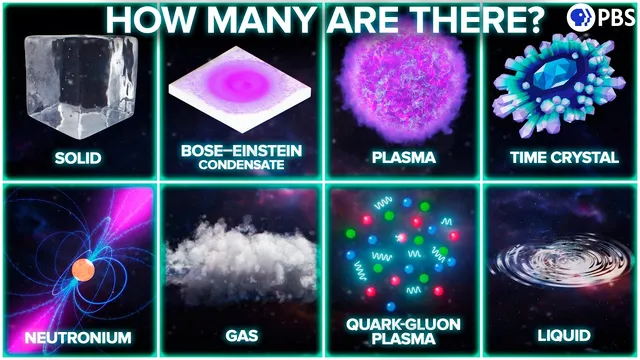
How Many States Of Matter Are There?
Based on PBS Space Time's video on YouTube. If you like this content, support the original creators by watching, liking and subscribing to their content.
A state of matter is defined by emergent collective behaviors, not just by the material’s name or a single temperature value.
Briefing
States of matter aren’t just labels for solids, liquids, and gases; they’re best understood as sets of emergent behaviors that arise from how particles interact under specific conditions. Heat and pressure shift those interactions, producing phase changes—like ice melting near 273 K, water boiling at higher temperatures, and extreme heating stripping electrons to create plasma. But the deeper organizing principle is that a “state” is defined not only by thermodynamic averages (temperature, pressure, density), but also by distinctive non-thermodynamic behaviors such as rigidity, viscosity, compressibility, and electrical resistance.
That framework quickly expands beyond everyday matter. In a plasma, electrons are free while nuclei remain bound; push temperatures far higher and nucleons themselves can break apart. Around the Hagedorn temperature—about 7 trillion Kelvin—quarks are stripped from nucleons, yielding a quark-gluon plasma. Despite being made of more “free” constituents, it behaves less like a simple gas and more like a liquid because strong interactions between quarks and gluons remain significant. Such extreme matter is created in particle accelerators in tiny amounts, and it also characterized the early universe and may exist in the cores of massive neutron stars.
From there, the “solid” analogs appear too. If quark-gluon plasma cools, it can transition into hadrons—protons, neutrons, and other quark combinations. The transcript describes hadrons as a kind of crystal of quark-gluon plasma, turning “quark snow” into stable building blocks. More broadly, quark matter—often discussed through quantum chromodynamics (QCD)—has its own phase diagram, using temperature versus baryonic potential rather than temperature versus pressure. On that map, neutron stars act like natural laboratories: quark matter can evolve from merged quark structures into neutronium, then into more exotic liquid-like quark phases.
Quantum mechanics also unlock additional states that don’t fit the classic temperature-driven pattern. Degenerate matter, including neutronium and Bose-Einstein condensates, can produce emergent phenomena like superconductivity and superfluidity because quantum states become densely occupied. Time crystals go even further: they form entangled configurations that oscillate between states even without energy input, making them thermodynamically distinct because their lowest-energy behavior still involves motion.
Finally, the concept scales upward and sideways. Different “states” can coexist at different levels—liquid water can contain frozen nuclear matter embedded within it. Larger-scale systems can mimic phase behavior too: sand grains are individually solid, yet airflow through sand can make the whole mixture act like a liquid, allowing light objects to float. Crowds can undergo phase-transition-like shifts from gas-like dispersal to liquid-like collective motion, with dangerous “crowd crush” behavior at high density. Even galaxies are modeled as fluids of stars, with gravity replacing electromagnetism.
The takeaway is that “states of matter” is partly a convention, but a powerful one: it organizes how interactions produce qualitatively different macroscopic behaviors, from the earliest moments of the universe to crowds—and even, in a speculative framing, to consciousness as an emergent information-processing state proposed by Max Tegmark from MIT.
Cornell Notes
The transcript argues that a state of matter is defined by emergent behaviors—how a system’s particles collectively act—not merely by the material’s name. Temperature and pressure drive phase changes, but the full definition also depends on an “equation of state” and other non-thermodynamic traits like viscosity, rigidity, and electrical resistance. Beyond solids, liquids, gases, and ordinary plasma, extreme conditions can produce quark-gluon plasma and hadrons, with their own phase behavior described by QCD. Quantum effects enable additional states such as superconducting and superfluid phases, and time crystals that oscillate even at their lowest energy. Similar phase-like behavior can appear in nested or larger-scale systems, such as sand flows, crowd dynamics, and galaxy modeling.
What makes something a “state of matter” rather than just a different temperature or a different sample?
How do temperature and pressure determine phases, and why does pressure matter?
What is the next state beyond ordinary plasma, and what conditions create it?
How does quark-gluon plasma connect to hadrons and neutron stars?
Why do time crystals count as a distinct state of matter?
How can sand, crowds, or galaxies resemble states of matter without being true “new phases” of matter?
Review Questions
- How do emergent behaviors and the equation of state jointly define a state of matter in the transcript’s framework?
- What roles do pressure and the phase diagram play in predicting phase transitions like freezing and boiling?
- Why does the transcript treat time crystals as thermodynamically distinct from other states of matter?
Key Points
- 1
A state of matter is defined by emergent collective behaviors, not just by the material’s name or a single temperature value.
- 2
Phase transitions depend on both temperature and pressure, which is why phase diagrams are two-dimensional rather than one-dimensional.
- 3
Thermodynamic averages connect through an equation of state, but non-thermodynamic properties (like viscosity, rigidity, and electrical resistance) often distinguish states.
- 4
Extreme heating can destroy nucleons and produce quark-gluon plasma near the Hagedorn temperature (~7 trillion Kelvin), with liquid-like behavior due to strong interactions.
- 5
Cooling quark-gluon plasma can form hadrons, and neutron stars can naturally sample quark-matter regimes described by QCD phase behavior.
- 6
Quantum mechanics enables additional states such as superconducting and superfluid phases, plus time crystals that oscillate even at their lowest-energy configuration.
- 7
Phase-like behavior can appear in nested or larger-scale systems (sand flows, crowds, galaxy models), even when the underlying components retain their original physical identities.