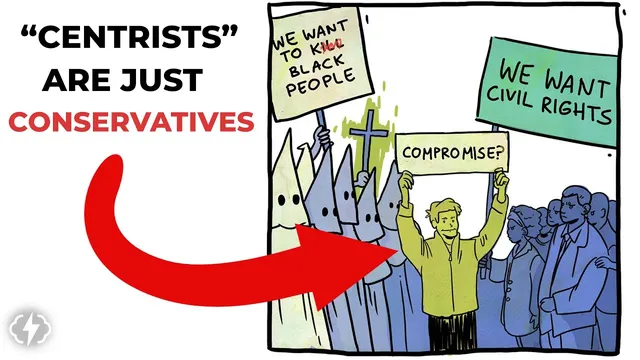
How "Moderates" Serve The Right
Based on Second Thought's video on YouTube. If you like this content, support the original creators by watching, liking and subscribing to their content.
The transcript frames left versus right as competing orientations toward society: remaking and redistributing power versus preserving hierarchy and order.
Briefing
Centrism in the U.S. is portrayed as a political mechanism that reliably slows change while helping shift policy rightward—especially when reactionary ideas already dominate institutions. The core claim is that “moderates” present themselves as neutral problem-solvers, but their preference for compromise and incremental adjustment functions as a one-way ratchet: justice gets delayed, and policies built by the right remain in place or get lightly modified rather than reversed.
The argument starts with a historical distinction between left and right: the left is framed as seeking to remake society and redistribute power and wealth more equally, while the right is framed as preserving existing hierarchy and order or returning to an older arrangement. From there, centrism is treated less as a true middle position and more as a product of what has become “established.” As political movements evolve—old left goals becoming the new conservative right—centrism ends up acting like conservatism with a softer tone. The video’s example is the centrist slogan about mixing incompatible systems, like “socialism and capitalism,” which is presented as incoherent because the underlying dispute is about who controls the means of production.
That theoretical framing is then grounded in a concrete case: immigration policy under Joe Biden. The transcript argues that Biden’s “compromise” approach did not dismantle Trump-era restrictions so much as retooled them. Title 42 is cited as a key example: originally used by the Trump administration to close the southern border under the banner of COVID-19 public health, it is described as still standing. The Biden administration is said to defend Title 42 in court, while also changing how it applies to unaccompanied minors. Even with that adjustment, the transcript claims Biden’s administration used the rule to expel roughly 700,000 migrants—more than the Trump administration’s cited figure of about 450,000. Meanwhile, the transcript adds that Biden continued border-wall construction, maintained the “Do Not Come” campaign, and left migrant detention facilities in place.
The transcript acknowledges that Biden did take some progressive steps—reinstating DACA and working on family reunification—but argues the overall pattern is “tweaking” right-wing policies rather than reversing them. Malcolm X is invoked to support the idea that when far-right politics are deeply embedded in power structures, centrist incrementalism allows politics to drift right without returning. The transcript also challenges the centrist self-image of judging ideas on their own merit, arguing that the Overton window in the U.S. is too narrow and skewed. With the political spectrum shifted rightward and the left underrepresented in mainstream debate, “pragmatic” selection still tends to pick from options that are already constrained by reactionary or neoliberal frameworks.
Finally, the transcript claims moderates dominate elections by being marketed as sensible and measured, targeting voters who want the “average” of Democrats and Republicans. It argues that this electoral logic, combined with moneyed incentives to keep certain politicians as spoilers, makes moderation less about rational deliberation and more about slowing outcomes until they become denial. The closing position is that democracy requires more than honoring moderates; it requires expanding real majority rule so that policy can reflect what many voters demand rather than waiting for change to trickle in.
Cornell Notes
The transcript argues that U.S. centrism is not a neutral middle but a political strategy that slows change while enabling a rightward drift. Left and right are framed as competing orientations toward society—remaking versus preserving hierarchy—so “moderates” end up acting like conservatives when the “middle” is defined inside a right-shifted Overton window. Immigration is used as the main case study: Title 42 is described as continuing under Biden, with policy adjustments that still lead to large-scale expulsions, alongside continued border-wall construction and related enforcement. Even when some progressive actions occur, the overall effect is portrayed as incremental retroactive change that delays justice rather than reversing reactionary policy. The transcript concludes that expanding real majority democracy matters more than venerating moderation.
Why does the transcript claim centrism often functions like conservatism rather than a true middle?
What is the immigration example used to show how centrist compromise can still produce rightward outcomes?
How does the transcript reconcile acknowledgments of progressive actions with its broader critique of centrism?
What role does the Overton window play in the transcript’s argument about “judging ideas on their own merit”?
Why does the transcript say moderates tend to dominate elections and slow justice?
Review Questions
- How does the transcript define the difference between left and right, and how does that definition lead to its critique of centrism?
- What specific immigration policies are cited to support the claim that centrist compromise can still produce rightward outcomes?
- According to the transcript, why does a narrow Overton window make “neutral” policy selection unlikely to be progressive?
Key Points
- 1
The transcript frames left versus right as competing orientations toward society: remaking and redistributing power versus preserving hierarchy and order.
- 2
Centrism is portrayed as a conservative function when the political baseline has shifted rightward, making “the middle” effectively resistance to meaningful change.
- 3
Title 42 is used as a case study to argue that Biden-era compromise maintained a major Trump-era border restriction while still enabling large-scale expulsions.
- 4
The critique distinguishes between limited progressive actions (like DACA reinstatement) and the broader pattern of incremental adjustment to enforcement rather than reversal.
- 5
The Overton window is described as too narrow and skewed rightward, so centrist “merit-based” selection still tends to choose from constrained options.
- 6
Moderates are said to dominate elections by being marketed as pragmatic and average, which can delay justice even when public demand points further left.
- 7
The transcript concludes that expanding real majority democracy matters more than honoring moderates as a solution to political stagnation.