How NOT to Learn Mathematics
Based on The Bright Side of Mathematics's video on YouTube. If you like this content, support the original creators by watching, liking and subscribing to their content.
Check prerequisites whenever a topic feels frustrating; missing foundations often masquerade as personal inability.
Briefing
Learning mathematics goes wrong most often when students start advanced topics without the foundations to make sense of them. That mismatch can feel like personal failure—students may assume they’re “stupid”—but the real issue is missing prerequisites. A functional analysis class becomes a case study in this: the material felt impenetrable not because the subject was inherently impossible, but because basic real analysis skills hadn’t been learned first. The fix is straightforward: when frustration hits, check what prerequisites the topic requires, then reorder study so the groundwork comes before the next step.
A second cluster of mistakes centers on how practice and feedback are handled. Reading math passively doesn’t teach it; mathematical understanding requires exercises and problem solving. Even after doing problems, repetition matters: skills like fraction reduction must be practiced repeatedly with similar tasks until the process becomes automatic. Without that cycle—practice plus repeated exposure—new concepts remain fragile and hard to retrieve under pressure.
Another common failure is trying to learn completely alone. Mathematics demands long stretches of solitary thinking, but staying silent about what’s confusing removes a key learning signal: it hides the fact that other people struggle with the same ideas. In classroom settings, this shows up when only a few students ask questions, leaving many others intimidated and convinced they’re the only ones lost. Discussion and explanation to others can reveal missing links, whether it’s a conceptual gap or a procedural one.
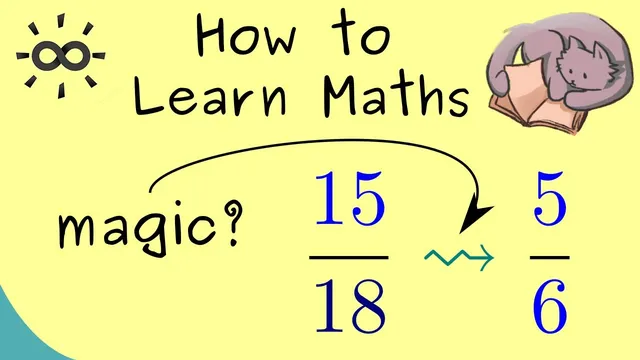
The transcript also highlights how “small” foundation issues can derail understanding in unexpected ways. When students were puzzled during an explanation of an L-decomposition, the confusion wasn’t about the abstract group-theoretic ideas—it was about an arithmetic step. A fraction like 15/18 being simplified to 5/6 happened too quickly and too quietly in the middle of the work, so some students couldn’t track the equivalence. The takeaway is that mathematical learning depends on both conceptual reasoning and the reliability of routine calculations.
Finally, learning tends to fail when results are treated as isolated facts. Mathematics is built as a connected structure: concepts link to prerequisites, motivate each other, and lead to further tools. Ignoring those connections can kill motivation because there’s no clear reason to care about a standalone result. For beginners, connections can feel invisible, but teachers can help by explicitly stating prerequisites and showing where a new idea leads—turning scattered topics into a network.
Overall, the path to better math learning is less about finding a magical method and more about getting the sequence right, practicing deliberately, repeating until procedures stick, learning with social feedback, and building a connected understanding rather than collecting disconnected results.
Cornell Notes
Mathematics learning breaks down when students tackle advanced topics without the prerequisites that make them intelligible. Frustration is often a sign of missing foundations, not lack of ability, and reordering study can fix it. Understanding also requires active practice: solving problems and repeating similar tasks until methods become automatic. Learning in isolation can hide shared confusion, so discussion and explaining ideas to others helps identify missing links. Finally, math knowledge sticks better when concepts are connected into a larger structure—teachers should show prerequisites and how each new result leads forward, rather than leaving students with isolated facts.
How can frustration during an advanced math class be a clue rather than a verdict?
Why doesn’t reading math (by itself) lead to real understanding?
What role does repetition play in mastering math procedures?
Why can learning alone slow down progress even when solitary thinking is necessary?
How can a small arithmetic step derail understanding of a bigger abstract concept?
Why is learning isolated results a motivation problem, not just a knowledge problem?
Review Questions
- What signs suggest a student is missing prerequisites rather than lacking ability, and what should they do next?
- How do exercises and repetition work together to build mathematical competence?
- Give an example of how connecting concepts (prerequisites and “where it leads”) can improve motivation compared with learning isolated results.
Key Points
- 1
Check prerequisites whenever a topic feels frustrating; missing foundations often masquerade as personal inability.
- 2
Use problem solving, not passive reading, as the core method for learning math.
- 3
Repeat similar problem types until procedures (like fraction reduction) become automatic.
- 4
Don’t learn only in silence—discussion and explaining ideas to others reveal shared confusion and missing links.
- 5
Treat arithmetic steps as part of the reasoning chain; fast or hidden simplifications can block understanding of abstract concepts.
- 6
Build a connected mental map of math by learning how concepts relate, what they depend on, and where they lead next.