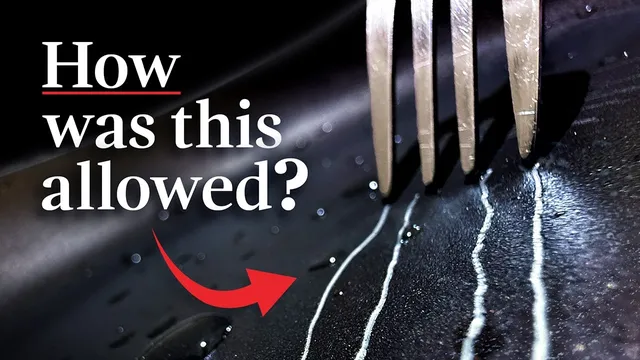
How One Company Secretly Poisoned The Planet
Based on Veritasium's video on YouTube. If you like this content, support the original creators by watching, liking and subscribing to their content.
Teflon’s inertness comes from strong carbon-fluorine bonds, but the long-term hazard traced in the transcript centers on PFAS processing aids used to manufacture it.
Briefing
A chain of fluorine-carbon chemistry turned a lab accident into a household revolution—and then into a decades-long environmental contamination problem. DuPont’s breakthrough polymer, polytetrafluoroethylene (Teflon), proved extraordinarily resistant to heat and chemicals. But the manufacturing process relied on per- and polyfluoroalkyl substances (PFAS) processing aids, especially PFOA (C8), that were persistent, bioaccumulative, and eventually found in water, wildlife, and human blood worldwide.
The story begins in 1936 when DuPont chemist Roy J. Plunkett accidentally polymerized tetrafluoroethylene (TFE) into a white, slippery powder after a cylinder valve malfunction. The resulting polymer—later trademarked as Teflon—was nearly indestructible because the carbon-fluorine bond is among the strongest chemical bonds. That inertness made it valuable for gaskets, seals, and protective coatings, including work tied to uranium hexafluoride handling for nuclear weapons. DuPont trademarked the material in 1944 and scaled production, but turning TFE into Teflon at industrial scale required controlling an exothermic reaction that could explode if overheated.
DuPont’s solution introduced PFOA (C8), a fluorinated acid purchased from 3M. C8 behaved like a surfactant: its water-loving head and Teflon-like tail formed microscopic bubbles in water, dispersing TFE so polymerization could proceed without runaway heat. That same chemistry—useful for manufacturing—also created a long-term hazard. C8’s carbon-fluorine bonds made it resistant to breakdown for decades, and its structure let it mimic fatty acids, potentially transporting through the bloodstream and accumulating in organs such as the liver.
By the 1960s, DuPont internal rat and dog studies showed liver enlargement, lethal toxicity at higher doses, and damage across multiple organ systems. Yet evidence of widespread contamination surfaced far later. In Parkersburg, West Virginia, farmer Earl Tennant’s cattle developed tumors and wasting symptoms after exposure to discolored water linked to DuPont’s Washington Works plant. Legal efforts uncovered thousands of documents and repeatedly flagged C8. DuPont had also been discharging large quantities into the Ohio River and allowing C8 sludge to leach from landfills.
A key turning point came when independent science later linked C8 exposure to multiple human diseases, including thyroid disease, testicular cancer, and kidney cancer. DuPont denied wrongdoing but faced settlements and, under regulatory pressure, moved away from C8. The replacement was GenX, a shorter-chain chemical (C6) intended to be more degradable. But GenX still contaminated air and water, and studies found it caused similar tumors in rats. The broader pattern—tweak the molecule, rename it, and continue—became a central critique of how PFAS regulation lagged behind industrial use.
PFAS now appear in nearly every environment, from cities to remote regions and even Antarctica. The transcript emphasizes that not all PFAS carry the same risk: long-chain fluoropolymers like Teflon are largely flushed from the body, while smaller acids such as PFOA and PFOS can enter the bloodstream and accumulate. It also highlights modern exposure routes—food packaging, contaminated water, and firefighting foams—and notes that the U.S. EPA only recently set enforceable drinking-water limits. The practical takeaway is that PFAS risk management often falls to prevention: filtering contaminated water, reducing exposure in high-risk areas, and pushing for source-level controls rather than relying on individual mitigation.
Cornell Notes
The transcript traces how DuPont’s Teflon success depended on PFAS processing aids—especially PFOA (C8)—that are extremely persistent and can accumulate in living organisms. A manufacturing workaround for explosive TFE polymerization used C8 to disperse TFE in water; that same chemistry later showed up in rivers, landfills, and human blood. Internal DuPont studies in the 1960s documented toxic effects across organs, but key findings were not widely shared, delaying public awareness. Legal and epidemiological work in communities near DuPont plants linked C8 exposure to multiple diseases, prompting a shift to GenX, which also spread and raised similar health concerns. The result is a broader PFAS “whack-a-mole” problem: replacing one fluorinated chemical often leads to another contaminant with comparable persistence.
Why did Teflon (PTFE) become so chemically resistant, and why did that matter for both products and risk?
What role did PFOA (C8) play in making Teflon safely at industrial scale?
How did C8 become a contamination problem beyond DuPont’s factories?
What evidence connected C8 to human health effects, and why was the risk assessment complicated?
Why did DuPont switch to GenX, and what went wrong with that replacement strategy?
How does the transcript distinguish between safer PFAS forms and the more dangerous ones?
Review Questions
- What chemical property of carbon-fluorine bonds makes PFAS both useful in consumer products and difficult to remove from the environment?
- Explain how C8 (PFOA) enabled TFE polymerization and why that same mechanism created a long-term exposure pathway.
- Why does the transcript argue that replacing C8 with GenX didn’t solve the underlying PFAS problem?
Key Points
- 1
Teflon’s inertness comes from strong carbon-fluorine bonds, but the long-term hazard traced in the transcript centers on PFAS processing aids used to manufacture it.
- 2
DuPont’s industrial Teflon production required controlling runaway heat during TFE polymerization, and PFOA (C8) served as a dispersing surfactant to prevent explosions.
- 3
C8’s persistence and fatty-acid-like structure helped it accumulate in organisms and spread through water systems, including rivers and public wells near DuPont plants.
- 4
Internal toxicity studies at DuPont documented multi-organ harm in animals, while key findings were not broadly shared, delaying public awareness and regulatory action.
- 5
Regulatory pressure led to a shift from C8 to GenX, but GenX also contaminated water and produced similar tumor outcomes in animal studies.
- 6
PFAS exposure routes emphasized include contaminated drinking water, food packaging, and firefighting foams, with newer EPA limits arriving only recently.
- 7
Because PFAS risk varies by chemical type and exposure level, the transcript argues prevention (especially water filtration in contaminated areas) is the most practical near-term strategy.