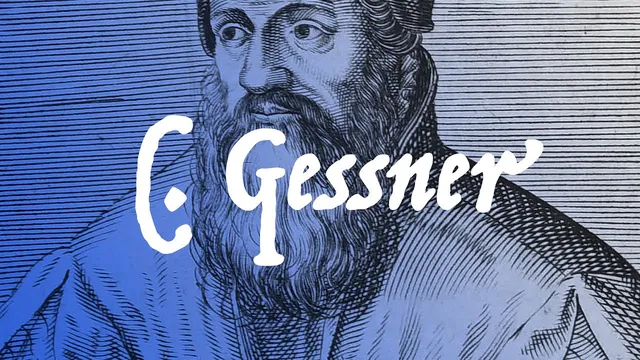
How One Man Organized All Knowledge
Based on trms's video on YouTube. If you like this content, support the original creators by watching, liking and subscribing to their content.
Information overload—accelerated by the Internet—creates a need for systems that capture, organize, and retrieve knowledge efficiently.
Briefing
Knowledge management surged in popularity because the modern world delivers information overload—so much data that people struggle to even keep up with what exists. In that context, Konrad Gastner’s 16th-century system stands out as an early, practical answer to the same problem: how to capture useful knowledge from a flood of books and turn it into something retrievable.
Gastner, born in 1516 in Zurich, built a career that spanned medicine and natural sciences, but his lasting impact came from bibliography—organizing books and topics. At age 25, he produced the Biblioteca Universalis, described as a comprehensive list of all books ever written, with each entry including complete information and a summary. A second volume expanded the approach by listing known topics and pointing readers to the books where those topics were addressed. The transcript frames him as a “father of bibliography” and, more broadly, one of the leading figures in knowledge management.
What makes Gastner’s work feel relevant today is the method behind it. He reportedly relied on a four-step workflow for reading and organizing: copy what matters onto paper sheets, assign a new line for every idea, cut the copied material into slips, then arrange the slips in a chosen order. Once the desired structure emerged, the slips were fixed into tables or small boxes for storage. The transcript calls this the earliest known description of a retrieved-and-reorganized information system based on notes taken from books.
The practical payoff was speed and synthesis. Gastner managed to read, summarize, and organize content from 12,000 books in four years—an output the transcript translates into an average of 8.2 books per day. Just as important, the system supported later recombination. Instead of locking notes into a single linear document, the slips could be taken out and rearranged to form new ideas, write literature, or prepare lectures.
Storage also mattered. Gastner’s notes were kept in a slip-box style format designed so the slips themselves formed a “book” of ideas. The transcript contrasts this with modern folders on a computer, emphasizing that Gastner’s approach made rearrangement easy without gluing—metal rails held slips in place while still allowing them to be reorganized on demand.
Overall, the transcript argues that Gastner’s slip-box method—splitting knowledge by idea and rebuilding it when needed—has endured for centuries because it directly addresses the same modern challenge: turning abundant information into usable, searchable, and reconfigurable knowledge.
Cornell Notes
Konrad Gastner’s Biblioteca Universalis and related work offered an early blueprint for knowledge management in an era of information overload. He organized knowledge by capturing useful material from books onto paper, separating ideas onto individual lines, cutting notes into slips, and then arranging those slips into new structures. The method supported later recombination: notes could be pulled from storage and rearranged to generate new ideas, write literature, or prepare lectures. Gastner’s output—summarizing and organizing 12,000 books in four years—illustrates how effective the workflow could be. The slip-box approach also anticipated modern “rearrangeable” note systems by keeping ideas visible and easy to reorder without destroying their modular structure.
Why does information overload make knowledge management feel urgent right now?
What did Konrad Gastner create, and how did it function as a knowledge system?
What are Gastner’s four steps for organizing knowledge from reading?
How did the slip-and-rearrange approach improve long-term usefulness of notes?
What evidence does the transcript offer that the method worked at scale?
Review Questions
- How do Gastner’s steps transform reading notes from a linear record into modular building blocks?
- What role does topic-to-book mapping play in making a bibliography more than just a list of titles?
- Why does the transcript treat storage format (slip boxes with rails) as part of the knowledge-management method rather than an afterthought?
Key Points
- 1
Information overload—accelerated by the Internet—creates a need for systems that capture, organize, and retrieve knowledge efficiently.
- 2
Konrad Gastner’s Biblioteca Universalis combined book-level summaries with topic-level navigation to connect readers to relevant sources.
- 3
Gastner’s workflow separated ideas into individual units by using one line per idea and then cutting notes into slips.
- 4
Rearrangeable notes let knowledge be rebuilt for different purposes over time, including writing, lecturing, and generating new ideas.
- 5
Slip-box storage supported modular reordering without destroying the notes, using rails to hold slips in place.
- 6
Gastner’s reported output (12,000 books in four years) illustrates that the method could scale beyond small personal note-taking.
- 7
The slip-box approach has persisted for centuries because it directly addresses the same problem modern note systems try to solve: turning abundant information into usable knowledge.