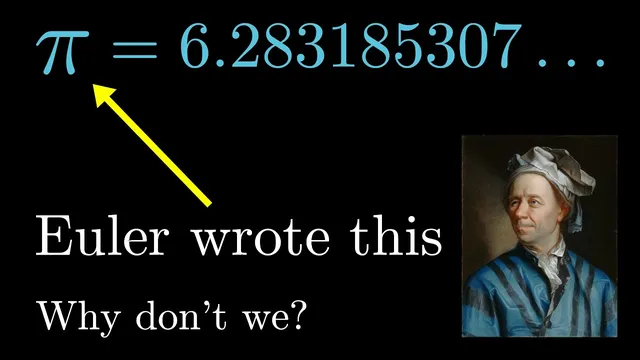
How pi was almost 6.283185...
Based on 3Blue1Brown's video on YouTube. If you like this content, support the original creators by watching, liking and subscribing to their content.
Euler sometimes used pi to mean the circumference of a unit-radius circle (the ~6.283185… constant), not just the ~3.1415… value.
Briefing
The commonly taught “pi” constant (3.1415…) became the default largely because of an 18th-century calculus textbook that spread a particular notation across Europe—despite earlier usage by Leonhard Euler that treated the symbol pi as the circumference constant we now often call tau (about 6.283185…). The pi-versus-tau debate may feel like a modern branding fight, but the historical record points to something more practical: mathematicians chose whichever circle constant made a given problem easiest to express.
Euler’s surviving notes and letters show that he sometimes wrote “Let pi be the circumference of a circle whose radius is 1,” which corresponds to the 6.28… constant. That usage likely reflected a simple meaning: pi as “perimeter,” not as a fixed universal ratio. In other contexts, Euler also used pi to represent a quarter turn of the circle—what today would be described as pi/2 or tau/4—suggesting the symbol functioned more like a flexible angle marker than a single, rigid number.
This flexibility fits Euler’s broader working style. He produced an enormous volume of mathematics—over 500 books and papers during his lifetime, with an output rate described as roughly 800 pages per year, followed by hundreds more publications after his death. The point wasn’t to declare one “correct” convention for circle constants. Instead, Euler solved problems, then wrote down the most convenient formulation for that specific task. If a quarter-circle constant simplified an argument, he used it; if a full-circle constant fit better, he used that; if a half-circle constant was the natural unit, he framed the work accordingly.
The shift toward the modern convention traces to an early calculus book from 1748. In a chapter describing the semicircumference of a circle with radius 1, the author expanded the number to 128 digits and then, “for the sake of brevity,” wrote “pi.” That single editorial choice—tying the symbol pi to the semicircumference ratio—helped standardize the notation across Europe and eventually the wider world. Other texts and letters varied, but this book’s influence made the “pi = 3.1415…” association stick.
So the “villain” isn’t a single person trying to sabotage a cleaner constant; it’s the historical inertia of which notation gained traction. The deeper lesson is about how math conventions should be judged: not by abstract correctness, but by usefulness in context. When standards arise, they can be answered relative to the problem at hand. Euler’s legacy, as portrayed here, is less about defending a particular constant and more about adapting notation to the task—turning conventions into tools rather than rules.
Cornell Notes
Euler’s use of the symbol pi was not fixed to today’s 3.1415… constant. In some writings, pi denoted the circumference of a unit-radius circle (about 6.283185…, what many now call tau). In other instances, Euler used pi to represent a quarter turn, aligning with how modern notation treats angle variables like theta. The modern “pi = 3.1415…” convention gained momentum through an influential 1748 calculus book, where the author expanded the semicircumference ratio to 128 digits and then abbreviated it as pi. The takeaway is that mathematical symbols often become “standard” because they spread, not because they were universally the best choice from the start.
What evidence suggests Euler sometimes used pi for the constant now associated with tau?
How did Euler’s use of pi resemble the modern role of theta?
What specific publication helped cement the modern meaning of pi as 3.1415…?
Why doesn’t the transcript treat the pi-versus-tau debate as a simple “right vs wrong” story?
What does Euler’s productivity imply about his approach to notation?
Review Questions
- How does the 1748 calculus book’s treatment of the semicircumference help explain why pi became associated with 3.1415…?
- Give two examples of how Euler used the symbol pi in ways that differ from today’s standard meaning.
- Why does the transcript argue that “which convention is right” can be the wrong question in mathematics education?
Key Points
- 1
Euler sometimes used pi to mean the circumference of a unit-radius circle (the ~6.283185… constant), not just the ~3.1415… value.
- 2
Euler also used pi in ways analogous to a general angle symbol, representing whichever circle fraction best matched the problem.
- 3
The modern association of pi with 3.1415… gained momentum from an influential 1748 calculus book that abbreviated the semicircumference ratio as “pi.”
- 4
Standard mathematical notation often becomes dominant through historical spread, not because it was the only correct choice.
- 5
Judging conventions should depend on the context: the most natural symbol is the one that simplifies the specific problem.
- 6
Euler’s massive, problem-driven output reflects a flexible approach to notation rather than a fixed campaign for a single definition.