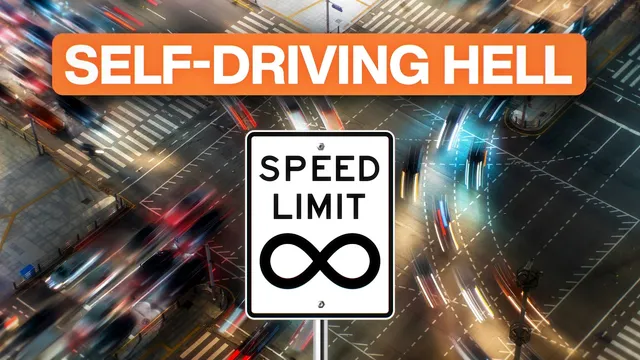
How Self-Driving Cars will Destroy Cities (and what to do about it)
Based on Not Just Bikes's video on YouTube. If you like this content, support the original creators by watching, liking and subscribing to their content.
Autonomous vehicles are operating in some U.S. cities, but they still require human remote assistance and can exhibit persistent, basic navigation failures.
Briefing
Self-driving cars are already operating in parts of the United States, but the most consequential claim here is that their rollout—driven by profit incentives, weak regulation, and a car-first design philosophy—could worsen city life rather than fix it. The argument isn’t that autonomy is impossible; it’s that deploying it on today’s road network and under today’s political economy will likely “destroy the fabric” of cities by increasing vehicle miles traveled, locking in car-centric land use, and reshaping streets for private vehicles instead of people.
The case begins with a reality check: autonomous vehicles are not fully hands-off everywhere. In San Francisco, “robo taxis” have required human assistance at intervals measured in miles, and remote operators have had to intervene when vehicles get stuck behind construction equipment or fail to execute maneuvers like turning right. Even when cars appear cautious and obey speed limits, the system still makes basic mistakes—such as driving in circles or honking—sometimes for days. Reports also describe driverless vehicles interfering with emergency response and blocking streets or transit.
A sharper warning comes from safety incidents. A widely cited example involves a pedestrian in Tempe, Arizona, struck by a modified Volvo SUV operating with an automated driving system developed by Uber. The crash report describes the vehicle switching its perception of the person between categories (vehicle, bicycle, and “other”), only recognizing the crossing risk about 1.2 seconds before impact—too late to stop safely. Another San Francisco case describes a woman hit by a human-driven car and then dragged under a Cruise robo taxi; the vehicle continued because it treated her as no longer present, prompting removal from service. The broader point: sensors and software can fail in ways that are not obvious until rare edge cases occur.
From there, the argument pivots to incentives and infrastructure. The rollout is portrayed as a bet that autonomy will be marketed as “safety,” while companies lobby for self-certification and reduced reporting of safety data. Even if autonomous systems reduce some crash types, the speaker argues they will introduce new ones—especially if they normalize higher speeds or treat pedestrians and cyclists as obstacles rather than participants in street life.
The transcript also targets American road design and induced demand. It argues that U.S. streets—especially high-speed “stroads” designed for fast travel—already endanger people, and that replacing human drivers with autonomous ones won’t fix the underlying geometry. Instead, cheaper, always-available robo taxi service could increase trips and longer-distance travel, intensifying congestion and sprawl. The same logic is extended to parking: if cars can drop off passengers and then circulate to find cheaper spaces, parking lots and garages may not disappear—they may be repurposed into charging and staging areas.
Finally, the transcript frames a political risk: autonomous vehicles could reshape cities around private subscriptions and lobbying power, undermining public transit. The proposed alternative is not “stop autonomous vehicles,” but “prepare cities so autonomy serves public goals”: limit where cars can go (including AVs), lower speeds, remove parking, expand high-capacity transit, and price driving to prevent empty vehicles from constantly circling. A comparison to Utrecht, Netherlands, is used to argue that car-light urban design can deliver safety and mobility without waiting for advanced automation—suggesting the real lever is car dependency, not driverless technology.
Cornell Notes
Autonomous vehicles are already operating, but the transcript argues their citywide impact will likely be negative if deployed on today’s car-first infrastructure and under profit-driven incentives. It points to recurring needs for human remote assistance, public incidents in San Francisco, and crash investigations where perception failures left insufficient time to avoid harm. The core concern is that cheaper, always-available robo taxi service could increase vehicle miles traveled, keep cities car-centric through parking/charging repurposing, and weaken public transit via lobbying and substitution. The proposed remedy is to change the rules of the street—limit car access (including AVs), reduce speeds, remove parking, expand transit, and price driving—so autonomy can only operate within a people-first framework.
If autonomous cars are “here today,” why does the transcript insist they’re not truly hands-off?
What safety mechanism failed in the Tempe, Arizona pedestrian crash described here?
How does the transcript connect autonomous-vehicle safety to street design rather than just sensor technology?
Why does the transcript predict robo taxis could increase congestion instead of reducing it?
What does the transcript say about parking, mobility for disabled people, and “universal access” claims?
What policy package is proposed to keep AVs from reshaping cities in a car-centric direction?
Review Questions
- Which specific examples of human assistance and on-road malfunctions are used to challenge the idea of fully driverless operation?
- How does the transcript use the Tempe, Arizona crash to argue that perception errors can be fatal even when sensors detect something?
- What combination of street-design and pricing changes does the transcript propose to prevent robo taxis from increasing congestion and undermining transit?
Key Points
- 1
Autonomous vehicles are operating in some U.S. cities, but they still require human remote assistance and can exhibit persistent, basic navigation failures.
- 2
Crash narratives are used to argue that perception and decision-making can fail in rare edge cases, leaving too little time to avoid harm.
- 3
Weak regulation and strong financial incentives are portrayed as pushing companies to deploy before systems are fully ready, including lobbying for self-certification and reduced safety reporting.
- 4
Cheaper, always-available robo taxi service could increase vehicle miles traveled through induced demand and through vehicles circulating for faster pickup and cheaper parking/charging.
- 5
Parking and curb space are unlikely to disappear; they may be repurposed into charging and staging areas while private AVs compete for proximity.
- 6
Universal mobility claims are questioned on practical grounds: many riders need assistance beyond what a vehicle alone can provide, and booking often depends on smartphones and credit cards.
- 7
The proposed counterstrategy is structural: limit car/AV access, lower speeds, remove parking, expand and protect public transit, and price driving to prevent empty circulation.