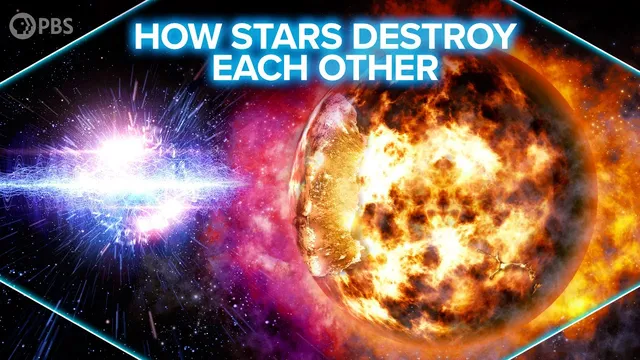
How Stars Destroy Each Other
Based on PBS Space Time's video on YouTube. If you like this content, support the original creators by watching, liking and subscribing to their content.
Classical novae occur when hydrogen accumulated on a white dwarf reaches critical temperature and pressure, triggering runaway fusion that ejects the white dwarf’s outer layers and briefly boosts brightness by tens of thousands of times.
Briefing
Binary star systems can turn ordinary stellar evolution into a chain of violent, observable catastrophes—white dwarfs ignite novae, neutron stars and black holes power X-ray binaries, and in rarer cases a pulsar can “evaporate” a companion into a black widow. The central through-line is that close orbits force matter to spill onto an ultra-dense remnant; the remnant’s extreme gravity and surface conditions then determine what kind of flare, spectrum, and long-term fate astronomers can detect.
The story begins with two stars born together in a binary orbit. After roughly a billion years, the heavier star burns out faster and collapses into a white dwarf: a planet-sized core of carbon and oxygen with a searing surface. As the companion star still lives, the pair spirals closer and a stream of red gas forms between them. The white dwarf’s intense surface gravity lets hydrogen accumulate until temperature and pressure reach core-like conditions. Fusion then erupts in a runaway burst, blasting the white dwarf’s outer layers into space and briefly shining tens of thousands of times brighter. Centuries later—on March 11, 1437—the light reached Earth, where Korean royal astronomers recorded a “guest star” in Scorpius. That historical flare is now recognized as a classical nova.
Modern telescopes don’t see the original system at the nebula’s center; the binary has drifted since 1437. Instead, astronomers find a flaring object off-center that alternates between visible and X-ray emission. Mike Shara, working from the 1980s discovery of the nebula, spent decades linking the explosion to a nearby cataclysmic variable: a white-dwarf binary that also matches a “dwarf nova” seen on old photographic plates as far back as 1923. The key insight is that dwarf novae are essentially the smaller, more frequent build-up-and-flare phase between classical nova explosions. Over time, the system repeatedly accumulates hydrogen, heats it in bursts, and eventually crosses a critical threshold that triggers the full nova.
Cataclysmic variables come in variants. In “polars,” a strong magnetic field channels infalling gas along field lines, producing synchrotron radiation and bright X-rays when material hits the white dwarf’s magnetic poles—like violent auroras. Yet the most extreme versions replace the white dwarf with a neutron star or black hole. Neutron stars and black holes form when massive stars die and their cores contract until nuclei merge into a hyperdense object; black holes then swallow themselves into an event horizon. In X-ray binaries, gas forms an accretion disk and heats to X-ray temperatures as it spirals inward. Uneven inflow causes X-ray variability: neutron-star systems can show flares from dense clumps and even pulsar-like metronome pulses when magnetic fields launch jets. Black hole systems can look calmer because there’s no solid surface to produce the same flare behavior.
Some of the rarest outcomes resemble a cosmic detective case. “Black widow” systems start as gamma-ray sources that should pulse like pulsars but don’t. Roger Romani’s observations revealed a pulsar orbiting a companion that has been stripped down into a brown dwarf. The pulsar’s jets sweep the companion hundreds of times per second, blasting off gas that forms an envelope: radio light gets blocked, while gamma rays pass through. The visible brightness changes as the heated “day” side and cooler “night” side rotate into view.
Finally, the transcript connects these binary tragedies to the universe’s most consequential explosions. In cataclysmic variables, some white dwarfs eventually retain most of the accreted mass—only ejecting about 5% during novae—until carbon and oxygen fusion runs away, producing a Type 1 supernova. Those events can be seen across the universe, turning intimate orbital dynamics into cosmological signals.
The discussion then pivots to gravitational-wave science, using a LIGO-related comment response to address whether a compact object in a merger could be a neutron star hidden behind an event horizon, whether it could be a primordial black hole, and why ordinary stars can’t generate detectable gravitational waves in these scenarios. The through-theme remains the same: extreme compactness and relativistic gravity determine what can be observed—and what can be ruled out.
Cornell Notes
Close binary systems can feed ultra-dense remnants—white dwarfs, neutron stars, or black holes—until conditions trigger dramatic outbursts. A classical nova happens when hydrogen builds on a white dwarf and ignites in a runaway fusion burst, briefly outshining the star by orders of magnitude; the 1437 “guest star” in Scorpius is identified with a modern cataclysmic variable. Dwarf novae are the weaker, recurring build-up-and-flare episodes between classical nova explosions. Replacing the white dwarf with a neutron star or black hole produces X-ray binaries where accretion disks glow in X-rays and variability depends on whether there’s a surface (neutron star) or only an event horizon (black hole). In rarer “black widow” systems, a pulsar strips a companion down to a brown dwarf, blocking radio light while gamma rays escape.
How does a classical nova differ from a dwarf nova in a cataclysmic variable system?
Why was the 1437 “guest star” not found at the center of its remnant nebula?
What physical conditions make X-ray binaries glow in X-rays rather than visible light?
How do neutron-star X-ray binaries differ observationally from black hole X-ray binaries?
What makes a “black widow” system look like a pulsar in gamma rays but not in radio pulses?
Why can’t a normal star be the smaller object in a LIGO-detected compact binary merger?
Review Questions
- What sequence of events turns a hydrogen-rich accretion flow into a classical nova on a white dwarf?
- How do magnetic fields in polars change the geometry and emission of accreting gas compared with non-magnetic cataclysmic variables?
- What observational signatures distinguish neutron-star X-ray binaries (including pulsars) from black hole X-ray binaries?
Key Points
- 1
Classical novae occur when hydrogen accumulated on a white dwarf reaches critical temperature and pressure, triggering runaway fusion that ejects the white dwarf’s outer layers and briefly boosts brightness by tens of thousands of times.
- 2
Dwarf novae are weaker, recurring outbursts in cataclysmic variables—essentially the build-up-and-flare phase between classical nova explosions.
- 3
The 1437 “guest star” in Scorpius is linked to a modern cataclysmic variable whose flaring emission is offset from the center of the nova remnant nebula due to system drift.
- 4
In X-ray binaries, accretion disks glow in X-rays because infalling gas heats to extreme temperatures as it spirals inward under intense gravity.
- 5
Neutron-star X-ray binaries can show surface-driven flares and pulsar-like metronome pulses, while black hole X-ray binaries lack the same surface-impact flare behavior.
- 6
Black widow systems arise when a pulsar strips a close companion down to a brown dwarf, forming an envelope that blocks radio light while gamma rays escape.
- 7
Type 1 supernovae can result when a white dwarf retains most accreted mass after repeated novae and eventually ignites carbon-oxygen fusion in a runaway reaction.