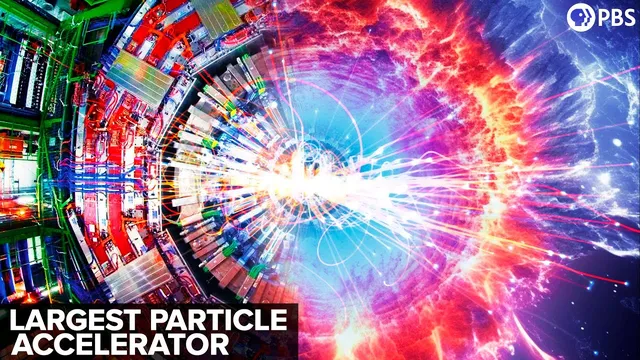
How Supernovas Act as Universe’s Largest Particle Accelerators
Based on PBS Space Time's video on YouTube. If you like this content, support the original creators by watching, liking and subscribing to their content.
Supernova shockwaves form when ejecta move faster than the local sound speed in the interstellar medium, creating a sharp propagating front.
Briefing
Cosmic rays—high-energy particles raining onto Earth—are largely powered by shockwaves from exploding stars, with supernova remnants acting as natural particle accelerators. The key mechanism is “Fermi acceleration,” where particles repeatedly bounce through turbulent magnetic fields at a supernova shock front, gaining energy each time. That process can push protons to around 10^17 electron volts, enough to explain a big share of the cosmic-ray spectrum, even if it still falls short of the most extreme particles observed.
The story starts with how shockwaves form. In ordinary media, pressure waves travel at the speed of sound, but a shockwave occurs when material moves faster than that—so the oncoming particles outrun sound and sweep up the material ahead. Supernovae produce exactly this: after a massive star’s iron-nickel core collapses into a neutron star, energy released in neutrinos helps drive the outer layers outward at a few percent of the speed of light. That speed is far above the local sound speed in the interstellar medium, creating a shock.
Magnetic fields then turn that shock into an accelerator. Charged particles spiral along magnetic field lines, and in a plasma the fields can reinforce and shape the flow. As a supernova expands, some magnetic field becomes trapped in the compact remnant while the rest is dragged outward with the explosion. The result is a shock front that carries both matter and intense magnetic turbulence. Because the interstellar medium is so diffuse, collisions are rare—yet the shock still forms a “collisionless” boundary where particles interact mainly through electromagnetic fields.
In the shock’s frame, a proton effectively sees material rushing in from both sides while magnetic turbulence piles up into two interacting regions. The proton scatters back and forth as it encounters moving magnetic irregularities, and each deflection can add energy due to the relative motion of the turbulent fields. Repeated crossings—diffusive, random-walk style—allow the particle to climb to much higher energies than the shock’s own bulk speed would suggest.
Supernova remnants can accelerate particles efficiently, but their limits matter. Their magnetic fields are weak compared with those in human accelerators like the Large Hadron Collider, so achieving extreme energies requires enormous effective sizes: turbulent regions can extend many times the width of the solar system, while the expanding shells grow to several light-years across. Even so, supernova shocks appear to top out around roughly 100 times below the highest-energy cosmic rays.
That gap points to other cosmic accelerators. Observations from the Pierre Auger Observatory suggest that ultra-high-energy cosmic rays are not concentrated along the Milky Way’s disk, implying sources beyond the galaxy and a correlation with the universe’s large-scale structure. Candidate engines include magnetars and active galactic nuclei, where supermassive black holes launch magnetized jets. Those jets inevitably drive shocks through surrounding gas and can inflate giant lobes of diffuse plasma and magnetic field across hundreds of thousands of light-years—large enough, even with weak fields, to reach the highest energies. The quest now is to determine which of these environments dominates the most energetic cosmic rays, since the origin of individual particles remains difficult to pinpoint.
Cornell Notes
Supernova remnants can act as universe-scale particle accelerators because their shockwaves and magnetic fields work together. After a massive star collapses, neutrino-driven outflows create a shock moving at a few percent of light speed—fast enough to exceed the sound speed in the interstellar medium. Charged particles then undergo Fermi (diffusive) acceleration: they scatter repeatedly across turbulent magnetic “walls” at the shock front, gaining energy on each crossing. Protons can reach about 10^17 eV, and iron nuclei about ten times higher, but this still falls short of the very highest-energy cosmic rays. The remaining extreme energies likely require larger-scale shocks, such as those driven by jets from active galactic nuclei, possibly in giant radio lobes spanning hundreds of thousands of light-years.
What turns an explosion into a shockwave, and why does that matter for cosmic rays?
How do magnetic fields enable Fermi (diffusive) acceleration at a supernova shock?
Why are “collisionless shocks” still capable of accelerating particles?
What energy scale can supernova remnants reach, and what does that imply?
What does the Pierre Auger Observatory suggest about where the highest-energy cosmic rays come from?
Why are active galactic nuclei jets considered promising for the most energetic cosmic rays?
Review Questions
- How does the combination of shock speed and magnetic turbulence determine whether a supernova remnant can accelerate cosmic rays efficiently?
- What specific observational pattern would you expect if ultra-high-energy cosmic rays originated mainly within the Milky Way, and how does Pierre Auger’s result differ?
- Why does scaling up the size of the acceleration region matter when magnetic fields are weak?
Key Points
- 1
Supernova shockwaves form when ejecta move faster than the local sound speed in the interstellar medium, creating a sharp propagating front.
- 2
Fermi (diffusive) acceleration relies on repeated scattering across turbulent magnetic fields at the shock, with energy gains tied to the motion of those magnetic irregularities.
- 3
Supernova remnants can accelerate protons to about 10^17 eV and iron nuclei to roughly ten times that, but this is still far below the most energetic cosmic rays.
- 4
The interstellar medium’s low density leads to “collisionless” shocks, where electromagnetic interactions with magnetic turbulence—not frequent collisions—enable acceleration.
- 5
The Pierre Auger Observatory’s sky maps suggest ultra-high-energy cosmic rays come from beyond the Milky Way and correlate with the universe’s large-scale structure.
- 6
Active galactic nuclei jets and their giant lobes provide a plausible path to the highest energies because they drive shocks on enormous scales, even when magnetic fields are weak.