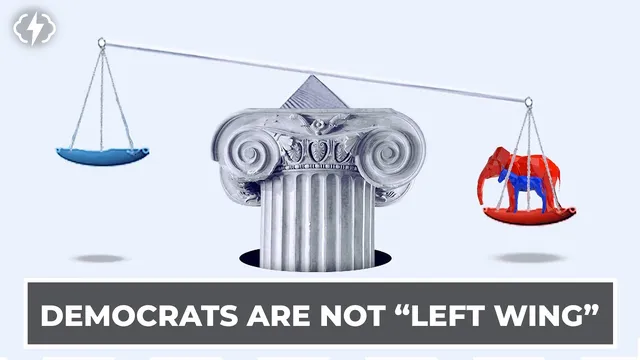
How The United States Ended Up With Two Right-Wing Parties
Based on Second Thought's video on YouTube. If you like this content, support the original creators by watching, liking and subscribing to their content.
The “ratchet effect” describes a system where Republican control moves policy rightward, while Democratic control prevents reversal and often freezes the shift rather than undoing it.
Briefing
The United States’ two major parties operate like a rightward ratchet: when Republicans gain power, policy shifts to the right; when Democrats return, the shift slows or stops rather than reversing—often while Democrats adopt right-leaning positions that expand what’s considered “acceptable” politics. The result is a political system that blocks left-wing momentum even when left-leaning ideas gain popularity, helping entrench a neoliberal status quo and pushing the country further right over time.
The core mechanism is the “ratchet effect.” In this model, Republican control “engages the gears,” allowing conservative policies to pass, judges to be replaced, and budgets to be approved. Democratic control is supposed to move the ratchet back left, but instead it freezes the mechanism—passively accepting rightward movement, moving right themselves, and blocking leftward change. The transcript points to public opinion as evidence that left policies have mainstream support: universal health care, higher minimum wages, tuition-free college, and federal marijuana legalization are described as widely popular, including among Democratic voters. Yet those proposals often fail to become law, attributed to Democratic resistance to leftward pressure rather than responsiveness to it.
That resistance shows up during elections and in governing decisions. Democratic elites are portrayed as clearing the path for centrist candidates—citing endorsements, fundraising advantages, and media coverage that favors “moderates” while marginalizing more left-leaning challengers. In office, the pattern is described as retreating from ambitious demands: examples include abandoning a push for a $15 minimum wage, infrastructure legislation shifting from a more ambitious version to a narrower one, and high-profile silence when workers attempt to unionize or strike. The transcript also describes what happens when Democrats hold power in immigration and foreign policy—such as maintaining hardline border practices, keeping the U.S. embassy in Jerusalem amid ongoing conflict, and continuing rising military budgets.
A concrete illustration is the corporate tax rate. Republicans are credited with cutting it sharply in 2017 (from 35% to 20%), shifting the tax burden toward average Americans while benefiting corporations and wealthy donors. Democrats are credited with raising it only partially afterward (to roughly 25–28), leaving the long-term trend still rightward. The broader claim is that Republicans push further on imperial foreign policy, restrictive immigration, and wealth hoarding, while Democrats promise to represent “the people” but deliver less than promised—sometimes passing progressive measures, but rarely and usually below what was pledged.
The transcript argues that Democrats also expand right-wing territory by adopting “law and order” style politics. It traces a lineage from Nixon’s phrase to Reagan’s war on drugs and then to Democratic “tough on crime” expansions, including the “super predator” narrative and the Clinton-era crime bill with “three strikes,” expanded death penalty scope, and mass incarceration. It adds that Democratic administrations have backed policing and surveillance measures, including increased police funding against protests and support for the Patriot Act.
Two structural reasons are offered for why this ratchet persists. First, both parties depend heavily on corporate donors—especially weapons, pharmaceuticals, and fossil fuels—pulling Democrats rightward beyond what their voters want. Second, the U.S. electoral system functions as a mostly majoritarian duopoly: third parties struggle, both major parties compete for the same centrist voters, and “lesser evil” dynamics reduce accountability. Even progressive figures, the transcript says, often get defanged through concessions as they move into the centrist fold.
The closing takeaway is bleak but action-oriented: meaningful change requires grassroots pressure and popular movements that can mount an effective opposition to the corporate duopoly and the neoliberal trajectory it sustains. The transcript points viewers toward organizing—local chapters, mutual aid, and left-wing political groups—as the path to real, lasting alternatives.
Cornell Notes
The transcript argues that U.S. politics functions as a “ratchet effect”: Republican control moves policy rightward, while Democratic control prevents reversal and often adds right-leaning policies. Even when left-wing proposals gain popularity—like universal health care, higher minimum wages, tuition-free college, and marijuana legalization—Democrats are portrayed as resisting or diluting them through election strategy, media favoritism for centrists, and governing retreats. Examples include abandoning a $15 minimum wage push, shifting infrastructure priorities, and maintaining hardline immigration and foreign-policy stances. The explanation combines corporate donor influence and a two-party electoral structure that blocks third parties and forces both parties to compete for centrist voters, keeping the center—and the whole system—moving right.
What does the “ratchet effect” mean in practical political terms?
Why does the transcript claim left-wing policies fail even when they’re popular?
How is the corporate tax rate used as evidence of the ratchet?
What “law and order” lineage does the transcript cite to show Democrats adopting right-wing territory?
What structural forces does the transcript say keep both parties moving right?
What does the transcript suggest as the path to real change?
Review Questions
- How does the transcript distinguish between Democrats being “ineffective” versus being “harmful” in left-wing policy outcomes?
- Which two structural explanations does the transcript give for why both parties remain tied to rightward politics, and how do they interact?
- What examples are used to show Democrats adopting right-wing policy frameworks, and what common theme links them?
Key Points
- 1
The “ratchet effect” describes a system where Republican control moves policy rightward, while Democratic control prevents reversal and often freezes the shift rather than undoing it.
- 2
Left-wing proposals can be widely popular yet still fail when Democratic elites prioritize centrist candidates and resist leftward demands.
- 3
Election and media dynamics are portrayed as gatekeeping mechanisms that steer Democratic politics toward moderates and away from more left-leaning contenders.
- 4
Governing decisions are cited as retreats from progressive goals, including scaled-back minimum wage efforts and diluted infrastructure priorities.
- 5
The corporate tax rate is presented as a measurable example of rightward drift: large cuts under Republicans and only partial restoration under Democrats.
- 6
The transcript argues Democrats expand right-wing territory by adopting punitive “law and order” approaches, tracing a lineage from Nixon and Reagan to Clinton-era crime policy.
- 7
Structural incentives—corporate donor dependence and a two-party electoral duopoly—are described as locking both parties into a neoliberal, rightward trajectory unless grassroots movements intervene.