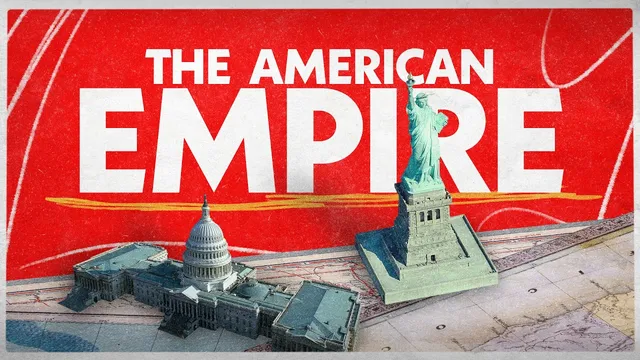
How The US Took Over The World
Based on Second Thought's video on YouTube. If you like this content, support the original creators by watching, liking and subscribing to their content.
U.S. influence is portrayed as empire-like because it extends through territories under U.S. jurisdiction, not just the 50 states.
Briefing
The United States functions less like a normal country and more like a global empire—projecting control through overseas territories, a vast network of military bases, and economic rules that bind other nations to American interests. The core insight is that post–World War II decolonization didn’t end American dominance; it reshaped it into a permanent, worldwide system of leverage that can operate without formal colonies.
American power began as a settler colony and then expanded beyond North America. The continental U.S. is only part of the picture: under U.S. jurisdiction there have long been additional territories with different legal statuses—such as Guam, American Samoa, the Philippines, Puerto Rico, the U.S. Virgin Islands, and various Pacific and Caribbean outlying islands. In the early 1940s, inhabited U.S.-controlled territories outside the states totaled about 19 million people, meaning roughly one in eight people under U.S. rule lived beyond the mainland. Daily life in these places often meant colonial-style constraints: learning English and U.S. history in school, using American dollars, celebrating U.S. holidays, and lacking the same constitutional protections available to mainland residents—alongside frequent colonial violence and limited political say.
World War II accelerated the scale of U.S. control. By the end of 1945, more people lived under American rule outside the mainland than within it—about 135 million people under U.S. control through occupations of parts of Germany, Korea, Japan, and Austria. Yet after the war, the U.S. largely stopped acquiring new formal colonies. The shift wasn’t a retreat from power; it was a change in method. Decolonization movements in Asia and Africa made old-style imperial administration too costly, and the Cold War required anti-colonial rhetoric that the U.S. couldn’t easily contradict. Most importantly, American strategists realized they could gain imperial benefits without running full colonial governments.
That realization fed the second pillar: a global web of military bases. After releasing some territories, the U.S. built and expanded installations worldwide, reaching an estimated scale of around 800 bases and roughly 173,000 troops across about 159 countries. The transcript contrasts this with other countries’ overseas footprints—citing far smaller numbers for Britain, France, and Russia—underscoring how unmatched the U.S. reach is. These bases are portrayed as tools for multiple purposes: nuclear positioning, intelligence and surveillance, rapid deployment for interventions, protection of strategic assets like oil, and even support for authoritarian allies. They can also function as pressure points that raise local military spending, and as platforms for covert operations, including a CIA-run propaganda radio effort from Swan Island aimed at Cuba and the broader Caribbean.
The third pillar is economic dominance. After World War II, the U.S., alongside institutions like the IMF and World Bank (with U.S. veto power), helped shape a global order where American capital moves more freely than labor. Through mechanisms such as the Marshall Plan and conditional loans, countries were pushed to cut government spending and sell assets to American firms. By 2012, the transcript claims U.S. companies owned 46% of publicly listed shares among the world’s top 500 corporations. The U.S. dollar’s centrality—especially for oil—further locks other countries into U.S. monetary policy. Sanctions complete the system: the transcript cites roughly 15,000 active U.S. sanctions, affecting about one-third of all nations and around 60% of poor countries, with the argument that sanctions can be as damaging as war.
Taken together, the message is that American empire persists through territory without formal annexation, military presence without declared war, and economic leverage without colonial rule—an arrangement that, like past empires, is framed as having overstayed its welcome and produced severe human costs while enriching powerful interests.
Cornell Notes
The transcript argues that U.S. global dominance functions like an empire, even though it often avoids formal colonial rule. It traces three pillars: (1) U.S. territorial holdings beyond the 50 states, with residents facing colonial-style limits and unequal rights; (2) a worldwide network of military bases that enables surveillance, coercion, and rapid intervention; and (3) economic control through institutions, dollar-based trade, corporate ownership, and sanctions. After World War II, decolonization and Cold War politics reduced the appeal of classic empire, but American power expanded through bases and economic systems instead. The result is a durable form of control that binds other countries to U.S. interests and can impose severe costs on civilian lives.
How does the transcript define “American empire” beyond the idea of the U.S. as a single country?
What examples of U.S. territorial control are used, and what conditions are described for people living there?
Why did the U.S. move away from formal colonies after World War II, according to the transcript?
What functions are attributed to U.S. military bases worldwide?
How does the transcript argue the U.S. dominates the global economy without formal colonial rule?
Review Questions
- Which three mechanisms does the transcript use to connect U.S. power to empire-like control, and how does each operate without formal annexation?
- What changes after World War II, according to the transcript, explain why the U.S. could expand influence while giving up some territories?
- How do dollar dominance and sanctions work together in the transcript’s account of economic control?
Key Points
- 1
U.S. influence is portrayed as empire-like because it extends through territories under U.S. jurisdiction, not just the 50 states.
- 2
Territorial control is described as creating unequal rights and political voice, with residents often subject to colonial-style education, currency use, and limited constitutional protections.
- 3
After World War II, the U.S. largely avoided classic colonial administration, but expanded a permanent global military presence to maintain leverage.
- 4
The transcript attributes multiple strategic functions to overseas bases, including intelligence, nuclear positioning, protection of strategic resources, and rapid intervention capability.
- 5
Economic dominance is framed as a system built on U.S.-led institutions, corporate access to foreign assets, and the centrality of the U.S. dollar in global trade.
- 6
Sanctions are presented as a major coercive tool that can inflict widespread civilian harm while advancing U.S. geopolitical goals.
- 7
The overall claim is that American empire persists through military and economic systems even when formal colonies shrink.