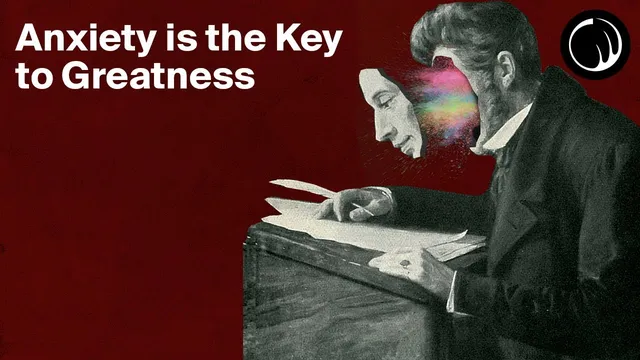
How the Way You Respond to Anxiety Changes Your Life - Søren Kierkegaard on Angst
Based on Pursuit of Wonder's video on YouTube. If you like this content, support the original creators by watching, liking and subscribing to their content.
Kierkegaard defines existential anxiety (“angst”) as the dizziness of freedom—awareness of choice and responsibility under deep uncertainty.
Briefing
Søren Kierkegaard’s central claim is that anxiety—what he calls “angst”—is not a malfunction to eliminate but a built-in feature of human freedom, and the way people respond to it determines whether life becomes meaningful or collapses into despair. Anxiety arises from the dizzying awareness that individuals can choose and must take responsibility for those choices, even though they face deep uncertainty about what the future holds and what the “right” decision even means. Kierkegaard frames this as existential dread tied to the unknowns of existence: people are forced to act without a map, steering through fog with no reliable guarantee that decisions will turn out as hoped.
That tension can paralyze. Anxiety can keep people from acting at all—like staring at an intimidating task list with a deadline that never feels safe to approach—because the mind keeps spinning and the fear of consequences never fully settles. Kierkegaard treats this avoidance as the real danger, not anxiety itself. Succumbing to inaction erodes the self, producing a “failed and unrealized” life that slides into despair: apathy, depression, and a sense of being stuck in a frictional, unreal experience of existence.
Yet Kierkegaard refuses to paint anxiety as purely negative. He argues that anxiety is a necessary ingredient of life, and that the difference between emptiness and fulfillment lies in how people move with anxiety rather than against it. Without anxiety, there would be no possibility—because uncertainty and risk are what make genuine choice meaningful. The task, then, is to retain agency: keep moving forward, act despite the spinning head, and accept that life will never become perfectly safe or perfectly timed.
Kierkegaard’s prescription is to pursue “passion,” but not in a vague sense. The passion must be anchored in “subjective truth”—a truth that feels true to the individual, something worth living and dying for, rather than a belief grounded only in objective proof. That often requires a “leap of faith,” a commitment made even without intellectual certainty. In this framework, people frequently try to escape anxiety by conforming to the status quo or by using distractions—substance abuse, chasing social status, superficial activity, or materialism—to avoid responsibility for their own choices. Kierkegaard’s counterpoint is that self-development depends on facing anxiety directly and using it as the pressure that makes authentic meaning possible.
The practical takeaway is blunt: life will remain uncertain, and there is no perfect moment to begin. The best response is to climb aboard anyway—choosing the most interesting heights and depths of the unknown available to a person—because refusing to act carries a worse psychological cost. Anxiety, in this view, is the price of living; despair is the byproduct of refusing to engage with the freedom and responsibility that come with being human.
The transcript also includes a sponsored segment about Blinkist, using a fictionalized reader story to illustrate how brief summaries can help someone explore more books and categories, but the philosophical core remains Kierkegaard’s argument that anxiety is unavoidable—and that meaning comes from how people commit to what they believe is worth the risk.
Cornell Notes
Kierkegaard treats anxiety (“angst”) as the existential feeling that comes with freedom and responsibility under uncertainty. People know they must choose, yet they lack the information needed to guarantee correct decisions, which can make anxiety paralyzing. Avoiding action doesn’t remove anxiety; it corrodes the self and can lead to despair—depression, apathy, and a life that never becomes real. Kierkegaard’s remedy is to move forward anyway by pursuing passion grounded in “subjective truth,” often through a leap of faith. The payoff is a more authentic life: anxiety becomes the price of living, while refusal to engage with it leads to a worse outcome.
What exactly does Kierkegaard mean by “angst,” and how is it different from everyday worry?
Why does anxiety sometimes lead to inaction, and what does Kierkegaard say happens when people give in to that paralysis?
How does Kierkegaard justify anxiety as necessary rather than purely harmful?
What is “passion” in Kierkegaard’s framework, and what does “subjective truth” mean?
What escape strategies does Kierkegaard criticize, and why are they ineffective?
What role does faith play, and how does the “leap of faith” relate to decision-making under uncertainty?
Review Questions
- How does Kierkegaard connect anxiety to freedom and responsibility, and why does that make anxiety unavoidable?
- What distinguishes “subjective truth” from objective proof in Kierkegaard’s account of passion?
- Why does Kierkegaard treat despair as a consequence of inaction rather than as a direct result of anxiety itself?
Key Points
- 1
Kierkegaard defines existential anxiety (“angst”) as the dizziness of freedom—awareness of choice and responsibility under deep uncertainty.
- 2
Anxiety can become paralyzing when people treat uncertainty as a reason to avoid action, but avoidance erodes the self over time.
- 3
Meaningful self-development requires moving forward with anxiety rather than trying to eliminate it.
- 4
Kierkegaard argues anxiety is necessary because it makes genuine possibility and authentic choice possible.
- 5
Passion should be oriented toward “subjective truth,” a lived belief worth living and dying for, not merely something objectively provable.
- 6
Escaping anxiety through conformity, status-seeking, addictions, or material distractions doesn’t remove responsibility; it delays authentic commitment.
- 7
There is no perfect time to act in an uncertain life; the best response is a leap of faith into what seems most worth it.