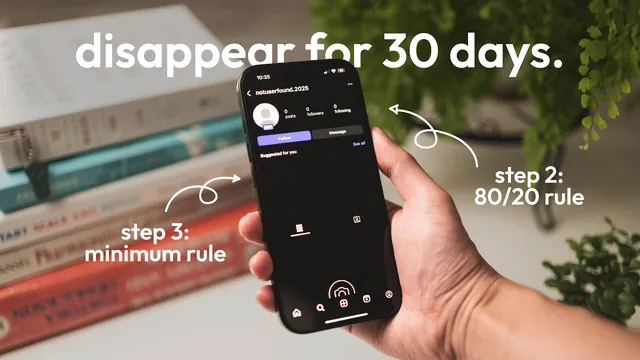
how to achieve more in 30 DAYS than others in a year.
Based on Kai Notebook's video on YouTube. If you like this content, support the original creators by watching, liking and subscribing to their content.
Pick one life-impacting goal and commit to a single central daily habit for 30 days instead of splitting attention across multiple ambitions.
Briefing
The fastest way to outpace others in 30 days isn’t a secret talent—it’s a disciplined setup: pick one life-impacting goal, build a daily habit around it, and then spend most of your time on the small set of tasks that produce disproportionate results. The core prescription is to choose a single “one thing” that, if done consistently for a month, makes everything else easier—whether that means daily workouts for fitness or daily studying for school. The emphasis is on foundation-building rather than going “way too hard,” since the point is to create momentum you can sustain.
That foundation starts with prioritization. Instead of juggling multiple ambitions, the plan is to select one area—career, school, or a project—that will meaningfully shift life outcomes. From there, the daily focus becomes a “central goal habit”: a repeatable action done every day for 30 days. For school, that means studying daily using effective methods (or developing methods that work), with the explicit goal of turning studying into a long-term habit rather than a short sprint.
Next comes the 80/20 rule, framed as an efficiency guide for choosing tasks. The principle isn’t interpreted as “doing less effort yields more results,” but as identifying which specific tasks generate a larger share of outcomes. Examples include business income patterns—where a minority of customers can drive most revenue—and the life version: concentrate on the 20% of activities that deliver the majority of impact. The practical takeaway is to identify “high impact tasks” and eliminate or reduce low-yield work.
The transcript gives concrete examples of high-yield habits and low-yield traps. Meal prepping is presented as a compound-benefit routine: cooking once supports consistent nutrition (including hitting macros), reduces daily decision fatigue, and gradually builds cooking skill. Sleep scheduling is treated as another compounding lever because it stabilizes the baseline for everything else. On the flip side, the advice warns against spending time on activities that feel productive but don’t move the needle—like passive studying, excessive organizing, and especially planning without doing. The “planning vs. doing” trap is singled out: time spent designing the day can crowd out the actual work.
A further productivity lever targets wasted minutes between tasks. Cutting transition time—like showering immediately after getting home instead of settling in—reduces the “little increments” of downtime that accumulate until there’s no room left for meaningful work. To support this, the transcript mentions Rise, an automatic time tracker that autotags projects and tasks, includes a website blocker and focus music, and can remind users when they’re getting distracted.
Finally, the plan introduces a “minimum goal routine”: a realistic daily baseline that follows an 80/20 mindset and avoids perfectionism. The goal is consistency over flawless execution—start with a manageable study duration (e.g., 30 minutes to 1 hour), then build the habit across the full 30 days. The closing message reframes productivity as progress toward a personal ideal that will never be fully reached; falling short isn’t failure so much as the fuel for reinvention and continued direction toward what matters.
Cornell Notes
The 30-day advantage comes from choosing one high-impact goal and turning it into a daily habit, then directing effort toward the tasks that generate the most results. Prioritization comes first: pick a single area (school, career, or a project) and define a central daily action that moves it forward. The 80/20 rule is used to identify the small set of activities that produce a disproportionate share of outcomes, while cutting low-yield work like excessive planning. Productivity also depends on reducing transition time between tasks and avoiding perfectionism through a “minimum goal routine” that stays realistic. The overall aim is consistency—doing enough every day to build momentum that lasts beyond the 30 days.
What is the “one thing” framework, and how does it prevent people from burning out?
How does the transcript apply the 80/20 rule to everyday work?
What counts as “high impact tasks,” and what are examples of compound habits?
Why does the transcript criticize planning, and what alternative does it recommend?
How does reducing transition time create more usable time?
What is a “minimum goal routine,” and how does it relate to perfectionism?
Review Questions
- If someone can only choose one daily habit for 30 days, what criteria should they use to decide what that habit is?
- How would you identify your personal “20% tasks” that produce most of your results, using the examples from the transcript?
- What transition-time changes could you make tomorrow to reduce wasted minutes between tasks?
Key Points
- 1
Pick one life-impacting goal and commit to a single central daily habit for 30 days instead of splitting attention across multiple ambitions.
- 2
Avoid “going too hard” at the start; the purpose is to build a sustainable foundation that can carry momentum beyond the month.
- 3
Use the 80/20 rule as a task filter: focus on the specific activities that generate disproportionate outcomes, not on the idea of doing less effort.
- 4
Prioritize compound habits like meal prepping and consistent sleep, and reduce low-yield time sinks such as passive studying and excessive organizing.
- 5
Cut transition time between tasks to prevent small downtime gaps from accumulating into lost productivity.
- 6
Replace perfectionism with a minimum goal routine: set a realistic daily baseline and build the habit across all 30 days.
- 7
Treat productivity as consistent direction toward what matters, even when the ideal outcome isn’t fully reached.