How to Add Joy & Whimsy Back Into Your Life
Based on Anna Howard's video on YouTube. If you like this content, support the original creators by watching, liking and subscribing to their content.
Howard connects adult loss of whimsy to childhood insecurity, including experiences that made her feel behind—especially in math—and later impostor-like fears around authority.
Briefing
A fear of being “dumb” can quietly drain a person’s playfulness—and restoring joy may require more than self-care rituals. In a wide-ranging reflection on inner-child work, Anna Howard connects adulthood’s loss of whimsy to childhood hierarchies that treat children as less capable, less autonomous, and less worth listening to. The result is a lifelong insecurity that can make adults smaller in social settings, less willing to take creative risks, and more likely to trade curiosity for efficiency.
Howard traces her own shift from goofier, uninhibited expression to a more guarded presence after a childhood pattern of feeling behind—especially around math, where she relied on counting on her fingers while her brother took advanced classes. A recent “meltdown” over the belief that she’s actually quite dumb becomes a turning point: the microphone in hand symbolizes adult authority, which carries an expectation of expertise, and that expectation collides with impostor syndrome. That tension leads her to focus on teachers and learning—how authority can either flatten beginners or create conditions where they can safely experiment.
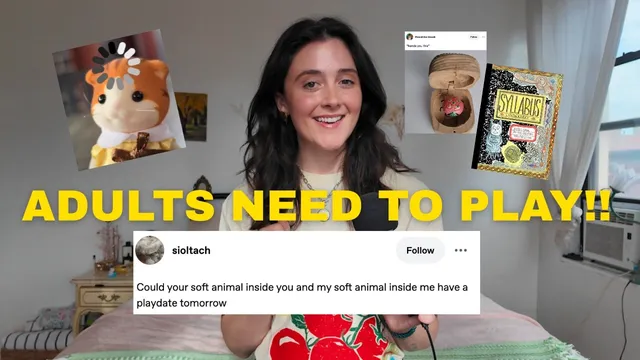
Her argument broadens beyond individual healing. She draws on Linda Barry’s illustrated “Syllabus,” including a guiding question on the cover: “Who is the teacher?” Barry’s classroom approach treats teaching as an experiment and beginners as essential collaborators. Howard highlights Barry’s critique of over-specifying creative tasks: when instructions become too precise, the “playing around” disappears, and with it the gradual figuring-out that makes an activity alive and transferable. Barry’s students, in Howard’s telling, learn to “remember to forget”—the efficient way—so they can regain flexibility and creative openness.
A pediatric occupational therapist’s framing adds another layer: play is not just a personality trait but a practiced skill that can be learned and returned to. Howard contrasts play as fixed temperament with play as something adults deprioritize in the name of efficiency. She also brings in a Substack essay by PAX arguing that liberation is tied to how children are treated: children are often controlled, infantilized, and denied agency, and adults internalize that dehumanizing hierarchy. Howard emphasizes that the harm isn’t only in extreme neglect or abuse; it also shows up in micro-moments—like adults talking about a child as if the child isn’t present—eroding autonomy and the ability to learn from children’s perspectives.
From there, the episode turns practical. Howard recommends building play back into adult life through experimentation: setting aside time that doesn’t exist to produce value, trying activities you’re not “good at,” and using alter egos or “playing pretend” to lower the barrier to creative risk. She points to improv classes as a reliable entry point because they reward staying in the moment, saying “yes,” and treating conversation like a game rather than a performance. The throughline is clear: joy isn’t childishness to outgrow—it’s a skill, a stance, and a way to keep learning without shrinking into shame. Howard ends by committing to more playful experimentation, including shifting some vlogging to Instagram, and—at least for now—prioritizing silliness over seriousness.
Cornell Notes
Anna Howard links adult loss of playfulness to childhood dynamics that place adults in authority and children in subordinate roles. Her own impostor-like fear of being “dumb” traces back to early experiences—especially around math—and shows up as less fun, less uninhibited expression. Drawing on Linda Barry’s “Syllabus,” she argues that teaching and creativity work best when beginners are treated as collaborators and when instructions leave room for “playing around,” the gradual figuring-out that makes activities alive. Play, supported by a pediatric occupational therapist’s view, is a practiced skill adults can return to, not a fixed personality trait. The episode also urges micro-level respect for children’s autonomy and suggests practical ways adults can rebuild play through experimentation, improv, and alter egos.
How does Howard connect childhood experiences to adult insecurity and reduced play?
What does Linda Barry’s “Syllabus” add to the discussion of play and learning?
Why does Howard treat play as a skill rather than a personality trait?
How does the PAX essay reshape the inner-child conversation?
What micro-moments does Howard say can harm children’s autonomy?
What concrete strategies does Howard recommend for getting play back?
Review Questions
- Which childhood experiences does Howard identify as feeding her adult fear of being “dumb,” and how does that fear change her behavior in social settings?
- How do Linda Barry’s teaching choices (especially around specificity vs. open-ended play) illustrate the episode’s definition of play as essential to learning?
- What does Howard say about the difference between treating children as autonomous people versus talking about them as if they aren’t present, and why does that matter for adult learning?
Key Points
- 1
Howard connects adult loss of whimsy to childhood insecurity, including experiences that made her feel behind—especially in math—and later impostor-like fears around authority.
- 2
Inner-child work should extend beyond personal reflection to the adult–child power imbalance that can plant “not enoughness” and reduce children’s autonomy.
- 3
Linda Barry’s “Syllabus” is used to argue that creativity and learning require room for “playing around,” not overly precise instructions that remove the gradual figuring-out.
- 4
Play is framed as a practiced skill that adults can return to, not a fixed personality trait that only some people naturally have.
- 5
Micro-moments—like speaking about a child as if the child isn’t present—can compound into internalized beliefs about agency and worth.
- 6
Howard recommends rebuilding play through experimentation: setting aside non-productive play time, trying skills you’re not “good at,” and using alter egos or improv to lower the barrier to creative risk.
- 7
The episode cautions against shaming parents and instead emphasizes respectful, attentive engagement with children as a personal starting point for change.