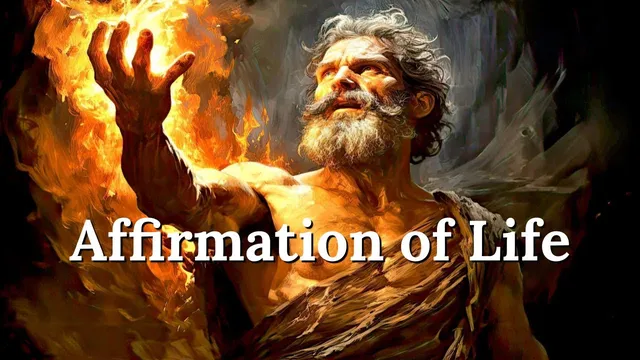
How to Affirm Life – Nietzsche’s Formula for Greatness
Based on Academy of Ideas's video on YouTube. If you like this content, support the original creators by watching, liking and subscribing to their content.
Nietzsche’s “pessimism of strength” affirms life’s suffering, evil, absurdity, and death rather than using them as reasons to withdraw.
Briefing
Philosophical pessimism doesn’t have to mean surrender. Friedrich Nietzsche’s “pessimism of strength” treats life’s suffering, evil, absurdity, and death not as reasons to withdraw, but as conditions to be faced—and even affirmed—by the kind of person strong enough to love reality in its full, ugly range.
Nietzsche distinguishes this robust stance from a darker pessimism that can curdle into anti-life attitudes. “Dionysian wisdom” involves an unsparing look at the human condition: the horror and meaninglessness that appear once illusions fall away. Paired with it is the “wisdom of Silenus,” the companion figure to Dionysus, whose lesson is that it would be better never to have been born—“the second best” being to die soon. When this knowledge metastasizes, it can feed self-hatred, hatred of humanity, and even anti-natalism, the view that bringing children into the world is unethical. It can also become passive nihilism: if life is fundamentally tragic and meaningless, action loses its point.
Nietzsche’s early answer to this problem leans on art. Art, in the tradition of “redeeming healing enchantress,” can veil truth, select and strengthen the beautiful, and withdraw the worst realities from sight so people can endure existence. Yet the remedy has limits. Reality keeps piercing artistic illusions, and there are moments when suffering and evil are so heavy that beauty alone cannot console. To move from endurance to genuine love of life, Nietzsche argues that a deeper capacity is required: the ability to affirm not only what is good and beautiful, but also what is terrible and ugly. That capacity is the heart of “pessimism of strength.”
In Nietzsche’s account, the strongest individuals don’t need justification for suffering; they enjoy it, even delighting in a world without God—chance and disorder included. Most people, by contrast, are “cowards” before life’s darker realities and rely on defense mechanisms that keep suffering, evil, and death outside awareness. The pessimism of strength is what remains when those defenses fail and the person still says “yes” to life.
How does such a character get built? Nietzsche’s “formula for greatness” is not mere acceptance of necessity or concealment of what’s real, but loving it. Greatness comes from a richly populated inner life: human beings are not unified selves but amalgams of competing drives—instincts like survival and sexuality, plus deeper motivations such as the will to power (growth and mastery), curiosity (seeking knowledge), and artistic drive (creating beauty). The measure of greatness is the number and strength of drives, not a single dominant trait. But greatness also requires internal conflict: drives that clash—power with self-control, solitude with sociability, desire with restraint—generate tension that produces energy, ambition, and creative achievement.
The final step is integration. All drives must be brought into a higher unity through an “organizing idea,” a guiding purpose that pulls the drives into orbit and functions as the living center of the self. When that unity holds, the person can face reality without illusions and affirm even the “strangest and hardest problems” of existence. In Nietzsche’s framing, this is a more life-affirming alternative to optimism, which often depends on denial and collapses when tragedy strikes. The result is a realistic, affirmative pessimism: seeing the dreadful truth—and still making it beautiful enough to live with.
Cornell Notes
Nietzsche’s “pessimism of strength” is a life-affirming form of philosophical pessimism that accepts suffering, evil, absurdity, and death without retreating into nihilism or anti-life conclusions. “Dionysian wisdom” and the “wisdom of Silenus” describe how confronting the human condition can lead to despair, anti-natalism, or passive nihilism—especially when truth is not metabolized into a stronger stance. Nietzsche’s early remedy is art, which can veil ugly truth and make existence bearable, but art cannot always carry people through life’s heaviest moments. True affirmation requires loving the terrible as well as the beautiful, achieved through cultivating greatness: strengthening many drives, allowing productive inner conflict, and unifying them under a compelling organizing idea that becomes the living center of the self.
What distinguishes Nietzsche’s “pessimism of strength” from pessimism that turns life-denying?
Why does Nietzsche treat art as a partial solution rather than a final one?
What is Nietzsche’s “formula for greatness,” and how does it relate to affirming life?
How do drives and internal conflict produce the energy associated with greatness?
What role does an “organizing idea” play in unifying drives?
Review Questions
- How can confronting “Dionysian wisdom” lead to anti-natalism or passive nihilism, and what prevents that outcome in “pessimism of strength”?
- Why does Nietzsche think art can make existence bearable but still fail to enable true love of life?
- According to Nietzsche, what combination of drive-strength, internal conflict, and organizing purpose produces the capacity to say “yes” to life?
Key Points
- 1
Nietzsche’s “pessimism of strength” affirms life’s suffering, evil, absurdity, and death rather than using them as reasons to withdraw.
- 2
“Dionysian wisdom” and the “wisdom of Silenus” can produce despair, anti-natalism, or passive nihilism when truth overwhelms the self.
- 3
Art can veil ugly truth and make existence bearable, but it cannot permanently shield people from reality’s heaviest moments.
- 4
True life-affirmation requires loving the terrible and ugly, not only the beautiful and good.
- 5
Greatness is built by strengthening many drives, not by having one dominant trait.
- 6
Internal conflict among strong drives generates tension and energy that can fuel creative and ambitious action.
- 7
A compelling “organizing idea” unifies competing drives into a harmonious system that functions as the living center of the self.