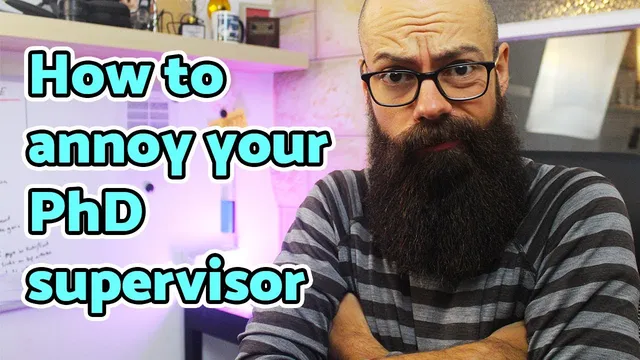
How to annoy your PhD supervisor | You are probably doing one!
Based on Andy Stapleton's video on YouTube. If you like this content, support the original creators by watching, liking and subscribing to their content.
Always arrive on time to scheduled supervisor meetings, and communicate early if something genuinely prevents attendance.
Briefing
A PhD supervisor’s calendar runs on reliability, and the fastest way to irritate them is missing scheduled meetings—or showing up late—without clear notice. When a student commits to a time slot and then disappears, the supervisor loses a block of work and spends the period waiting, wondering whether the student will arrive. That disruption matters even more because supervisors juggle packed schedules and often rely on those face-to-face windows to coordinate instruments, decisions, and next steps. Even anxiety or uncertainty about what to say isn’t a reason to skip; supervisors still need the interaction, and the meeting time is treated as valuable.
The next major annoyance is “vanishing” from the supervisor’s day-to-day view. In lab-based research, supervisors often assume that if a student isn’t in the lab, they aren’t working—especially when visitors are around and the lab’s activity is visible. In humanities or work-from-home setups, the same principle applies: supervisors benefit from small, frequent touchpoints where they can spot progress, share ideas, and offer timely help. Email presence can substitute for physical presence, but it only works if the student keeps sending updates and doesn’t wait passively for replies. The underlying goal is to stay on the supervisor’s mental radar and maintain a steady flow of informal contact.
Preparation is the third recurring problem. Supervisors want meetings to function like productive check-ins, not brainstorming sessions where the student arrives with no plan. Each meeting should include a clear narrative: what results emerged since the last meeting, what actions were agreed, what problems were encountered, how they were handled, and what solutions or next steps are planned for the coming week. Students who take a back seat—expecting the supervisor to generate answers—risk wasting the supervisor’s time and can end up being steered down inefficient paths because the supervisor lacks context about what’s already been tried.
Beyond meeting mechanics, supervisors also get frustrated when progress stalls for weeks. Some obstacles are real—instrument access, administrative delays, or other constraints—but repeated apathy and excuses erode the momentum supervisors are trying to build with the student. A PhD is framed as continuous problem-solving, including the small daily frictions: contacting the right people, gaining instrument time, tracking down information, and navigating access hurdles. Even when experiments fail, supervisors want evidence of momentum—something to report, even if it’s “it didn’t work, but here’s what I tried.”
Finally, supervisors dislike long-term misalignment on research output and academic planning. Disagreements should stay academically rigorous rather than combative; when the student has a reason, running a targeted experiment to test the claim is often the constructive route. And because peer-reviewed papers drive academic careers, students who don’t have any papers “on the horizon” can unsettle supervisors. A practical fix is keeping a running list of potential papers and sharing it early, so the supervisor can see the story forming and feel confident that the end goal is actively being built.
In short: show up reliably, stay visible, come prepared with a progress narrative, maintain momentum even through setbacks, and keep the supervisor connected to both the research process and the publication trajectory.
Cornell Notes
Supervisors get annoyed when students break the basic mechanics of supervision: missed meetings, low visibility, and unprepared check-ins. Reliability matters because supervisors schedule their time around those slots; no-show behavior wastes a calendar block and forces waiting. Visibility matters because supervisors often equate “not around” with “not working,” whether in labs or via email updates. Meetings should be structured around a progress story—results, agreed actions, problems solved, and next steps—so the supervisor isn’t forced into guessing or improvising. Over the long run, stalled progress, combative dynamics, and lack of any publication plan can further strain the relationship.
Why do missed or late meetings irritate supervisors so quickly?
What does “being visible” mean in different PhD contexts?
What should a prepared meeting include beyond just updates?
How can a student disagree with a supervisor without damaging the relationship?
Why can lack of papers unsettle a supervisor even if research is ongoing?
Review Questions
- What specific behaviors make a supervisor’s calendar feel “wasted,” and how can a student prevent that?
- How should a student structure the content of a meeting to avoid turning it into unproductive brainstorming?
- What steps can a student take to keep a supervisor confident about publication progress before papers are ready?
Key Points
- 1
Always arrive on time to scheduled supervisor meetings, and communicate early if something genuinely prevents attendance.
- 2
Maintain visibility through being present in the lab/office when possible and through consistent email updates when working remotely.
- 3
Enter meetings with a progress narrative: results, completed agreements, problems solved, and next steps for the coming week.
- 4
Don’t rely on the supervisor to generate solutions; propose options based on what’s already been tried and what’s likely next.
- 5
Keep momentum even when experiments fail—report what you did and what you learned rather than disappearing for weeks.
- 6
Handle disagreements with evidence and targeted experiments, not arguments for their own sake.
- 7
Track potential publications early by sharing a running list of paper ideas so the supervisor sees the end goal forming.