How To Be More Productive Than Everyone Else - The 4 Levels Method
Based on Justin Sung's video on YouTube. If you like this content, support the original creators by watching, liking and subscribing to their content.
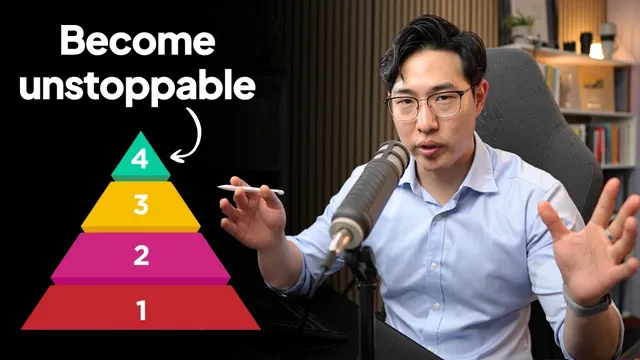
Productivity is best treated as four levels—tracking, frontloading, prioritization, and flow—because each level unlocks a different kind of result.
Briefing
Productivity isn’t a single skill—it’s a ladder of four levels, and most people get stuck low enough that work feels chaotic, progress stalls, and stress becomes the default. The core message is that moving from “tracking” to “frontloading,” then to “prioritization,” and finally into “flow” can turn productivity from miserable obligation into controlled, lower-stress execution. Once all four levels are mastered, the payoff isn’t just more output; it’s more freedom—less overwhelm, more career momentum, and a process that can feel enjoyable rather than punishing.
At Level 1, “tracking,” people operate on vague mental awareness of responsibilities and then measure success by whether they feel behind or on top. The result is constant overwhelm and little control, especially when responsibilities multiply. The fix is visibility: shift from mental tracking to explicit tracking by writing down a day-by-day timeline of how time is actually spent. A key benefit of this exercise is that it reveals hidden time sinks (like commuting) and exposes “gaps” where time disappears—often into procrastination disguised as quick scrolling. The transcript emphasizes that even people at higher levels should periodically do this to keep the system honest.
Level 2, “frontloading,” is about making tomorrow easier by planning today. Instead of reacting all day, people spend time the night before or over the weekend setting up schedules, to-do lists, and structures that reduce decision fatigue. The goal is clarity: tasks should have start and end points, and schedules should specify what’s being worked on rather than vague blocks. Techniques like maintaining an ideas collection help prevent random thoughts from hijacking focus.
Yet Level 2 can still feel crushing. The problem isn’t the planning method; it’s the natural trap of overstuffed schedules. When too many items keep getting pushed back, the to-do list becomes a growing backlog of “debt,” and the daily plan starts to feel like proof of failure. The transition out of this trap is Level 3.
Level 3, “prioritization,” is where productivity starts feeling easier because progress becomes visible. It requires choosing what to say no to—knowing that every yes blocks something else. This is difficult because many “no” choices are still genuinely important; they’re just not the most important right now. A practical coaching framework is that prioritization is about tasks, not values: even if family matters, not every family-related task can outrank every other task every day. Balance comes from letting priority order fluctuate day to day, so “no” becomes “not right now,” without guilt.
Level 4 is “flow,” described as deep work that can be triggered consistently rather than sporadically. The transcript frames flow as the state where time flies, concentration peaks, and work feels almost effortless—yet it depends on strong inputs: removing distractions and creating an “auditory focus bubble.” Tactics include using phone do-not-disturb, coordinating with others using a visible “do not disturb” signal (like a sticky note), and using white noise. The transcript highlights Brain.fm, a focus-music app that uses neural phase locking to push the brain toward deep focus, with claims of consistency even for ADHD. The overall takeaway: the biggest gains come not from better scheduling, but from knowing what to do—and then repeatedly entering flow once the right work is chosen.
Cornell Notes
Productivity is organized into four levels: tracking, frontloading, prioritization, and flow. Level 1 (“tracking”) creates overwhelm because people only loosely monitor responsibilities; explicit time tracking reveals hidden time sinks and unexplained gaps. Level 2 (“frontloading”) reduces daily friction through planning and systems, but it can still fail when schedules become an ever-growing backlog. Level 3 (“prioritization”) brings meaningful progress by forcing hard choices—saying no to important tasks so the most important work moves forward. Level 4 (“flow”) delivers the highest-quality output by enabling consistent deep focus, supported by distraction control and auditory focus tools like Brain.fm.
Why does Level 1 (“tracking”) often feel miserable, even when someone is trying hard?
What does “frontloading” at Level 2 change about daily work?
Why can Level 2 still leave someone overwhelmed even with good planning?
What makes Level 3 (“prioritization”) feel difficult—and what’s the practical mindset shift?
How does Level 4 (“flow”) differ from earlier levels, and what helps trigger it consistently?
Review Questions
- If someone’s schedule keeps growing into a backlog, which level is most likely the bottleneck, and why?
- What’s the difference between “values” and “tasks” in the prioritization framework described for Level 3?
- What specific environmental and auditory steps are recommended to trigger flow at Level 4?
Key Points
- 1
Productivity is best treated as four levels—tracking, frontloading, prioritization, and flow—because each level unlocks a different kind of result.
- 2
Explicit time tracking (writing down a timeline) reveals hidden time sinks and unexplained gaps that mental tracking misses.
- 3
Frontloading reduces daily friction by planning the day before or over the weekend with clear, specific tasks and schedules.
- 4
Overstuffed schedules at Level 2 naturally turn into a growing backlog; that’s a signal to move to Level 3 rather than keep tightening the same system.
- 5
Level 3 prioritization requires saying no to important tasks; balance comes from letting priority order shift day to day while treating “no” as “not right now.”
- 6
Flow at Level 4 depends on consistent deep focus, supported by distraction control and an auditory focus bubble.
- 7
Brain.fm is presented as a focus-music tool using neural phase locking to help people enter deep flow quickly and consistently, including for ADHD.