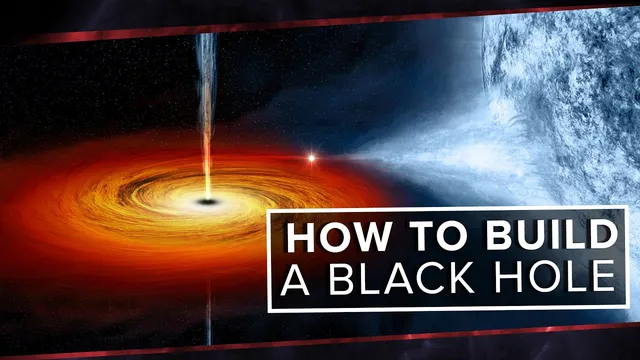
How to Build a Black Hole
Based on PBS Space Time's video on YouTube. If you like this content, support the original creators by watching, liking and subscribing to their content.
A neutron star forms when a collapsing iron core undergoes electron capture, producing a dense ball of neutrons.
Briefing
A black hole forms when a collapsing stellar core becomes compact enough that its radius matches (and then falls inside) the radius of the would-be event horizon—an outcome driven by quantum pressure failing under extreme gravity. The path to that threshold starts with a massive star’s death: fusion builds an iron core, fusion stops because iron fusion absorbs energy, and the core collapses. The collapse forces electrons into protons, creating a neutron star—an object with at least about 1.4 times the Sun’s mass packed into a radius roughly the size of a city, with density comparable to an atomic nucleus.
For a neutron star, quantum mechanics provides the temporary brake on collapse. Neutrons behave as fermions, and the Pauli exclusion principle prevents them from occupying the same quantum state. When the star’s interior is described in six-dimensional quantum phase space (three position dimensions plus three momentum dimensions), the available phase space becomes “completely full,” producing degenerate matter. That filling generates “degeneracy pressure,” a powerful resistance to gravity that keeps the star from shrinking further.
But the Heisenberg uncertainty principle changes the stakes as density rises. Because position and momentum cannot both be sharply defined, confining neutrons to smaller regions forces their momenta to become highly uncertain—meaning the neutrons must occupy a much wider range of momentum values. As the star gets denser, momentum space effectively expands, and the quantum pressure that relied on phase-space filling becomes harder to maintain. The result is counterintuitive: adding mass to a neutron star doesn’t make it expand in position space; quantum effects drive it to shrink in radius while “spreading” in momentum space.
Eventually the neutron star crosses a critical mass where the star’s physical radius and the event horizon overlap. The threshold given is about three solar masses. At that point, the event horizon forms and the neutron star submerges beneath it, sealing off the interior from the outside universe. Once inside, all spacetime paths (geodesics) point inward toward a central region of infinite curvature—the singularity. From the star’s own perspective, collapse is an inward cascade; from the outside observer’s perspective, the horizon is the last meaningful boundary, and the singularity is pushed to an infinitely distant future in external time.
After formation, the black hole’s external influence is largely summarized by a short list of conserved properties: mass, electric charge, and spin. The internal details of the original matter are not preserved in any directly accessible way. Real black holes then evolve rather than remain static: they grow, can radiate (leak), and interact with their surroundings—setting up later discussions about how black holes affect the universe on larger timescales.
Cornell Notes
A black hole forms when a collapsing stellar core becomes so dense that the event horizon appears—when the core’s radius shrinks to match the would-be horizon. Neutron stars resist collapse through quantum effects: Pauli exclusion forces fermions into different quantum states, filling phase space and creating degeneracy pressure. But Heisenberg uncertainty implies that extreme confinement in position space forces large momentum uncertainty, and increasing mass drives the star to shrink in radius rather than expand. Once the neutron star exceeds a critical mass (about three times the Sun’s mass in this account), the event horizon forms and the star disappears from the outside universe. Afterward, the black hole’s outside influence is characterized mainly by mass, electric charge, and spin.
Why does a neutron star resist gravitational collapse before it becomes a black hole?
What role does six-dimensional quantum phase space play in the explanation?
How does the Heisenberg uncertainty principle undermine degeneracy pressure as the star gains mass?
What is the critical condition for event horizon formation in this narrative?
What happens to the collapsing matter once it crosses the event horizon?
Which properties of the original star remain relevant after black hole formation?
Review Questions
- How do Pauli exclusion and Heisenberg uncertainty each contribute to neutron-star stability, and why do they fail differently as mass increases?
- In the explanation given, why does adding mass make a neutron star shrink in radius rather than expand in position space?
- What changes at the critical mass (about three solar masses), and how does that determine what an outside observer can and cannot see?
Key Points
- 1
A neutron star forms when a collapsing iron core undergoes electron capture, producing a dense ball of neutrons.
- 2
Pauli exclusion prevents fermions from sharing the same quantum state, creating degeneracy pressure that initially resists collapse.
- 3
Neutron-star structure is framed in six-dimensional quantum phase space (3D position plus 3D momentum), where degenerate matter corresponds to phase-space being filled.
- 4
Heisenberg uncertainty forces large momentum uncertainty when neutrons are confined to tiny regions, driving momentum-space expansion as density rises.
- 5
Increasing mass shrinks the neutron star’s radius; once it reaches roughly three solar masses, the event horizon forms and the star submerges.
- 6
After formation, the black hole’s external influence is summarized by mass, electric charge, and spin, while internal details become inaccessible.