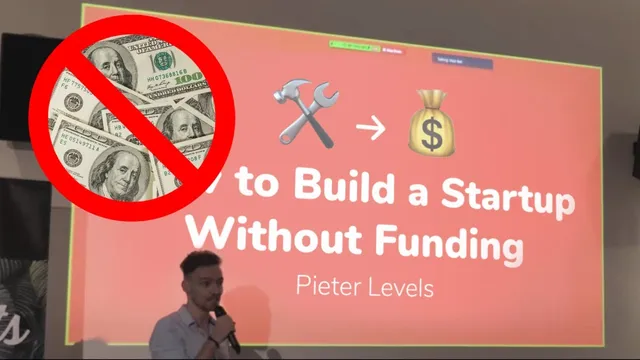
How to Build a Startup Without Funding by Pieter Levels @ Dojo Bali
Based on @levelsio's video on YouTube. If you like this content, support the original creators by watching, liking and subscribing to their content.
Bootstrapping works best when founders start from a real personal problem, not a generic app category.
Briefing
Bootstrapped startups can scale without venture capital by running a repeatable cycle: solve a problem from personal frustration, ship fast with minimal tooling, launch to the right communities for organic traction, monetize early, automate once revenue is stable, and then exit or repeat. Pieter Levels’ core message is that “funding-free” isn’t a limitation—it’s a forcing function that makes execution, validation, and cash flow the center of the process.
Levels’ own path starts with a collapse in income while traveling through Asia after graduating in Holland. His YouTube earnings dropped sharply, and the stress triggered anxiety and panic attacks. Instead of waiting for a stable job, he created a self-imposed sprint: “12 projects in 12 months.” The early projects were mostly fun experiments—like an email-based music playlist tool and a flip-book concept with thin margins—but one product, “Go Fucking Do It,” began generating real money by charging users if they failed a self-set deadline (Stripe-powered, with the charge triggered by a friend’s email response). That shift—from near-zero to hundreds of dollars per month—gave him breathing room and proved that small, targeted products could monetize.
The breakthrough came from accidental virality and crowd-sourced data. A spreadsheet of nomad-friendly cities—built to answer a practical question about where internet is fast and living costs are reasonable—went viral when it leaked publicly. Users added data, turning the spreadsheet into a dataset. Levels then converted it into Nomad List, launching it on Hacker News and Product Hunt, where it reached top rankings. Over time, Nomad List grew into a large, crowd-sourced platform with thousands of cities and hundreds of thousands of data points, supported by membership fees.
From there, the pattern hardened into a framework. First, idea selection: don’t chase generic app categories; look for what’s missing in daily life and what personally annoys you. Second, build strategy: avoid coding boot camps and instead learn to code “just in time” by using Google, YouTube, Stack Overflow, and direct problem-solving. Levels argues for a prototype window of about one month—good enough to validate—because long development without users is a common failure mode.
Third, launch tactics: use platforms like Product Hunt, Hacker News, Reddit, and niche forums, but treat them as conversations rather than ad channels. Product Hunt timing matters (Pacific time), visuals and slogans should be clear, and comments should be handled like a human. Hacker News and Reddit require frank, non-spam posting; niche subreddits and targeted communities can produce higher conversion.
Fourth, growth philosophy: prioritize organic growth over bots, follow/unfollow schemes, and paid spikes that fade when spend stops. Levels also recommends building with users—using feedback boxes to collect feature requests and fix issues quickly—then re-engaging later via newsletters or alerts. Fifth, monetization: get the first dollar within weeks (ideally during launch) and validate willingness to pay using pricing pages, “buy buttons,” and even fake checkout tests that don’t collect real card data. He highlights business models where the main product can be free while revenue comes from premium features, memberships, sponsorships, or patron-style support.
Finally, once revenue exists, automate. Levels describes running hundreds of “robots” (scheduled cron jobs and parallel processes) to handle tasks like data updates, job scraping, and refunds, with a single human on standby for monitoring. The cycle ends with an “exit” option—selling when growth and revenue multiples make sense—or repeating the process with new problems. The overall takeaway is blunt: without cash flow, validation is incomplete; with automation and organic traction, a solo founder can build durable businesses without venture capital.
Cornell Notes
The central playbook is a bootstrapped startup cycle: pick a problem you personally feel, build a small prototype quickly, launch into communities for organic traction, monetize early to validate willingness to pay, then automate operations once the product is working. Levels’ examples—especially Nomad List—show how crowd-sourced data and community launches can turn a simple spreadsheet into a membership business. He argues against long coding boot camps, recommending “learn to learn” via Google and just-in-time problem solving. Growth should come from real users and feedback loops, not bots or paid spikes that disappear when spending stops. Automation (robots/cron jobs) can then keep the business running with minimal human effort, enabling scale without hiring teams.
How did Levels turn personal frustration into a monetizable startup, and what role did “small” products play?
Why did Nomad List take off, and what specific launch/community choices mattered?
What’s the “build” philosophy behind his coding advice—especially his stance on boot camps?
How should founders launch when they want organic growth rather than spammy traffic?
What does “monetize early” look like in practice, including his validation experiments?
How does automation change the founder’s role after growth and revenue arrive?
Review Questions
- What personal problem did Levels use as the starting point for Nomad List, and how did that problem shape the product’s data model?
- Why does Levels believe organic growth is a better validation signal than paid spikes or bot-driven traffic?
- What are the risks and ethical boundaries of using fake checkout/payment tests to validate willingness to pay?
Key Points
- 1
Bootstrapping works best when founders start from a real personal problem, not a generic app category.
- 2
Ship many small projects quickly; let “what sticks” determine where to invest deeper effort.
- 3
Learn to code through just-in-time problem solving (Google, Stack Overflow, direct iteration) rather than waiting for boot camp timelines.
- 4
Validate with launches in the right communities, using honest participation and clear presentation—not spam or marketing-only posts.
- 5
Treat monetization as validation: aim for the first dollars within weeks and test willingness to pay with pricing pages or feature-level buy buttons.
- 6
Prioritize organic growth and user feedback loops; bots and paid spikes can create misleading traction that fades when spend stops.
- 7
Automate after revenue is proven, then shift the human role to monitoring and rapid fixes rather than constant manual operations.