How to Build a Teleporter with Aliens
Based on minutephysics's video on YouTube. If you like this content, support the original creators by watching, liking and subscribing to their content.
Teleporter engineering between civilizations requires shared definitions of units that don’t depend on local artifacts.
Briefing
Building a teleporter for aliens near Alpha Centauri runs into a basic problem: humans and outsiders can’t rely on shared physical artifacts or local standards. If one side says “make an arc 300 cubits long,” the other side needs the same definition of a cubit—or the result won’t match. The solution is to communicate using universal, idea-based definitions of matter, time, and distance rather than Earth-specific objects.
The groundwork starts with “materials” defined at the level of atoms and molecules. Instead of shipping a vial of lithium, the message would specify the atom by its internal structure—“the atom that has 3 protons, 3 neutrons, and 3 electrons.” Water becomes a molecular recipe: “one atom with 8 protons plus two atoms with 1 proton.” With enough of these structure-based descriptions, both civilizations can agree on what to build with, even if they’ve never met.
Next come clocks, again defined by reproducible quantum behavior. A second can be specified by instructing the aliens to use a particular atom (55 protons and 78 neutrons) and measure the time it takes for a photon emitted in a defined way to oscillate 9,192,631,770 times. Distances follow the same pattern: define the meter by how far light travels in 1/299,792,458 of a second. In principle, this gives a complete shared measurement system for time and length.
Mass is where the plan hits a roadblock—literally, because the current kilogram is tied to a specific physical chunk of metal stored on Earth. That makes it impossible to define mass to distant aliens using only abstract, structure-based instructions. To fix this, the discussion points to a near-future shift toward redefining the kilogram in terms of constants or atomic properties. Two candidate approaches are highlighted: (1) define the kilogram using a specified number of atoms—described as about 21.5253873 septillion atoms with 14 protons and 14 neutrons; or (2) define it by the mass lost when an atom or molecule emits light, where the photon’s oscillation frequency is about 135.6392534 septillion septillion times per second. The “pile of atoms” method sounds simpler, but it’s described as harder and more expensive to implement.
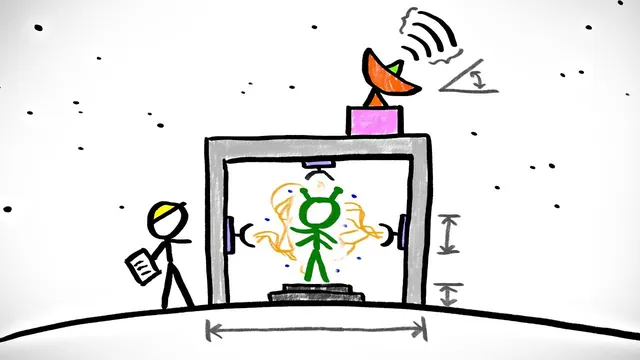
Once mass can be communicated as an idea rather than an object, the teleporter design can proceed using consistent definitions across worlds. The end goal is a wormhole teleporter that allows visits between Earth and Alpha Centauri—followed by diplomacy over dinner—and a symbolic payoff: showing the former metal artifact that used to serve as the mass standard.
Cornell Notes
A shared teleporter project with aliens requires a shared measurement language. Atoms and molecules can be specified by particle counts (protons, neutrons, electrons), enabling “materials” to be defined without shipping objects. Time and distance can be defined through reproducible physical processes: a second via a photon oscillation count (9,192,631,770) and a meter via light travel in 1/299,792,458 of a second. Mass is the sticking point because the kilogram is currently tied to a specific metal artifact on Earth. A proposed fix is to redefine the kilogram using either a fixed number of atoms (about 21.5253873 septillion atoms with 14 protons and 14 neutrons) or mass loss tied to a photon frequency (about 135.6392534 septillion septillion oscillations per second).
Why can’t a teleporter blueprint rely on Earth-specific units like “cubit” or a stored kilogram artifact?
How can “materials” be communicated without sending physical samples?
What makes the proposed clock definition workable for distant civilizations?
How is the meter defined in this idea-based system?
Why is mass the hardest quantity to standardize, and what two redefinition routes are mentioned?
How does solving the mass-definition problem enable the wormhole teleporter plan?
Review Questions
- What measurement quantities can be defined using universal physical processes, and which one is blocked by reliance on a physical artifact?
- Compare the two proposed kilogram redefinitions: what does each one tie the kilogram to, and what practical tradeoff is mentioned?
- How do the atom-based definitions of materials support building a teleporter when neither side has visited the other’s planet?
Key Points
- 1
Teleporter engineering between civilizations requires shared definitions of units that don’t depend on local artifacts.
- 2
Atoms and molecules can be specified by particle counts (protons, neutrons, electrons) to communicate materials across space.
- 3
A second can be defined via a photon oscillation count from a specified atomic transition (9,192,631,770 oscillations).
- 4
A meter can be defined using light travel distance in a fraction of a shared second (1/299,792,458).
- 5
Mass is difficult because the current kilogram is tied to a specific metal object stored on Earth.
- 6
A future kilogram definition can be based either on a fixed number of atoms (about 21.5253873 septillion atoms with 14 protons and 14 neutrons) or on mass loss tied to photon emission frequency (about 135.6392534 septillion septillion oscillations per second).
- 7
Once mass is defined as an idea, consistent engineering instructions become possible for building a wormhole teleporter.