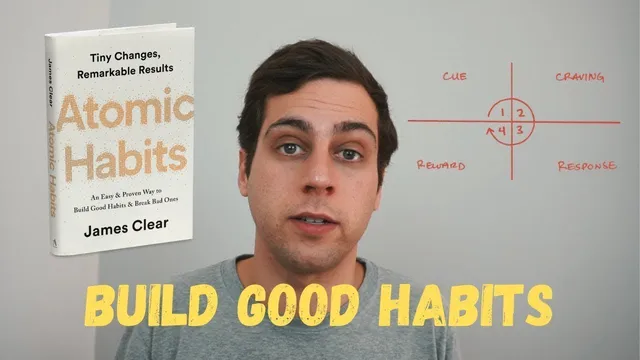
How to Build Good Habits: Atomic Habits by James Clear
Based on Dan Silvestre's video on YouTube. If you like this content, support the original creators by watching, liking and subscribing to their content.
Habits form through a cue → craving → response → reward loop; changing behavior means redesigning that loop.
Briefing
Good habits stick when they’re engineered as a repeatable loop: cue, craving, response, and reward. The core insight is that consistency doesn’t come from willpower alone—it comes from designing the environment and the experience so the right behavior becomes the default. Habits are automatic behaviors that deliver goals efficiently, but they also create stability and security. That’s why habit change matters for health, productivity, and everyday decision-making.
At the center of the framework is the “habit loop.” A cue triggers the brain by signaling a predictable reward. Craving supplies the motivational pull—often not for the behavior itself, but for the improved state it promises. The response is the actual action, and whether it happens depends heavily on friction: the more resistance attached to the behavior, the less likely it is to occur. Finally, the reward closes the loop by satisfying the craving and teaching the brain which actions are worth repeating. If any part of the loop is missing, the behavior won’t become a habit: without cues and craving, the behavior won’t start; without reward, it won’t repeat.
The framework then turns that loop into four practical “laws of behavior change.” First, make habits obvious by strengthening awareness of cues. A quick tool called a habit scorecard helps people list daily habits and label each as good (+), bad (−), or neutral (=), using identity as a tiebreaker: behaviors that align with the person someone wants to become tend to be “good,” while those that conflict tend to be “bad.” To make new habits easier to notice, people can add cues tied to time and location using implementation intentions (“I will [behavior] at [time] in [place]”). Habit stacking pairs a new behavior with an existing one (“After I [current habit], I will [new habit]”), and the best stacks rely on cues that already show up reliably—like stairs, a daily coffee routine, or a specific time of day.
Second, make habits attractive by increasing the pull of the reward. The dopamine mechanism matters here: anticipation of pleasure often drives action more than the final payoff. Temptation building pairs a desired activity with a needed one—for example, listening to favorite podcasts only while running, or playing preferred music only while eating vegetables. A simple planning method pairs “temptations” with “needs” so the brain gets the reward immediately after the effort.
Third, make habits easy by reducing friction and prioritizing action over planning. Motion (preparing and thinking) doesn’t produce outcomes; action does. Two tactics help: prime the environment so the right choice is the default (lay out workout clothes, prep fruits and vegetables), and scale down the habit into a two-minute version so starting is effortless. This introduces “gateway habits,” where the smallest step reliably leads to the larger goal over time.
Fourth, make habits satisfying by ensuring immediate success. What feels rewarding right away gets repeated. That can mean choosing rewards that don’t undermine the new behavior (reward exercise with something like a massage, not ice cream). Habit trackers—physical calendars with checkmarks or digital apps—create visible progress and streaks, reinforcing the identity behind the behavior. If someone misses a day, the rule is “never miss twice”: return quickly to protect the streak. When motivation fails, scaling down again is the fallback. Over time, repeated actions become votes for identity—writing makes a writer, running makes a runner—so habits ultimately shape who someone becomes.
Cornell Notes
The transcript frames habit-building as engineering a repeatable loop: cue → craving → response → reward. Habits form when cues reliably trigger action, motivation is strong, friction is low enough to make the response happen, and the reward is immediate enough to reinforce repetition. Four laws translate the loop into practice: make habits obvious (track and add cues), attractive (use temptation building), easy (reduce friction and scale to a two-minute version), and satisfying (use immediate rewards and habit trackers). Streaks provide feedback, and the “never miss twice” rule helps people recover quickly after setbacks. The payoff is identity: repeated behaviors reinforce the kind of person someone becomes.
What are the four parts of the habit loop, and why does each one matter?
How does a habit scorecard help someone make habits “obvious”?
What’s the difference between implementation intentions and habit stacking?
How does temptation building increase the likelihood a habit sticks?
Why does scaling down a habit (the two-minute version) work?
What makes habits satisfying, and how do streaks and “never miss twice” fit in?
Review Questions
- Which part of the habit loop is most affected by friction, and what practical steps reduce that friction?
- Give one example each of implementation intention, habit stacking, and temptation building—then explain how each one strengthens a different part of the loop.
- How would you design a habit tracker system and apply the “never miss twice” rule after a missed day?
Key Points
- 1
Habits form through a cue → craving → response → reward loop; changing behavior means redesigning that loop.
- 2
Use a habit scorecard to label daily habits as good (+), bad (−), or neutral (=), using identity alignment as the deciding factor.
- 3
Make new habits obvious by adding reliable cues via time/location plans (implementation intentions) and by pairing them to existing routines (habit stacking).
- 4
Make habits attractive by using temptation building—attach a desired reward to the needed action so anticipation drives follow-through.
- 5
Make habits easy by reducing friction: prime the environment and scale the habit down to a two-minute “gateway” version to ensure action starts.
- 6
Make habits satisfying by delivering immediate success through appropriate rewards and by tracking progress with streaks; recover fast using “never miss twice.”