How to build lasting routines with ADHD
Based on Ali Alqaraghuli, PhD's video on YouTube. If you like this content, support the original creators by watching, liking and subscribing to their content.
Start with clarity by defining the routine’s real incentive—social, health, or practical reasons that make daily repetition worthwhile.
Briefing
Lasting routines for ADHD don’t come from willpower or rigid “discipline.” They come from building the right routine for the right incentive—and then engineering an environment and system that makes the routine easy to start, hard to derail, and fast to recover when it slips.
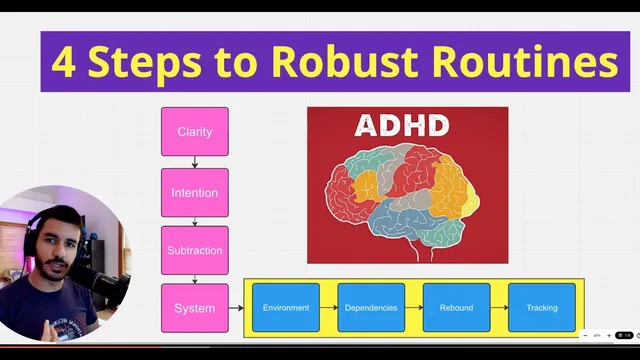
The foundation starts with clarity: people often skip the most basic question—why the routine matters. Wanting a routine because it looks impressive on social media (like waking up to do 100 push-ups) usually fails because there’s no internal reason to sustain it. The teeth-brushing example is used to show what real incentives look like: better breath, healthier teeth, and smoother social interaction. If the “why” isn’t strong, the routine never gets the mental fuel to survive normal distractions.
Next comes intention, framed as a concrete commitment to start at a specific time, in a specific place, and in a specific setting. Vague goals (“I should do this”) don’t reliably trigger action, especially for people who struggle with starting. Implementation intention—telling oneself exactly when and where to begin—reduces friction at the moment the routine needs to start.
The third step is subtraction, the move most people miss. Even when clarity and intention are present, routines collapse if something more dopamine-rich is within reach. A personal example centers on evening planning: the plan was to sit down at 10 p.m., but the phone pulled attention away until midnight. The fix wasn’t changing the routine—it was removing the competing stimulus by deleting social media apps, reorganizing the phone, and blocking distractions so the routine had the attention bandwidth it needed.
After subtraction, the routine must be turned into a system with four parts. First, optimize the environment so the next action is obvious—like toothbrush and toothpaste placed where they can’t be missed. This matters more for ADHD because clutter and weak cues increase distractibility. The retainer example shows “habit stacking”: placing the retainer next to the toothbrush so the nightly action automatically cues the next step.
Second, remove dependencies so the routine doesn’t break when circumstances change. A routine that requires a specific toothbrush or a habit tracker pinned to a bedroom wall becomes fragile. Moving tracking to a phone and keeping cues portable makes the routine resilient across locations.
Third, build a rebound plan. Most people respond to a missed day with negative self-talk (“I can’t stick to routines”), which creates a loop of self-doubt and emotional avoidance. Instead, the approach is diagnostic and curious: ask why the routine cracked—was the environment wrong, was a dependency missing, was something distracting, and is the routine still worth doing? This shifts the mindset from criticism to problem-solving and supports iteration.
Finally, tracking is emphasized as essential for improvement, though it’s treated as a topic for a later video. The overall message is iterative engineering: routines will have cracks, but a well-designed system helps them hold up—and bounce back quickly—so they become robust over time.
Cornell Notes
The core claim is that lasting routines for ADHD are built through engineering, not willpower: strong incentives plus a system that makes the routine easy to start, hard to derail, and fast to repair after setbacks. The process begins with clarity (why the routine matters) and intention (when and where to start). Subtraction removes competing distractions—like reorganizing and blocking phone apps that steal attention during evening planning. The system then relies on environment cues, removing dependencies so routines work across locations, and a rebound plan that replaces self-criticism with a diagnostic, curious mindset. Tracking supports iteration, though it’s deferred for deeper coverage later.
Why does “clarity” come before motivation or discipline in building routines?
What does “intention” mean here, and how does it help with starting?
What is “subtraction,” and why is it described as the step most people miss?
How do environment optimization and “habit stacking” make routines more reliable?
What does it mean to remove dependencies, and why does it prevent routines from becoming fragile?
How should someone respond when a routine breaks—what’s the rebound plan?
Review Questions
- Which part of the routine-building process is meant to strengthen the incentive, and what example is used to illustrate it?
- How does subtraction differ from simply “trying harder” to follow a routine?
- What are two ways the system reduces fragility when routines are attempted in different environments?
Key Points
- 1
Start with clarity by defining the routine’s real incentive—social, health, or practical reasons that make daily repetition worthwhile.
- 2
Use intention by specifying the exact time and place to begin, turning vague goals into concrete start conditions.
- 3
Apply subtraction by removing or blocking competing distractions that deliver more immediate dopamine than the routine.
- 4
Optimize the environment so the routine cue is obvious and in front of you, especially in clutter-prone settings.
- 5
Remove dependencies so the routine works across locations and doesn’t rely on one specific object or one fixed place.
- 6
Build a rebound plan that replaces self-criticism with a diagnostic checklist to identify what broke and how to fix it.
- 7
Track progress to support iteration and routine robustness over time, with tracking treated as a separate deeper topic.