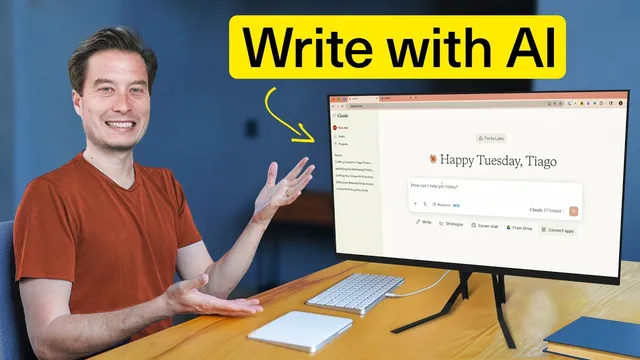
How to Build Your AI Writing System: The FULL Walkthrough
Based on Tiago Forte's video on YouTube. If you like this content, support the original creators by watching, liking and subscribing to their content.
Train a style guide on real, recent writing samples that match the author’s current voice and structure, using enough text for the model to learn patterns.
Briefing
A practical AI writing system can scale output without scaling time by turning writing into a loop: train a style guide from real samples, force the model to follow an implementation workflow, and then feed back every new draft into the guide so it improves over time. The core move is to treat “style” as a structured, prioritized set of rules backed by examples—not as vague preferences—and to pair that with a step-by-step prompt sequence that gathers the missing content (topic, tension, arguments, objections, visuals) before drafting.
The process starts with selecting writing samples that mirror how the author communicates today. In the walkthrough, 20 recent long-form essays—nearly 70,000 words—are pulled into Claude using a Chrome extension called One Tab. The samples are limited to public professional writing so the model learns a consistent voice and level of formality. The author then asks Claude to generate a comprehensive AI writing style guide based on those texts. The first version is described as “fine” but too abstract, so the guide is refined to include concrete examples and counterexamples for each guideline. The result is a much more usable document, but it becomes long enough to introduce a new failure mode: prioritization.
As the style guide grows to roughly 10,000–15,000 words, sections can contain multiple principles with no clear hierarchy. That matters because writing is inherently hierarchical—deciding what comes first in a paragraph (a provocative “what if” question, the compounding benefits, or an expanding-possibilities frame) changes the entire piece. To fix this, the author re-prompts the model to rank-order each set of guidelines within each section from most foundational and nonnegotiable to least important. With that ordering in place, the model is expected to emphasize top-ranked rules during drafting and treat lower-ranked items as secondary.
A style guide alone isn’t enough, because an AI asked to “write an essay” will otherwise “charge ahead” without knowing what to say. The second critical tool is an implementation guide appended to the style guide: a sequence of prompts that asks the author for one input at a time—topic, central tension or paradox, systems/frameworks (if relevant), cross-domain connections, real-world applications, objections (optional), and whether to include a visual. The workflow is tailored rather than generic; for instance, the tension/paradox step is included because it matches the author’s writing approach.
To make the system reusable, the style guide is downloaded as standalone markdown and uploaded into a project workspace labeled “AI writing system.” That project context becomes the environment where new drafts are generated. In the example test, the author drafts a piece comparing early hiphop production—specifically the invention of drum machines—to today’s creativity and generative AI. They paste extensive book excerpts (from Dillot Time by Dan Charis and Jeff Perez) into Claude, answer the implementation questions, and even delegate framework-building to the model once the source context is provided. The draft comes out around 1,800 words, with the author estimating time savings from roughly 20 hours down to about 10.
The final—and most distinctive—feature is self-improvement. After reviewing a draft, the author identifies a line that feels “corny” and AI-like, then converts that mistake into a new guideline by adding a section to the style guide inside the project using “copy to project.” The system thus accumulates new rules derived from real outputs, reducing the chance of repeating the same failure in future writing. The takeaway is a four-step template: build a prioritized, example-backed style guide; add an implementation prompt workflow; run drafts inside a project with the guide uploaded; and continuously patch the guide using errors and surprises from each new piece.
Cornell Notes
The system scales writing by combining three components: a style guide trained on real samples, a separate implementation guide that collects the inputs needed to draft, and a feedback loop that updates the style guide after each draft. The style guide is refined to include both examples and counterexamples, then reorganized with a clear hierarchy so the model knows which rules matter most when multiple principles conflict. The implementation guide turns drafting into a guided interview—topic, central tension, frameworks, cross-domain connections, applications, objections, and visuals—so the AI doesn’t “write blindly.” Finally, mistakes become new rules: a “corny” phrase is converted into an added guideline inside the project, making future drafts less likely to repeat the same issue.
Why does the walkthrough emphasize selecting specific writing samples (and how many)?
What problem appears after the style guide becomes very long, and how is it fixed?
What role does the implementation guide play that the style guide cannot?
How does the system become reusable for future writing tasks?
How does the example draft leverage extra context beyond the style guide?
What makes the system “self-improving,” and how is improvement actually implemented?
Review Questions
- How does prioritizing guidelines within each style-guide section change the model’s drafting behavior when multiple rules could apply?
- What inputs does the implementation guide collect, and why does that prevent the AI from writing without the author’s intended perspective?
- Describe the difference between correcting a draft manually and converting a mistake into a new style-guide guideline using the project workflow.
Key Points
- 1
Train a style guide on real, recent writing samples that match the author’s current voice and structure, using enough text for the model to learn patterns.
- 2
Refine the style guide to include both examples and counterexamples so rules are actionable and failure modes are explicit.
- 3
Add a hierarchy to the style guide by ranking guidelines within each section from nonnegotiable to optional to prevent prioritization drift.
- 4
Use a separate implementation guide to collect topic-specific inputs (especially central tension/paradox) before drafting so the AI doesn’t write “blind.”
- 5
Run drafting inside a project workspace that stores the latest style guide as project knowledge, making the system reusable across topics.
- 6
Convert recurring mistakes from drafts into new style-guide sections using “copy to project,” creating an ongoing feedback loop that improves future outputs.