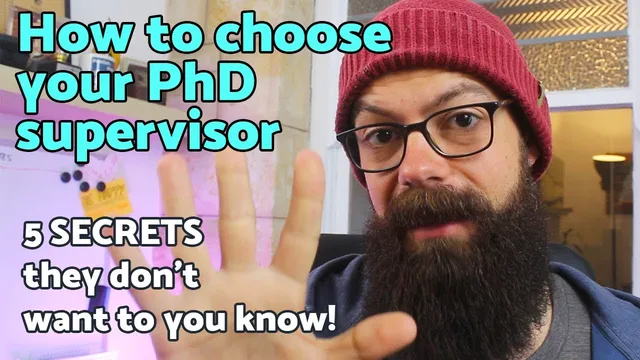
How to choose your PhD supervisor | 5 secrets they won't tell you
Based on Andy Stapleton's video on YouTube. If you like this content, support the original creators by watching, liking and subscribing to their content.
Treat the supervisor relationship as a make-or-break factor because daily communication and working style directly affect research consistency, output quality, and mental well-being.
Briefing
Choosing a PhD supervisor can determine whether a doctorate feels sustainable—or mentally draining—because the day-to-day student–supervisor relationship shapes consistency, research quality, and well-being. The core message is blunt: if the working dynamic breaks down, it can derail progress, slow output, and harm mental health. A PhD runs on steady effort, and a supervisor who blocks that rhythm—whether through poor communication, unhelpful behavior, or personality clashes—creates real damage beyond academic logistics.
The first practical step is to evaluate research fit by looking beyond reputation. Instead of relying on staff profile pages or news coverage, the guidance is to search Google Scholar for the supervisor’s most recent peer-reviewed papers and read the introductions and abstracts for relevance to the student’s interests. Downloading papers and scanning the current direction of the group helps identify whether the work is actually aligned with what the student wants to study. The transcript also emphasizes that supervisors and academics often have copies of their own papers and may share them directly if asked.
Next comes due diligence through people who already live in the lab. By using author lists on recent papers, students can identify current PhD students, postdocs, or recently graduated researchers in the group—then ask pointed questions about organization, time availability, support, and whether students feel appreciated. The underlying warning is that academics are still people: some are disorganized, overpromise, underdeliver, or become less accessible as their own success grows and travel and commitments expand. A key counterintuitive claim is that top publication success does not guarantee good supervision; in some cases, highly successful professors may have less time and more ego-driven behavior.
Personality and crisis behavior matter just as much as expertise. A suggested test is to meet for a coffee and observe how the person engages when not everything is going well—because competitive, grant-driven environments can bring out harshness when papers are rejected or collaborations fail. The transcript describes supervisors who can become volatile, even cruel, under pressure, and argues that a person who seems caring and present in a calm conversation is more likely to remain workable during setbacks.
Compatibility then turns those impressions into concrete expectations. Students should ask how the supervisor manages work—hands-on versus hands-off, micro-managing versus delegating, and expectations around lab time (including weekends) and support for life constraints like international travel. The relationship is framed as reciprocal: supervisors need students for output, grants, and papers, especially as students shift from learning to producing mid-PhD.
Finally, the transcript recommends considering co-supervisors as risk management. A primary supervisor can be the more established lead, while a carefully chosen co-supervisor provides backup if the primary relationship becomes strained or unbalanced. The overall takeaway is to avoid rushing the decision, treat lecturer quality as separate from supervision quality, and choose based on research alignment, interpersonal fit, and realistic expectations—so the PhD doesn’t start with surprises once the academic world’s pressures arrive.
Cornell Notes
A PhD succeeds or fails largely through the daily student–supervisor relationship, which affects consistency, research output, and mental well-being. To choose well, students should verify research fit using the supervisor’s most recent peer-reviewed papers (via Google Scholar) and read introductions/abstracts for alignment with their interests. They should also gather “inside” information by contacting current or recently graduated PhD students and postdocs from the supervisor’s author lists, asking about organization, time, and whether students feel supported. A coffee meeting can reveal personality and crisis temperament, while compatibility questions clarify expectations like lab hours, management style, and support for personal constraints. Adding a co-supervisor can provide insurance if the primary supervisor’s style or availability becomes problematic.
Why does the student–supervisor relationship carry so much weight in a PhD?
How can a student assess whether a supervisor’s research is actually current and relevant?
What questions should students ask current or recently graduated lab members?
What does a coffee meeting test for, and why is it not enough to judge by “niceness” alone?
How should students evaluate compatibility beyond personality?
Why consider a co-supervisor, and what role can they play?
Review Questions
- What specific evidence (paper recency, abstract relevance, author-list connections) would you use to test research fit before committing to a supervisor?
- Which expectations—lab hours, management style, travel impact—should you clarify in a compatibility conversation, and what would you do if the answers conflict with your needs?
- How would you decide whether a co-supervisor is worth adding, and what risks would they mitigate in your particular situation?
Key Points
- 1
Treat the supervisor relationship as a make-or-break factor because daily communication and working style directly affect research consistency, output quality, and mental well-being.
- 2
Verify research alignment using the supervisor’s most recent peer-reviewed papers on Google Scholar, focusing on introductions/abstracts rather than reputation or older highlights.
- 3
Reach out to current and recently graduated lab members using author lists to ask concrete questions about organization, time availability, support, and whether students feel appreciated.
- 4
Use a low-stakes meeting (like coffee) to gauge personality and presence, but remember that stress behavior in academia often reveals the real temperament.
- 5
Clarify compatibility by asking about management style (hands-on vs hands-off), micro-management, lab-hour expectations (including weekends), and how the supervisor supports personal constraints.
- 6
Consider adding a co-supervisor to reduce risk if the primary supervisor is unavailable, overly ego-driven, or otherwise mismatched with the student’s needs.
- 7
Don’t assume that being a great lecturer predicts being a great supervisor; grant pressure and research dynamics can change how someone behaves.