How to Communicate Across the Quantum Multiverse
Based on PBS Space Time's video on YouTube. If you like this content, support the original creators by watching, liking and subscribing to their content.
Interpretations of quantum mechanics can be hard to distinguish because they share the same linear Schrödinger equation, which fixes measurement outcomes.
Briefing
Quantum mechanics may be testable—and potentially usable for “telephone”-style communication across quantum branches—if the Schrödinger equation is not perfectly linear. The core idea is that most interpretations of quantum theory (including Many Worlds, Copenhagen, and de Broglie–Bohm) reproduce the same predictions as long as the standard Schrödinger equation holds exactly. That sameness makes it hard to distinguish between interpretations experimentally. The path out of that stalemate is to look for tiny deviations from linearity: even small nonlinear terms could create new, non-local observables in the wavefunction, letting experiments probe what happens after measurement.
The argument starts with a familiar physics analogy: overlapping sound waves can be separated because the medium behaves linearly, allowing superposition. In quantum mechanics, superposition works the same way—wavefunctions add without interfering in a way that changes the evolution of each component. But that clean behavior depends on linearity. If the “rules of the medium” for quantum evolution include nonlinearities, then different components of a superposed state could influence each other. That would undermine the usual claim that other “worlds” in Many Worlds are dynamically isolated.
Steven Weinberg is credited with the first key insight: if the Schrödinger equation contains even a slight nonlinear modification, the wavefunction would acquire extra observables beyond the standard local quantities like position, momentum, and spin. Those additional observables would be non-local—spanning the entire wavefunction—so they could, in principle, reveal whether the wavefunction truly collapses (as in Copenhagen) or persists and branches (as in Many Worlds).
Joseph Polchinski then sharpened the stakes. In a 1991 paper, he showed that almost any nonlinear modification would allow real information to be transmitted between entangled particle pairs—potentially enabling faster-than-light communication and even backward-in-time signaling. The universe’s usual “no superluminal information” constraint would fail. Polchinski also identified a specific nonlinear framework that avoids the worst causality violations while still enabling communication across quantum branches.
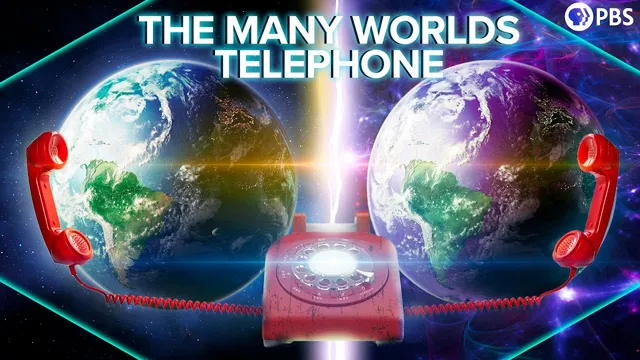
That leads to the “Everett-Wheeler telephone,” a thought experiment designed to send a bit between versions of an observer in different branches. Using a Stern–Gerlach apparatus, one observer chooses whether to prepare an electron in spin-down or spin-up, effectively encoding a bit into the wavefunction. After both branches pass through a hypothetical nonlinear field that spreads information across the entire wavefunction, a later Stern–Gerlach measurement reveals a corresponding flip in the other branch’s outcome—so the observer in the other timeline can infer the bit. The catch is that communication would only work with branches generated by the telephone’s own measurement process.
The transcript closes by emphasizing a stark fork: either quantum mechanics is exactly linear (making these effects vanish), or it is nonlinear (opening the door to exotic signaling), or it supports a branch-to-branch communication mechanism of the Everett-Wheeler type. The segment then pivots to unrelated PBS Space Time viewer questions about astrophysics—how rapidly rotating white dwarfs might arise from mergers versus accretion in post-common-envelope binaries—and to a brief detour on the origin of the “That’s funny” quote often misattributed to Isaac Asimov and others.
Cornell Notes
The discussion centers on why quantum interpretations are hard to test: Many Worlds, Copenhagen, and de Broglie–Bohm all match the same experimental predictions when the Schrödinger equation is perfectly linear. The proposed way to break that tie is to search for tiny nonlinear corrections to the Schrödinger equation. Steven Weinberg argued that nonlinearities would introduce new, non-local observables in the wavefunction, potentially distinguishing collapse from branching. Joseph Polchinski showed that most nonlinearities would enable real information transfer between entangled particles, threatening causality, but he also constructed a scenario that avoids faster-than-light signaling while enabling communication across quantum branches via an “Everett-Wheeler telephone.” Such communication would likely be limited to branches created by the experiment itself.
Why do different interpretations of quantum mechanics tend to produce the same predictions?
How does the sound-wave analogy connect to superposition in quantum mechanics?
What would nonlinear terms in the Schrödinger equation change, according to Weinberg?
What did Polchinski show about nonlinear quantum mechanics and entanglement?
How does the “Everett-Wheeler telephone” transmit a bit between branches?
Review Questions
- What specific assumption about the Schrödinger equation makes different quantum interpretations experimentally indistinguishable in the transcript’s framing?
- Explain, in your own words, why linearity is treated as the condition that preserves superposition without cross-talk between components.
- What is the operational role of the Stern–Gerlach device in the Everett-Wheeler telephone thought experiment?
Key Points
- 1
Interpretations of quantum mechanics can be hard to distinguish because they share the same linear Schrödinger equation, which fixes measurement outcomes.
- 2
Superposition behaves cleanly only when the underlying evolution is linear; nonlinearities would allow different wavefunction components to influence each other.
- 3
Weinberg argued that nonlinear corrections would introduce new non-local observables in the wavefunction, potentially distinguishing collapse from branching.
- 4
Polchinski showed that most nonlinear Schrödinger modifications would enable real information transfer between entangled particles, threatening causality.
- 5
Polchinski also outlined a nonlinear scenario that avoids faster-than-light signaling while still enabling branch-to-branch communication.
- 6
The Everett-Wheeler telephone uses Stern–Gerlach spin measurements plus a hypothetical nonlinear field to transmit a bit between branches created by the experiment itself.