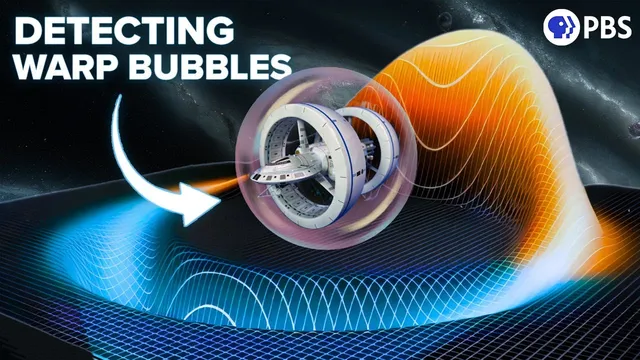
How To Detect Faster Than Light Travel
Based on PBS Space Time's video on YouTube. If you like this content, support the original creators by watching, liking and subscribing to their content.
A warp bubble moving at constant velocity should produce no detectable gravitational waves because spacetime far away remains effectively flat.
Briefing
A future burst of an Alcubierre-style warp bubble—rather than steady “warp cruising”—could generate a distinctive gravitational-wave signal detectable by next-generation observatories, according to a new numerical-relativity study. The key idea is that a warp bubble moving at constant velocity would leave spacetime essentially flat far away and produce no gravitational waves, but the moment the bubble forms, accelerates, slows, or collapses, spacetime curvature changes rapidly enough to radiate gravitational waves. That makes a “warp failure” scenario—whether accidental or a controlled shutdown—one of the most realistic ways for an alien warp technology to leave an observable imprint.
The study revisits the original Alcubierre warp metric from general relativity, which allows superluminal relative motion of spacetime regions by expanding space behind a bubble and contracting it in front. The long-standing obstacle is that the required stress-energy tensor appears to demand exotic matter, including negative energy, and possibly an unknown equation of state to keep the bubble stable over time. Instead of claiming anyone can build such a drive, the researchers ask a narrower, testable question: if a warp bubble exists and then collapses, what gravitational-wave pattern would it produce, and would Earth-based detectors have a chance?
To answer that, the team uses numerical relativity—solving Einstein’s equations step-by-step by slicing four-dimensional spacetime into a sequence of three-dimensional hypersurfaces, like a flipbook. They rewrite the warp metric in terms of quantities defined on each hypersurface and evolve both the geometry and the matter distribution using an assumed equation of state tailored to a failing bubble. Because no known equation of state can sustain the Alcubierre metric, the assumptions are speculative; the point is to learn what gravitational radiation emerges when the engineered configuration breaks.
In the catastrophic collapse model, the bubble first collapses inward, then expands outward at the speed of light. That outward surge is accompanied by a burst of gravitational waves tied to the rapid fluctuations in spacetime curvature. The resulting waveform would look unlike the black hole or neutron star merger signals LIGO has already observed: researchers liken it to a head-on black hole collision, but without the characteristic ringdown tail that occurs as a merged object settles.
Detectability depends on both strain and frequency. For a warp bubble with a 1 km radius traveling at 10% the speed of light, the study estimates a gravitational-wave strain of about 10^-21 at Earth if the event occurred roughly a megaparsec away (around 3 million light-years), or somewhat farther—comparable to the distance of Andromeda. That strain level matches LIGO’s sensitivity threshold, but the predicted signal frequency is around 300 kHz, far above LIGO’s effective range. The paper notes that detectors operating in the mega- to gigahertz band would be needed to catch such high-frequency bursts. Still, a closer event within our galaxy would be “louder,” and faster-than-0.1c motion would strengthen the radiation—though the energy requirements and potential physics pathologies grow severe.
The study also highlights a multimessenger possibility: when the exotic matter disperses after collapse, it could produce both positive and negative energy components, potentially yielding an electromagnetic counterpart alongside the gravitational waves. Even if alien warp bubbles never exist, the work remains useful because it stress-tests general relativity’s edge cases and develops simulation tools for exotic spacetime dynamics.
Cornell Notes
The Alcubierre warp metric predicts that a warp bubble moving at constant velocity would not generate detectable gravitational waves, because spacetime far away stays effectively flat. Gravitational radiation should appear when the bubble’s spacetime geometry changes—especially during formation, acceleration, shutdown, or collapse. A new numerical-relativity study simulates a failing warp bubble by evolving Einstein’s equations on a sequence of 3D hypersurfaces, using speculative assumptions about an equation of state for exotic matter. The collapse produces a burst waveform unlike standard black hole/neutron star mergers, and it could reach strain levels near 10^-21 for a 1 km bubble at 0.1c at megaparsec distances. However, the signal frequency (~300 kHz) sits well above LIGO’s current sensitivity band, pointing instead to future high-frequency gravitational-wave detectors.
Why would a steady warp bubble be “quiet” in gravitational waves?
What makes the Alcubierre warp metric physically difficult even before any detection question?
How does the simulation handle the complexity of evolving spacetime and matter?
What does a bursting warp bubble’s gravitational-wave signal look like compared with known astrophysical events?
Would LIGO detect such a burst from a nearby galaxy?
What multimessenger signal might accompany a warp-bubble collapse?
Review Questions
- What physical change in a warp bubble is most responsible for gravitational-wave emission in the Alcubierre scenario?
- Why does matching strain sensitivity alone not guarantee detectability for the modeled warp-bubble burst?
- How does the predicted waveform differ from the typical ringdown signature seen after black hole mergers?
Key Points
- 1
A warp bubble moving at constant velocity should produce no detectable gravitational waves because spacetime far away remains effectively flat.
- 2
Gravitational waves are expected when the warp field changes over time—especially during formation, acceleration, shutdown, or collapse.
- 3
The study uses numerical relativity by evolving Einstein’s equations on a sequence of 3D hypersurfaces to simulate a failing warp bubble.
- 4
A catastrophic collapse model predicts an inward collapse followed by outward expansion at the speed of light, generating a burst-like gravitational-wave signal.
- 5
The modeled 1 km, 0.1c warp bubble could reach strains near 10^-21 at megaparsec distances, but the signal frequency (~300 kHz) is far above LIGO’s current band.
- 6
Detecting such events likely requires future high-frequency gravitational-wave detectors operating in the mega- to gigahertz range.
- 7
A warp-bubble collapse might also produce an electromagnetic counterpart, making multimessenger searches a key strategy.