How to develop an interview guide in qualitative research (step by step guide with examples)
Based on Qualitative Researcher Dr Kriukow's video on YouTube. If you like this content, support the original creators by watching, liking and subscribing to their content.
Treat the interview guide as a tool for answering the study’s research questions, not as a one-size-fits-all template.
Briefing
A strong qualitative interview guide isn’t built by chasing a universal template—it’s built to help researchers answer their specific research questions. That framing matters because the moment feels high-stakes to newcomers: one “wrong” question can feel like it could ruin the entire study. The practical takeaway is simpler. There’s rarely a single correct interview guide; the real test is whether the questions and prompts reliably support the study’s research questions, and whether the interviewer can judge that fit.
Creativity sits at the center of that process. Participants often don’t withhold information; they forget. People may struggle to recall when they felt something, or what exactly happened at a particular point in the past. So the interviewer’s job becomes less about extracting and more about facilitating memory and reflection. Three techniques anchor that approach. First, use cognitive facilitation: start broad, then narrow; invite reflection on sensory details like sounds and smells to reactivate the experience; and gradually guide participants toward the specific topic of interest. Second, dig around the topic by asking many similar questions from slightly different angles, which helps surface details that a single direct question might miss. Third, use hypothetical questions—imagining an ideal day, a “perfect” scenario, or what someone would do differently—because it reduces pressure and makes people more willing to share beliefs and opinions.
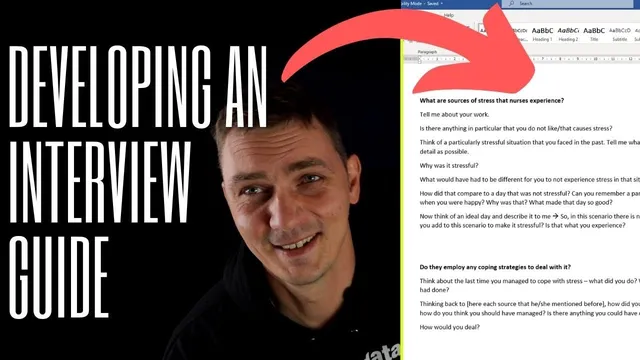
The guide-building process then becomes a workflow. Using a hypothetical study about stress in nurses, the researcher first writes the two core research questions into a blank document: sources of stress and coping strategies. Under each, they brainstorm every relevant question that comes to mind, aiming for breadth and multiple perspectives rather than immediate perfection. For the stress question, the guide begins with general prompts that help participants enter storytelling mode—such as describing their workday or whether they like their job—before moving toward stress triggers. A key move is to start with open-ended recall of a particular stressful day, asking what happened, when, and why it felt stressful, while also probing for theorizing: what would have needed to change for that day to be less stressful? The same logic applies in reverse by asking about a non-stressful or best day, then comparing what made it different.
For coping strategies, the guide collects questions that focus on action and counterfactuals: what participants did to deal with stress, what they wish they had done, what they think they “should” do, and what others might do. The interviewer can also revisit previously mentioned stressors one by one—linking each source of stress to what coping looked like in practice.
After generating a large pool of prompts, the final step is arranging them into a sequence that feels like a natural conversation. The order should generally follow broad-to-specific progression, with initial warm-up questions and closing questions added as needed. Even with a carefully planned guide, the interviewer must remain flexible during the interview—letting participants finish when they drift into relevant territory rather than interrupting to force the script—because participant comfort and responsiveness drive richer data.
Cornell Notes
A qualitative interview guide should be designed to answer the study’s research questions, not to match a rigid universal template. Creativity is essential because participants often forget details; the interviewer’s job is to help them remember through structured prompting. Three techniques support that: start broad and narrow, use sensory reflection (e.g., sounds and smells), dig with similar questions from different angles, and ask hypothetical questions to reduce pressure and elicit beliefs. Building the guide starts with writing the research questions, brainstorming many related prompts under each, then reordering them into a natural broad-to-specific conversation flow. During the interview, flexibility matters: let participants complete relevant thoughts instead of interrupting to follow the planned order.
Why does “creativity” matter when developing an interview guide in qualitative research?
How does starting broad and narrowing down improve recall?
What does “digging around the topic” look like in practice?
Why use hypothetical questions when asking about stress and coping?
How should the guide-building workflow work from draft to final order?
What does flexibility during the interview mean, even with a planned guide?
Review Questions
- Design a mini interview guide for a topic of your choice: what broad-to-specific warm-up questions would you start with, and what would you use to narrow toward your core research question?
- Give an example of how you would use hypothetical questions to elicit coping strategies without requiring participants to disclose everything as a personal experience.
- When reordering prompts, what criteria would you use to decide what comes first and what comes later in a natural conversation flow?
Key Points
- 1
Treat the interview guide as a tool for answering the study’s research questions, not as a one-size-fits-all template.
- 2
Expect newcomers to feel overwhelmed, but recognize that qualitative interviewing allows judgment and adaptation rather than strict correctness.
- 3
Use creativity to address forgetting: prompts should help participants remember rather than assume they are withholding information.
- 4
Apply cognitive facilitation by starting broad, then narrowing, and by inviting reflection on sensory details like sounds and smells.
- 5
Dig around key topics by asking multiple similar questions from different angles to surface overlooked details.
- 6
Use hypothetical questions to reduce pressure and encourage theorizing about beliefs, ideal scenarios, and counterfactuals.
- 7
After brainstorming many prompts, reorder them into a broad-to-specific sequence and stay flexible during the interview when participants raise relevant points early.