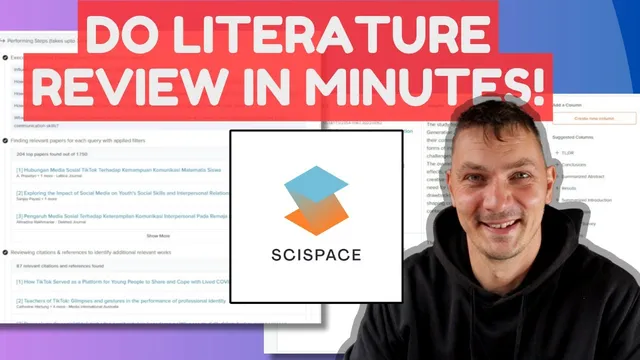
How to do Literature Review FAST with SciSpace
Based on Qualitative Researcher Dr Kriukow's video on YouTube. If you like this content, support the original creators by watching, liking and subscribing to their content.
Deep search prompts users to narrow broad topics into specific research questions before running an extended literature search.
Briefing
SciSpace’s “deep search” (deep review) turns an early, fuzzy literature review into a structured set of findings by acting like an AI research agent: it asks for tighter scope, then runs an extended search across many sources and returns a navigable “table of contents” of themes, plus per-paper summaries with methods and potential research gaps. The payoff is speed—presented as hundreds of times faster than manual sifting—while still requiring the user to read and engage with the underlying papers.
The workflow starts with a broad topic idea, such as the impact of TikTok on youth. Instead of immediately dumping results, deep search prompts the user to narrow the query—e.g., specifying communication skills, targeting teenagers, and clarifying the context. The user can “talk to it like a human,” and the system uses that narrowing to generate relevant search queries and begin a longer processing run. During the run, progress indicators and explanations show what it is doing: exploring multiple angles, searching across different sources, and building a comprehensive review rather than a shallow list.
Once the process finishes, the output is organized into major themes, including positive and negative influence categories, along with other subtopics that help the user quickly understand what the literature says at a high level. This first pass is framed as the most time-consuming part of traditional PhD-style reviewing—getting a feel for the field—yet deep search compresses it into a rapid overview. The results also function like an interactive index: the user can scroll through generated entries (with an example showing “20 out of 171”), open sources, and decide what to read next.
Beyond summaries, SciSpace supports deeper engagement with individual papers. Each article entry includes an “insight” view that roughly captures what the study found—such as an example claiming TikTok videos enhance students’ speaking skills based on observations and interviews—so the user can quickly judge relevance before downloading or reading. For papers behind paywalls, SciSpace can still help with discovery and summarization, while the user can rely on institutional access (university library subscriptions) to obtain full text.
A standout feature is the ability to ask targeted questions about a paper. The transcript highlights follow-up prompts like “What methods were used?” and “Does the article provide any mention of research gaps to be explored?” The gap-finding is described as partly inferential: rather than only quoting explicit “gaps,” the system draws on study design and then suggests what future research could investigate—such as how to integrate school-based learning strengths with TikTok usage more effectively.
Overall, the tool is positioned as a practical accelerator for literature reviews: use deep search to map the field, use per-paper insights to triage what matters, and then use library access and direct reading to verify and extend the work. It’s presented as a paid platform with a free option for exploration, with the suggestion that even a short subscription can be worthwhile for intensive review work.
Cornell Notes
SciSpace’s deep search is designed to speed up literature reviews by narrowing a broad topic into a focused query, running an extended “agent-like” search, and returning an organized set of themes plus paper-level insights. Instead of only listing articles, it produces a table-of-contents-style overview (e.g., positive vs. negative influence) so users can quickly grasp what the field knows. For individual papers, it summarizes key findings and can generate structured details such as methods. It also helps identify research gaps, sometimes by inferring future directions from the study’s design rather than relying solely on explicit “gap” statements. This matters because the early “getting a feel for the literature” step is often the most time-consuming part of research planning.
How does deep search turn a vague topic (like TikTok and youth) into a usable literature review plan?
What does the output look like after deep search finishes, and how does that help triage what to read?
How does SciSpace handle paywalled papers during the review process?
What kinds of questions can be asked about a specific paper, and what kinds of answers are produced?
Why is the “research gaps” output described as more than just quoting what authors wrote?
Review Questions
- When starting a literature review with a broad topic, what narrowing questions does deep search prompt, and why are they important?
- How does the system’s theme-level overview (table-of-contents style) change the way a researcher selects which papers to read first?
- What is the difference between explicit research gaps and gaps inferred from study design, based on the examples given?
Key Points
- 1
Deep search prompts users to narrow broad topics into specific research questions before running an extended literature search.
- 2
The process runs longer than basic search and provides progress-style explanations of what queries and sources are being explored.
- 3
Results are organized into theme categories (such as positive vs. negative influence) to help users quickly map the field.
- 4
Per-paper “insight” summaries let users triage relevance before downloading or reading full text.
- 5
SciSpace can summarize paywalled papers, while full access can be obtained through university library subscriptions.
- 6
Questioning individual papers can generate structured details like methods and research-gap suggestions, sometimes inferred from study design.
- 7
A short paid subscription can be positioned as cost-effective for intensive literature-review sprints, with a free option for initial exploration.