How To Earthquake-Proof A House
Based on Veritasium's video on YouTube. If you like this content, support the original creators by watching, liking and subscribing to their content.
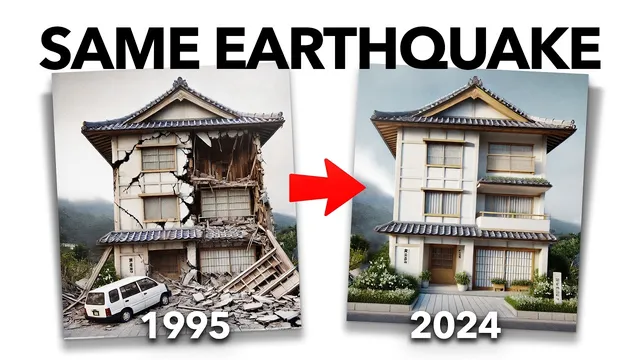
E-Defense was funded after the 1995 Kobe earthquake, where building collapse accounted for over 80% of deaths.
Briefing
Japan’s 1995 Kobe earthquake—despite a “only” magnitude 6.9—killed more than 6,000 people and left hundreds of thousands homeless, with over 80% of deaths tied to building collapse. That outcome pushed Japanese authorities to fund a research effort aimed at making structures survive shaking, and it produced E-Defense, the world’s largest earthquake simulator. The facility’s central shake table can test full-scale building components under realistic earthquake motions, helping engineers identify what makes buildings resist collapse and what still fails inside otherwise standing structures.
E-Defense was built after scientists and policymakers concluded that better disaster prevention required controlled, repeatable experiments using real seismic records. The shake table itself is a 20-meter by 15-meter platform weighing about 800 tons, driven by hydraulic actuators on multiple sides and additional actuators beneath it to move the table vertically. In practice, the system can apply accelerations up to 15 meters per second squared—over 1.5 g—while handling test masses up to 1,200 tons. Achieving that kind of force for minutes at a time depends on large nitrogen pressure reserves. Liquid nitrogen is converted to gas in storage tanks, then transferred into oil via pistons, allowing the actuators to deliver consistent pressure throughout a test rather than fading as the run continues.
The facility also solves a key engineering constraint: actuators can only move in one direction, so E-Defense uses bespoke seven-meter universal joints to transfer motion without over-stressing the system. To reproduce earthquakes faithfully, researchers feed the table seismic signals recorded by instruments such as geophones—devices that convert ground motion into electrical signals using a coil, magnet, and springs. Because earthquakes vary in both intensity and duration, E-Defense runs different recorded waveforms: the Kobe event lasted about 20 seconds with high peak acceleration, while the 2011 earthquake produced much longer shaking. Those differences matter for design, since a building can fail from short, violent pulses or from prolonged stress.
Results from early tests helped quantify the value of modern construction. After E-Defense opened in 2005, researchers compared two traditional Japanese wooden houses shaken at Kobe-level intensity: one retrofitted with braces, beams, and metal joints, and one left unmodified. The retrofitted house stayed up, while the unmodified one demonstrated that older housing systems were not adequate for powerful earthquakes. The data aligned with building-code changes introduced in 1981, which required seismic dampening and isolation features; in Kobe, post-1981 houses had dramatically lower collapse rates than older stock.
E-Defense’s work extends beyond preventing collapse to preserving function during and after shaking. Indoor injuries in Kobe were often caused by furniture and fixtures falling, so tests include realistic “contents” inside structural specimens to study how to reduce secondary hazards. The next frontier is keeping buildings operational: even when structures don’t collapse, burst pipes and lost utilities can force residents to leave. With seismologists estimating a 70% chance of a magnitude 8 earthquake near Japan’s Tokai region within 30 years, the stakes are clear—E-Defense is built to turn uncertainty about timing into preparedness about performance.
Cornell Notes
E-Defense was created in response to the 1995 Kobe earthquake, where a magnitude 6.9 quake caused thousands of deaths largely through building collapse. The facility uses a massive shake table—driven by hydraulic actuators and powered by nitrogen pressure reserves—to reproduce real earthquake motions recorded by geophones. Experiments comparing older and code-upgraded wooden houses showed that relatively inexpensive reinforcement (braces, beams, metal joints) can dramatically improve survival. Beyond structural collapse, researchers also test how interior hazards like falling furniture injure people and how to prevent “functional loss” such as burst pipes and power outages. The work matters because Japan cannot predict the next major quake, but it can design buildings to perform better when it arrives.
Why did Kobe’s earthquake produce so many casualties even though its magnitude was 6.9?
How does E-Defense generate realistic earthquake shaking at full scale?
What did the house-comparison tests reveal about earthquake resistance in Japan?
Why do earthquake duration and waveform shape matter for design?
What problem comes after preventing collapse—keeping buildings usable?
How do researchers address injuries caused by things inside buildings?
Review Questions
- What engineering components allow E-Defense to apply precise, repeatable forces for long shake durations without losing pressure?
- How do the Kobe and 2011 earthquake shaking characteristics differ, and why would that change design priorities?
- What evidence from the wooden-house tests supports the effectiveness of post-1981 building-code upgrades?
Key Points
- 1
E-Defense was funded after the 1995 Kobe earthquake, where building collapse accounted for over 80% of deaths.
- 2
The shake table can test full-scale loads up to 1,200 tons and apply accelerations up to 15 m/s² (over 1.5 g).
- 3
Nitrogen pressure reserves enable consistent actuator force throughout multi-minute tests by converting liquid nitrogen to gas and transferring pressure to oil.
- 4
Bespoke universal joints transfer actuator motion to the shake table, preventing mechanical stress from one-direction actuator limits.
- 5
Real earthquake waveforms are replayed using recorded seismic signals from geophones, capturing both intensity and duration differences across events.
- 6
Post-1981 building-code features and retrofits (braces, beams, metal joints) sharply improved survival in controlled house comparisons.
- 7
Earthquake preparedness must address functional loss and interior hazards, since non-collapsed buildings can still fail via burst pipes and falling furniture.