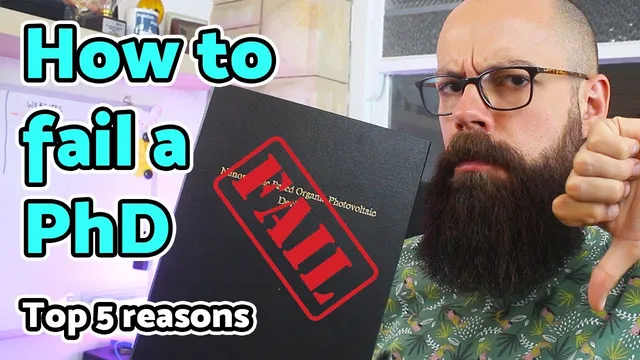
How to fail a PhD | 5 key things to avoid!
Based on Andy Stapleton's video on YouTube. If you like this content, support the original creators by watching, liking and subscribing to their content.
Academic rigor must show up in daily decisions, because examiners judge the thesis as evidence of careful thinking even without seeing the process.
Briefing
Failing a PhD isn’t just about doing experiments or writing papers—it’s about convincing a small panel of expert examiners that the work proves the candidate has become an expert in a narrow slice of a field. That conviction is judged largely through the thesis itself: a “big, thick, boring” document that outsiders (and examiners) will actually read. Because examiners weren’t present for the day-to-day process, any lack of rigor shows up indirectly—through sloppy decisions, weak reasoning, or results that feel “dodgy.” The core takeaway is simple: academic rigor and consistent effort aren’t optional, because the final product must make strangers feel confident.
The first and most damaging failure mode is cutting corners, even when the shortcuts seem minor. Skipping careful lab practices, not reading enough in literature-heavy work, or being less rigorous in small decisions can compound over time. Examiners may not know what was skipped, but they can still detect the outcome: work that doesn’t reflect careful thinking. The second failure is failing to show up—missing lab time or not putting in sustained hours for months at a stretch. One cited case involved a student who didn’t attend for roughly three months at the start; another showed the opposite pattern, attending for about six months and then disappearing. The message is that a PhD’s timeline can feel long early on, but the “catch-up” cost becomes brutal later.
The third failure is choosing the wrong examiners. Near submission, supervisors recommend examiners who are experts in relevant areas, but politics and personal perceptions can matter. If an examiner’s expertise doesn’t align with the thesis’s core components—or if there’s existing friction between supervisors and examiners—review may become less favorable. The transcript gives an example where examiners spanned colloid/surface science and solar-cell-related expertise, allowing each examiner to rigorously assess the parts they understood best.
The fourth failure is poor time management and project management. Three or four years can vanish quickly, and candidates who “take their foot off the gas” early often spend the final stretch panicking to recover lost progress. The recommended countermeasure is building milestone checkpoints—decision points at the end of year one and year two—to evaluate what’s working, what isn’t, and where to double down or pivot. Research uncertainty remains, but consistent work and structured review prevent wasted time.
The fifth failure is staying at the level of reporting rather than synthesizing. Examiners need to feel that the candidate has drilled into what the results mean, not merely logged what was done and what was found. A thesis must turn evidence into an argument in the candidate’s own words—covering significance, limitations, and the boundaries of claims—so the panel feels comfortable awarding a PhD to someone who now owns that narrow topic as an authority. In short: rigor, presence, smart examiner selection, disciplined planning, and deep synthesis are the difference between a thesis that convinces and one that fails to earn trust.
Cornell Notes
A PhD is judged by whether examiners—strangers to the day-to-day process—feel confident that the candidate has become an expert in a narrow research slice. That confidence comes from the thesis, which must reflect consistent academic rigor, sustained effort, and careful thinking rather than shortcuts or uneven attendance. Candidates can fail by cutting corners, not showing up for months, choosing examiners who don’t align well (or who are politically unlikely to be receptive), and letting time management collapse early. Even strong experiments can fall short if the thesis only reports results instead of synthesizing their meaning, significance, and limitations into a clear, evidence-based argument.
Why does “cutting corners” early in a PhD increase the risk of failing later?
What does “showing up” mean in practice, and why is it framed as a major failure point?
How can examiner choice affect outcomes even when the thesis is strong?
What project-management approach helps prevent end-of-PhD panic?
What distinguishes a thesis that convinces examiners from one that merely documents work?
Review Questions
- Which failure modes in the transcript are primarily about process (daily rigor, attendance, planning) versus primarily about thesis construction (synthesis and argument)?
- What milestone checkpoints would you set for a hypothetical year-one and year-two plan, and what decisions would trigger a pivot?
- How would you evaluate whether a proposed examiner is a good fit for your thesis’s core claims and methods?
Key Points
- 1
Academic rigor must show up in daily decisions, because examiners judge the thesis as evidence of careful thinking even without seeing the process.
- 2
Cutting small corners early can compound into a thesis that feels less reliable or less carefully reasoned.
- 3
Consistent attendance and work hours—whether in-person or remote—are essential; disappearing for months can derail the PhD.
- 4
Examiner selection matters: alignment with the thesis’s key areas and interpersonal/professional dynamics can affect how feedback is delivered.
- 5
Time management should rely on milestone checkpoints and decision points at set times (e.g., end of year one and year two) to avoid end-stage panic.
- 6
A strong thesis doesn’t just report results; it synthesizes evidence into an argument that explains significance and limitations in the candidate’s own words.
- 7
The thesis must be dense enough to demonstrate substantial work and expertise, because examiners rely on the document to form confidence.