How to Finally Stop Procrastinating (ADHD Entrepreneur)
Based on Ali Alqaraghuli, PhD's video on YouTube. If you like this content, support the original creators by watching, liking and subscribing to their content.
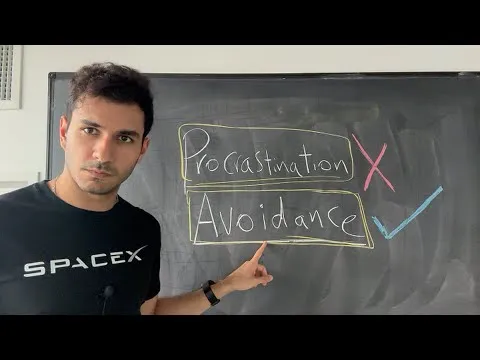
Procrastination is more about low motivation drivers (dopamine for interest and norepinephrine for urgency), while avoidance is more about fear and emotional resistance to change.
Briefing
Procrastination and avoidance are two different ways the brain sidesteps action—and fixing the right one determines whether goals move forward or stall. The core distinction: procrastination is largely a “motivation chemistry” problem (low drive to start), while avoidance is a “fear and uncertainty” problem (emotional resistance to the task and what success might change). Both lead to missed work, self-doubt, and a downward spiral of feeling “like crap,” but they require different interventions.
The framework starts with a practical question: when someone isn’t doing the task that matters, are they postponing it because they lack urgency/interest, or are they actively steering away because it feels threatening? Procrastination tends to show up when the goal isn’t clear, the task feels tedious, and there’s no deadline or consequence pressing the person forward. In that state, the brain doesn’t generate enough of the two chemical drivers tied to action: dopamine (curiosity, reward-seeking, willingness to engage) and norepinephrine (urgency, “I need to do this now,” often triggered by deadlines and consequences). When both are low, action drops. The “easy” fix for procrastination is therefore structural: make the task more engaging (increase dopamine) and/or attach it to time pressure (increase norepinephrine). That can mean scheduling a specific time to work, creating a deadline, and using implementation intentions like “sit down and do it,” especially for tasks that otherwise feel boring—like handling mail.
Avoidance looks different. It often appears even when the person knows exactly what to do, understands the task’s importance, and feels urgency—yet still can’t make themselves start. That pattern points to avoidance, which is typically rooted in fear. The transcript groups fear into fear of failure and fear of success, arguing they’re effectively the same underlying fear: fear of change and the unknown outcomes of stepping into a new state. The more uncertain the potential consequences, the stronger the avoidance. A personal example illustrates the mechanism: after early business success, the person suddenly couldn’t sit down to create ads or engage in sales work, as if the business became intolerable. The cause was fear that scaling would disrupt life—relationships, stability, and the ability to handle a new level of responsibility—so the brain tried to protect the person by steering away from the work.
The solution for avoidance is less about scheduling and more about belief and information. Since fear is often driven by beliefs, changing the belief can reduce the emotional threat. Another approach is to turn unknowns into knowns: run a structured “what happens if…” exercise to map likely outcomes, worst cases, and best cases, then prepare for them. With more accurate information and less uncertainty, the fear of success/failure loses its grip, avoidance weakens, and action becomes more likely.
Finally, the transcript offers a self-diagnostic routine: check dopamine by asking whether the task is clearly defined and can be made interesting/beneficial; check norepinephrine by asking when it must be done and what consequence follows if it isn’t done. If those checks don’t explain the stall, the person likely faces avoidance—then the work shifts to identifying fear/limiting beliefs and filling informational gaps. Repeatedly taking the right kind of action builds momentum and trust in one’s ability to execute goals.
Cornell Notes
The transcript distinguishes two reasons people don’t do important work: procrastination and avoidance. Procrastination is tied to low “action chemistry”—especially dopamine (curiosity/interest) and norepinephrine (urgency from deadlines and consequences). Avoidance persists even when the task is clear and urgent, and it’s usually driven by fear of change—often framed as fear of success or fear of failure, but rooted in uncertainty about what outcomes will look like. The practical fix matches the diagnosis: add structure, deadlines, and task interest for procrastination; for avoidance, change beliefs and reduce uncertainty by mapping likely outcomes and preparing for worst cases. The payoff is more consistent action and regained self-trust.
How can someone tell whether they’re procrastinating or avoiding a task?
Why does the transcript connect procrastination to dopamine and norepinephrine?
What are concrete tactics for fixing procrastination?
What drives avoidance, according to the transcript?
How can someone reduce avoidance when fear is the barrier?
What self-check questions does the transcript suggest for diagnosing the problem?
Review Questions
- What specific conditions tend to produce procrastination in this framework (clarity, interest, deadlines), and how do dopamine and norepinephrine fit in?
- How does the transcript redefine fear of success and fear of failure, and why does that matter for choosing an intervention?
- If someone is clear on the task and feels urgency but still avoids starting, what steps should they take next according to the transcript?
Key Points
- 1
Procrastination is more about low motivation drivers (dopamine for interest and norepinephrine for urgency), while avoidance is more about fear and emotional resistance to change.
- 2
If the task is tedious and there’s no deadline or consequence, both dopamine and norepinephrine can stay low, reducing the likelihood of starting.
- 3
Fix procrastination by adding structure: schedule work, create deadlines, and use implementation intentions like “sit down and do it.”
- 4
Fix avoidance by addressing fear: identify limiting beliefs and reduce uncertainty by mapping likely outcomes and preparing for worst cases.
- 5
A practical diagnostic routine is to run a dopamine check (clarity and interest) and a norepinephrine check (timing and consequences).
- 6
When the dopamine/norepinephrine checks don’t explain the stall, treat it as avoidance and focus on belief change and information gaps rather than more scheduling alone.