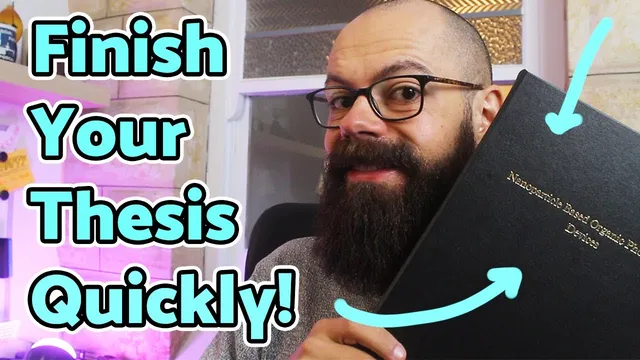
How to finish a PhD thesis quickly | 5 simple tips to write a thesis in two months!
Based on Andy Stapleton's video on YouTube. If you like this content, support the original creators by watching, liking and subscribing to their content.
Treat thesis completion as a daily writing job: produce words consistently, not occasionally.
Briefing
Finishing a PhD thesis quickly comes down to treating writing like a daily, non-negotiable job—then aligning supervisors and your own goals so feedback doesn’t stall the process. After experiments are done and data analysis is largely complete, the thesis becomes a conversion task: turn results into clear graphs and images, then write the words that interpret them. The core message is simple but demanding: one page at a time, one word at a time, built through discipline rather than inspiration.
A practical routine anchors the advice. The recommended approach is to “own your day” by committing to writing first thing in the morning and repeating focused sessions throughout the day. One example schedule runs as: write for an hour and a half, take a short break, write again for another hour, have lunch, then write for another hour and a half (with additional shorter writing time as needed). The key is consistency—writing Monday through Sunday for about two months—so momentum carries the project to completion.
That daily grind only works if supervision doesn’t become a bottleneck. The transcript stresses that delays often happen when supervisors are still reviewing drafts, even though they aren’t necessarily rewarded for speed. To prevent that, the advice is to have an explicit, early “hard chat” with the supervisor: set a finish date (for example, within three months), define what turnaround time looks like for revisions, and schedule regular check-ins every couple of days. If needed, bring in the head of school so expectations are formal and feedback loops stay tight.
To make the workload psychologically manageable, the thesis should be broken into mini goals. A concrete example: each day, produce a graph, convert it into an image, insert it into the thesis, and write detailed text about it. Milestones matter because waiting to celebrate until the entire thesis is done can kill motivation. Visual progress tracking—like moving “paper clips” from one jar to another after each chapter—helps make progress obvious and keeps energy up.
Perfectionism is treated as the enemy of speed. Early drafts may be “poorly written” until editing happens after supervisor review; the priority is producing words and not getting stuck on formatting, graph aesthetics, or other details. If a graph looks imperfect but communicates the data correctly, that’s enough to move forward.
Finally, rest is framed as part of the plan, not a reward. Even during an intense two-month push, the routine includes switching off in the evenings, sleeping early, eating well, and avoiding alcohol—so the next day starts with enough reserve energy to keep writing. Some people may need a full rest day weekly; others may do better with evening downtime. Either way, the thesis-writing sprint is presented as a human process: disciplined, supported, and sustainable enough to reach the finish line and still have energy to edit.
Cornell Notes
The fastest path to finishing a PhD thesis is to treat writing as a daily, structured work block and to remove the most common cause of delay: slow supervisor feedback. Once experiments are done and analysis is mostly complete, the thesis work becomes producing graphs/images and writing the interpretation of results. A consistent routine—multiple writing sessions per day—can carry a thesis from draft to submission in roughly two months when paired with discipline and accountability. Speed also depends on supervisor buy-in: set a clear deadline, request rapid revision turnaround, and schedule frequent feedback check-ins. Mini goals (e.g., one graph plus its written section per day) and visible progress tracking help maintain momentum while avoiding perfectionism and building in rest.
What does “own your day” mean in the context of thesis writing, and why is it emphasized?
Why do supervisors often become a bottleneck, and how can a student prevent that?
How should mini goals be designed to keep thesis work moving daily?
What role does perfectionism play in slowing thesis completion, and what’s the recommended counter-strategy?
How does rest fit into a fast thesis-writing plan?
Review Questions
- What specific daily writing routine is suggested, and how does it differ from “working whenever there’s time”?
- What steps should be taken to secure supervisor buy-in before starting the main writing sprint?
- How do mini goals and visible progress tracking change motivation compared with waiting to celebrate at the end?
Key Points
- 1
Treat thesis completion as a daily writing job: produce words consistently, not occasionally.
- 2
Convert results into graphs/images as inputs, but focus on writing the interpretation as the main output.
- 3
Build a repeatable writing schedule with multiple focused sessions per day to maintain momentum.
- 4
Get explicit supervisor buy-in early by setting deadlines, revision turnaround expectations, and frequent feedback check-ins.
- 5
Break the thesis into concrete mini goals (e.g., one graph plus its written section per day) and track progress visibly.
- 6
Avoid perfectionism during drafting; prioritize producing text and handle polishing after feedback.
- 7
Plan rest deliberately—switch off in the evenings or schedule a weekly rest day—so energy lasts through editing and submission.