How to Formulate Research Problem
Based on Research-Hub's video on YouTube. If you like this content, support the original creators by watching, liking and subscribing to their content.
Problem formulation (gap spotting) is the foundation of thesis proposals; background, literature, methodology, and recommendations follow from it.
Briefing
Problem formulation—spotting a real gap and turning it into a researchable question—sits at the center of every thesis proposal, because the rest of the writing process (background, literature, methodology, and recommendations) depends on it. The lecture frames research as a response to a concrete problem rather than an exercise done for promotion, completion, or the sake of “doing research.” In that view, identifying the problem is the hardest and most consequential step: once the problem is clear, the researcher can more confidently decide what to study, what evidence to gather, and what kind of methods will fit.
The session argues that problem formulation should not be driven by a catchy title. In many settings, “title defense” encourages students to generate multiple eye-catching working titles and then pick one based on aesthetics. Instead, the lecture pushes for a workflow where the working title comes last—after the research problem, goal, and core argument are written. A working title should capture the key concepts and align with the research problem; it is expected to change as the study develops.
Two main routes can produce a research problem. One route is observation of concrete social realities: watching what is happening in workplaces and communities, then translating those observations into a gap worth investigating. The lecture emphasizes that observation can yield legitimate, researchable problems without first mining journal articles. The second route—reserved for a later lecture—is identifying gaps through a literature review, where researchers read existing studies and locate what prior authors missed or failed to address.
To make the process practical, the lecture walks through four one-page research problem samples, each showing how a problem, goal, thesis statement, and early methodological direction can be built.
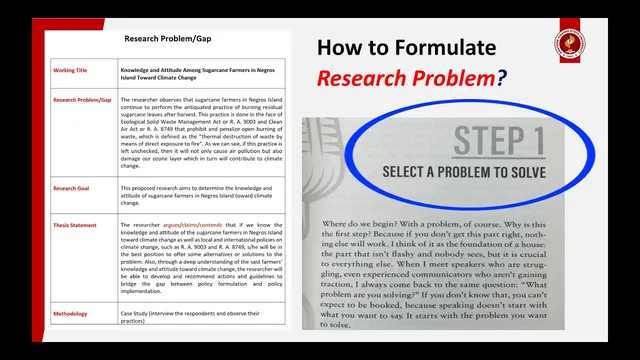
The first sample comes from field observation in Negros: sugarcane farmers continue burning residual leaves after harvest despite environmental laws such as RA 9003 and RA 8749. The problem links the practice to air pollution, ozone damage, and climate change, and it also raises a policy-implementation angle—farmers may know the rules but still comply only if disposal costs are manageable. The proposed goal is to determine farmers’ knowledge and attitudes toward climate change and related policies, and the thesis statement positions the study as a basis for recommendations that bridge policy formulation and policy implementation. Methodologically, the lecture steers toward qualitative case study work using interviews and observation.
The second sample uses a quantitative logic: the Philippine government’s long-running anti-drug efforts have not stopped drug addiction cases from rising. Here, the goal is to determine the relationship between a sports program and drug addiction cases in selected barangays (e.g., in Tacloban), leading to a correlational design and a working title like “Sports as Drug Abuse Prevention.”
The third sample targets school-based management compliance: based on records, 19 of 22 high schools in Biliran failed assessments for SBM level 3 advanced. The goal becomes identifying factors and challenges administrators and teachers face in meeting standards, with qualitative case study methods suggested through interviews and observation.
The fourth sample shifts to policy research during COVID-19: the central bank faces pandemic-driven instability in banking operations, prompting a policy paper-style goal to identify policy challenges, mechanisms/tools used to respond, and best practices. The lecture again recommends qualitative case study methods, supported by interviews, observation, and archival research.
Across all examples, the lecture’s core message is consistent: start with the problem and its evidence, then set the goal and thesis statement, and only afterward decide on methods and a working title that truly matches the study’s key concepts.
Cornell Notes
Problem formulation (or gap spotting) is presented as the starting point of thesis proposals because every later section—background, literature, methodology, and recommendations—depends on the clarity of the research problem. The lecture warns against “title defense” habits that prioritize eye-catching titles; instead, the working title should be drafted after the problem, goal, and thesis statement are written. Two main ways to formulate a research problem are observation of concrete social realities and identifying gaps through a literature review (addressed later). Four one-page samples illustrate how different problem types lead to different goals and methodological choices, including qualitative case studies (interviews/observation/archival research) and quantitative correlational designs. The key payoff: once the problem is clear, the research journey becomes more coherent and researchable.
Why does the lecture treat problem formulation as the most difficult and most important step in thesis writing?
What are the two major ways to formulate a research problem or identify a research gap?
How does the lecture argue that working titles should be handled compared with “title defense”?
How does the sugarcane burning example show observation-based problem formulation?
How do the examples connect problem type to method choice (qualitative vs quantitative)?
What does the lecture mean by “loaded phrases” like “based on records” or “researcher observes”?
Review Questions
- What steps does the lecture recommend in order (problem → goal → thesis statement → methodology → working title), and why does it insist the working title comes last?
- Compare the sports-drug example with the sugarcane-climate example: what kind of research question is each one asking, and how does that determine whether a correlational quantitative design or a qualitative case study is appropriate?
- In the SBM example, why does the lecture emphasize evidence phrases like “based on records,” and how does that affect the credibility of the research problem?
Key Points
- 1
Problem formulation (gap spotting) is the foundation of thesis proposals; background, literature, methodology, and recommendations follow from it.
- 2
Research is framed as a response to a real problem, not an activity done for promotion or simply to complete degree requirements.
- 3
Working titles should be aligned with the research problem and drafted after the problem, goal, and thesis statement—not chosen first for aesthetics.
- 4
Two main routes to formulate problems are observation of concrete social realities and identifying gaps through a literature review.
- 5
Method choice should follow the problem’s nature: qualitative case study approaches fit knowledge/attitudes and lived experiences, while quantitative correlational designs fit relationship questions between measurable variables.
- 6
Evidence-signaling phrases such as “researcher observes” and “based on records” help establish that claims rest on concrete observation or documented data.
- 7
Recommendations become defensible only after data collection clarifies whether the gap is driven by knowledge, attitudes, constraints, or implementation failures.