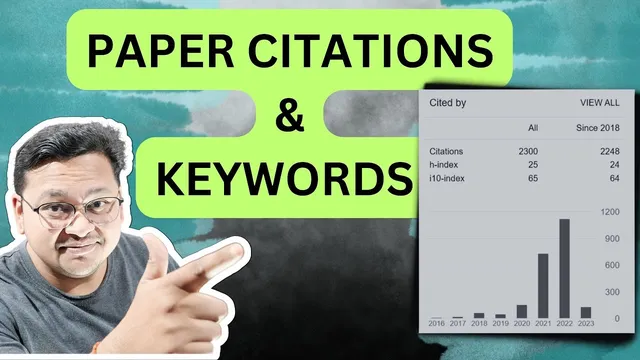
How to get Citations in Paper? || Importance of keywords || Research Publications || Dr. Akash Bhoi
Based on eSupport for Research's video on YouTube. If you like this content, support the original creators by watching, liking and subscribing to their content.
Keywords influence whether an article is discoverable in major search platforms, which affects reading and citation likelihood.
Briefing
Citations don’t start with writing—they start with the right keywords showing up where search engines and databases can actually find them. Keywords matter because they determine whether researchers searching a topic (or browsing related work) can locate an article in platforms like Google Scholar, Scopus, and Web of Science, which in turn affects how often the work gets read and cited over time.
The transcript breaks keyword strategy into two linked roles. First, authors need to choose exact, relevant keywords while drafting a paper so the article matches what others are likely to type into search bars. Second, once the paper is published, those same keywords help readers discover the work during literature searches, increasing the odds they will cite it. In practice, keywords tend to be pulled from and reinforced by three places in a manuscript: the title, the abstract, and the keyword list. For example, a topic like “breast cancer detection” paired with “deep learning,” “feature selection,” or “hybrid rule-based” phrasing can align the paper with queries such as “breast cancer detection using deep learning,” making the article more discoverable.
The importance of keyword selection is framed as a pipeline: better keyword relevance can lead to more visibility, which can produce more citations, which then feeds into common research metrics such as the h-index and i10-index. Those indices are presented as part of a broader author profile that universities and scientific communities track.
To find and refine keywords, the transcript highlights search-platform behavior. On Google Scholar, signing out is recommended to avoid personalized search history influencing autocomplete suggestions. When a user types a seed phrase like “EEG signal,” Google Scholar’s autocomplete and suggested queries surface common related terms—such as “signal processing,” “classification,” “feature extraction,” “pre-processing,” “signal filtering,” and “signal denoising.” The same approach can be repeated on Google search to observe what other researchers frequently search. The practical workflow suggested is to collect these suggestions into an Excel list, then reuse the most relevant terms while shaping the paper’s title and abstract.
Beyond Google, Web of Science is presented as a tool for both journal discovery and keyword extraction. After creating an account, a user can use Web of Science’s journal search features—either searching by journal name or, more usefully, by submitting a manuscript title and abstract. The system then extracts keywords from the provided text and returns a refined list of journals where similar work has been published. The transcript illustrates this with an example where terms like “hyper parameter optimization,” “machine learning,” “ensemble,” and “five-fold cross validation” are extracted from the title/abstract and used to generate journal recommendations. This approach helps authors who are unsure which keywords to use and helps researchers looking for relevant literature by revealing the language databases associate with a topic.
Overall, the core message is straightforward: keywords are the bridge between manuscript content and database search behavior, and treating them as a deliberate, data-driven step can improve discoverability, citations, and downstream research impact metrics.
Cornell Notes
Keywords influence whether an article is discoverable in major databases and search engines, which then affects citation counts and research metrics like the h-index and i10-index. Keywords typically appear in the title, abstract, and keyword list, and matching those terms to what researchers search is key. Google Scholar’s autocomplete and related suggestions can be used to identify commonly searched phrases; signing out helps avoid personalized history. Web of Science can go further by extracting keywords from a submitted title and abstract and recommending journals where similar articles have been published. Using these keyword insights during drafting improves the chances that readers find and cite the work.
Why do keywords affect citations rather than just search results?
Where should keywords be placed in a manuscript to maximize discoverability?
How can autocomplete suggestions on Google Scholar help identify effective keywords?
What is the advantage of using Web of Science’s journal search with a title and abstract?
How should a researcher use the keyword workflow in practice?
Review Questions
- Which three manuscript sections are emphasized as the most important places for keywords, and why?
- How does signing out before searching on Google Scholar change the usefulness of autocomplete suggestions?
- What inputs does Web of Science use to extract keywords for journal recommendations, and what output does it provide?
Key Points
- 1
Keywords influence whether an article is discoverable in major search platforms, which affects reading and citation likelihood.
- 2
Place high-relevance keywords in the title, abstract, and keyword list to align with how databases index content.
- 3
Use Google Scholar (and Google) autocomplete suggestions to identify phrases researchers commonly search for, and record them for later use.
- 4
Signing out before searching helps prevent personalized search history from skewing suggested keywords.
- 5
Collect suggested keyword variations (including related subtopics) and incorporate the most relevant terms when drafting the title and abstract.
- 6
Use Web of Science journal search with a manuscript title and abstract to extract keywords and generate a suggested journal list based on similarity.
- 7
More relevant keyword matching can translate into higher visibility, more citations over time, and improved citation-based metrics like the h-index and i10-index.