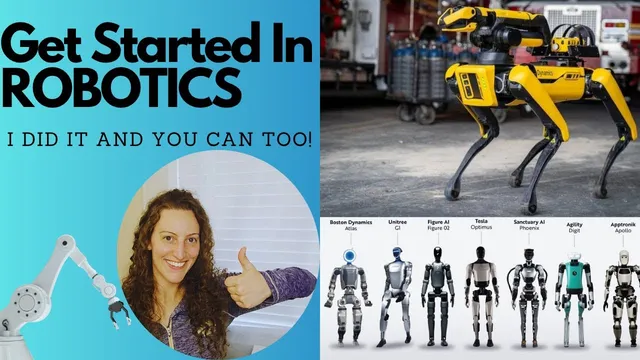
How To Get Started in Robotics (Steps You Can Take TODAY)
Based on Code Mechanics: My PhD Life in AI & Robotics's video on YouTube. If you like this content, support the original creators by watching, liking and subscribing to their content.
Expect robotics progress to be cumulative; comfort comes from sustained learning rather than a quick start.
Briefing
Getting started in robotics is less about picking a single “right” path and more about stacking cumulative learning—industry awareness, a structured learning plan, and early hands-on work—so progress doesn’t feel like an overnight leap. Robotics draws people from many STEM backgrounds, and there’s no universal route into the field. The practical takeaway is to expect a gradual build: comfort and excitement come from sustained learning, not from deciding one day and executing the next.
A first step is building industry awareness by mapping what exists today and where the field is heading. That starts with personal clarity—what kinds of robots exist, whether there’s a favorite robot, which companies or labs feel like a target, and most importantly why robotics matters to you. From there, staying current becomes a research routine: YouTube product-launch demos can show what hardware is being marketed and what capabilities are trending, even if the content is promotional. The robotics subreddit offers a mix of hobby and larger-scale work, and it helps newcomers absorb the jargon used in real projects. Podcasts add another layer of context by translating conference and research signals into approachable discussions.
Two specific podcast recommendations anchor this “stay current” phase. One is the Robot Report Podcast episode “IKRA recap,” tied to the International Conference on Robotics and Automation (IKRA), which draws thousands of attendees and features an exhibition hall where companies showcase demos—often including humanoid robots—while also recruiting future employees. The second is the Google DeepMind podcast episode “Redefining Robotics with Karolina Prada,” featuring the senior director of robotics at Google DeepMind. The emphasis here is on learning how a well-resourced research group frames robotics trends and what kinds of work are worth tracking.
With that awareness in place, the next move is crafting a road map and learning agenda. The agenda is a checklist of topics needed to close knowledge gaps; the learning plan is how each topic will be learned. Roadmap videos can help identify common math-heavy prerequisites, since robotics roles typically require strong foundations in mathematics. The transcript also draws a blunt boundary around entry: most robotics jobs expect a college degree, so the recommended baseline is a STEM bachelor’s degree—computer science, electrical engineering, mechanical engineering, or applied math—followed by involvement in engineering-focused college clubs (robotics, race cars, or hardware/software projects) and internships.
For people with an unrelated bachelor’s degree, the path becomes gap analysis: compare robotics curriculum roadmaps to prior coursework, then decide between self-study and formal coursework. In the U.S., community college is highlighted as a cost-effective way to fill gaps in linear algebra, calculus, and differential equations. Another option is transitioning into a master’s or post-baccalaureate program, but that comes with financial cost and still requires background preparation.
Finally, hands-on work should start early and often—without rushing to buy hardware. Simulators lower the barrier by removing setup time and letting learners follow tutorials immediately. Gazebo and Isaac Sim are mentioned, but Isaac Sim is described as GPU-intensive; for laptop-friendly starts, Weebots is recommended, including its structured user guide and tutorials. After simulator success, project-based learning takes over: begin with small, concrete goals like moving a block from point A to point B or driving a car from point A to point B, then add complexity once the baseline works. Keeping dated notes helps learners track progress and reflect on how long each step took—turning experimentation into a measurable learning trajectory.
Cornell Notes
Robotics entry works best as a cumulative process: build industry awareness, create a learning agenda and plan, then start hands-on work early. Industry awareness means tracking trends and hardware through YouTube demos, the robotics subreddit, and robotics podcasts—especially IKRA recap content and Google DeepMind’s “Redefining Robotics with Karolina Prada.” A learning agenda lists missing topics; a learning plan maps how to learn them, with math foundations (linear algebra, calculus, differential equations) treated as non-optional. Most robotics jobs expect a STEM bachelor’s degree, but unrelated degrees can be bridged via community college courses or graduate programs. For hands-on learning, simulators reduce friction; Weebots is suggested for lower hardware requirements, followed by small projects that expand in complexity.
Why does the transcript emphasize “cumulative learning” instead of a quick switch into robotics?
What does “industry awareness” mean in practice, and how should a newcomer build it?
Which two podcast episodes are recommended for early robotics orientation, and what value does each add?
How should someone with a STEM bachelor’s degree versus an unrelated bachelor’s degree approach the math gap?
Why start with a simulator instead of buying a hardware kit, and which simulator is suggested for lower-end laptops?
What does “start small” look like when building a first robotics project?
Review Questions
- What specific activities build industry awareness, and how do they differ (YouTube vs. subreddit vs. podcasts)?
- How do a learning agenda and learning plan work together, and what role does math play in the road map?
- Why does the transcript recommend simulators first, and what project structure helps prevent discouragement?
Key Points
- 1
Expect robotics progress to be cumulative; comfort comes from sustained learning rather than a quick start.
- 2
Clarify personal direction early by answering why robotics matters and which robot types or target organizations fit.
- 3
Build industry awareness using YouTube demos, the robotics subreddit, and podcasts—especially IKRA recap content and Google DeepMind’s “Redefining Robotics with Karolina Prada.”
- 4
Create a learning agenda (topic checklist) and a learning plan (how each topic will be learned) before committing to projects.
- 5
Plan for math foundations as a prerequisite; fill gaps via community college courses if the bachelor’s degree is unrelated.
- 6
Use simulators to lower the barrier to entry; start with Weebots if GPU resources are limited.
- 7
Begin projects with small, concrete goals (point A to point B) and add complexity only after the baseline succeeds.