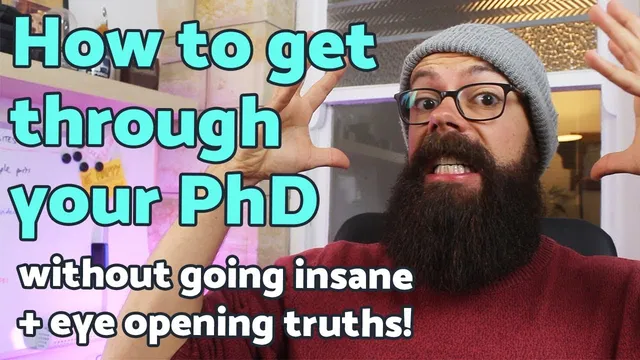
How to get through your PhD without going insane! Eye opening truths
Based on Andy Stapleton's video on YouTube. If you like this content, support the original creators by watching, liking and subscribing to their content.
Choose the single most important task that advances the PhD at each stage, and schedule it as the priority rather than juggling everything equally.
Briefing
Getting through a PhD without losing your mind comes down to two things: building a sustainable, mentally protective routine—and refusing to let toxic academic culture dictate your life. The most damaging pressure isn’t the work itself; it’s the expectation to hustle constantly, sleep poorly, and treat anxiety as normal in highly competitive environments. A supportive lab culture—especially a supervisor who treats the student as someone they’re helping rather than a “paper machine”—can remove much of the stress before it starts. Even without the “perfect” supervisor, the path forward is still clear: focus on what moves the PhD forward, protect attention, and develop coping skills for the emotional ups and downs.
A practical starting point is to identify the single most important task at any given time and schedule it like it matters. Early in a project, that often means deep literature reading to understand the field well enough to spot gaps; only then should experiments and planning take over. The key is to avoid constant context switching—writing, seminars, experiments, and literature reviews all compete for attention, but progress usually concentrates in one dominant activity. To make that realistic, the advice is to set aside daily “deep work” blocks—long, uninterrupted focus sessions—so distractions from supervisors’ whims, social media, and other interruptions don’t steal momentum.
Academic politics are the next mental health threat. Academia can be ego-driven and competitive, with infighting that often has little to do with the science itself. The recommended strategy is to stay out of it: don’t get pulled into disputes between supervisors or other academics, and don’t treat personal conflict as part of the job. Since the stakes can feel high while the consequences are often non-life-or-death, the emotional cost tends to come from pride and rivalry rather than necessity.
Sustaining the work requires thinking in marathon terms, not sprint terms. Burnout commonly hits in the first or second year when students try to be in the lab constantly, including weekends, because that’s what the culture signals. Instead, build a routine that leaves room for recovery: aim to finish the week with energy rather than depletion, and remember that being “there” on weekends doesn’t determine whether someone is a real PhD student. Running your own race also means coping with rejection—papers get rejected frequently, and it’s rarely helpful to interpret every review as a verdict on personal worth.
Two concrete rejection coping methods are offered. First, name what you’re feeling—“I’m feeling not clever enough,” for example—so the emotion loses some power. Second, write out the rejection experience, then cross out anything that isn’t a fact, such as assumptions that reviewers disliked you personally. After stripping away self-judgments, the situation often reduces to a boring baseline: a submission was reviewed and rejected.
Finally, balance is treated as non-negotiable. Build at least one full day per week with no project or email checking, using activities like nature walks, hobbies, exercise, or community groups to restore reserves. For students without established networks—especially international students—joining interest groups or meetups can rebuild identity outside academia. The overall message is straightforward: protect focus, avoid toxic dynamics, pace the long haul, and create a life that keeps the PhD from consuming everything.
Cornell Notes
A sustainable PhD mental health strategy centers on protecting attention, pacing the workload, and building a life outside academia. Progress comes from repeatedly identifying the single most important task—often literature grounding early on—then scheduling deep, uninterrupted work blocks to avoid constant distraction. Academia’s politics and rejection are treated as predictable stressors; the recommended response is to stay out of interpersonal conflicts and use coping tools like naming emotions and separating facts from self-judgments. Finally, the long-term fix is balance: maintain a routine you can sustain for years and reserve at least one full day weekly for non-academic recovery. This matters because it prevents burnout and keeps motivation intact across the entire PhD timeline.
How can a PhD student decide what to do when there are always multiple tasks competing for attention?
What does “deep work” look like in this PhD context, and why is it recommended?
Why is academic politics treated as a mental health risk, and what’s the suggested response?
How should students think about workload to avoid early burnout?
What are two specific techniques for coping with paper or project rejection?
What balance practices are recommended to protect mental health over the long term?
Review Questions
- What single task should a PhD student prioritize at the start of a project, and how should that priority change later?
- Which two rejection-coping methods are recommended, and how do they reduce the emotional impact of rejection?
- What weekly routine element is described as essential for balance, and what kinds of activities are suggested to fill that day?
Key Points
- 1
Choose the single most important task that advances the PhD at each stage, and schedule it as the priority rather than juggling everything equally.
- 2
Use deep work blocks—long, uninterrupted focus sessions—to protect attention from supervisor demands and everyday distractions.
- 3
Stay out of academic office politics; interpersonal conflicts between academics are not the student’s responsibility to manage.
- 4
Treat the PhD as a marathon by building a sustainable routine that prevents early burnout, including avoiding the “lab all weekend” trap.
- 5
Develop rejection coping skills: name emotions to defuse them and separate facts from self-judgments by crossing out non-factual assumptions.
- 6
Maintain balance with at least one full day per week that is fully non-academic, using nature, hobbies, exercise, and community groups to restore energy.
- 7
Build a life and social network outside academia—especially through meetups or interest groups—so identity doesn’t collapse into research alone.