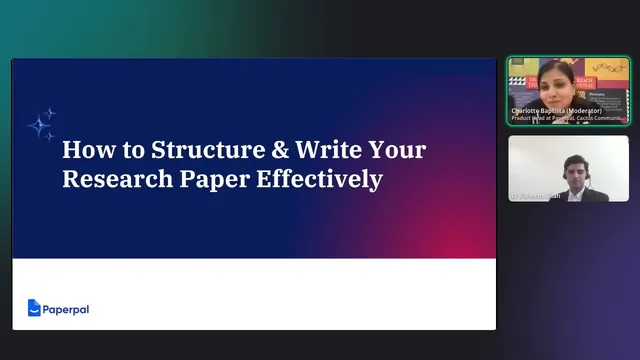
How to Get Your Research Paper to the Finish Line - AI Writing Tips by Paperpal
Based on Paperpal Official's video on YouTube. If you like this content, support the original creators by watching, liking and subscribing to their content.
Write your way to better writing: drafting repeatedly builds skills that reading alone cannot replicate.
Briefing
Getting a research paper across the finish line depends less on “perfect writing” and more on a repeatable workflow: write early and often, tighten the draft with feedback and high-quality examples, and treat submission as a reviewer-experience problem (clarity, formatting, and integrity). Dr. Faheem Ullaah, an assistant professor and cyber security program director at the University of Adelaide, framed academic writing as a skill built through doing—then reinforced with targeted critique and study of top papers.
Ullaah’s core advice starts with volume and iteration. Reading books about writing helps, but it cannot replace drafting your own paper; improvement comes after multiple attempts, with the “10th paper” typically stronger than the first. He also recommends building a feedback loop into the writing process: share individual sections (like abstracts) with lab mates or supervisors, and ask for paragraph-level comments. Finally, he urges writers to learn from exemplary publications in their target venue—especially by observing how strong papers open sections and structure arguments, rather than starting paragraphs without a clear purpose.
When the conversation turns to productivity and structure, the emphasis shifts from inspiration to acceptance criteria. Ullaah described what reviewers look for when deciding whether a submission deserves attention: the significance of the work (why it matters and who benefits), novelty (what is new relative to prior research), and a clear gap in the literature. Methodology must also be credible—data sources and experimental design need to match the research question. He added that presentation matters too: results are easier to evaluate when they include visuals like figures, graphs, or tables, and the discussion section should reflect on findings, limitations, and what future work they enable.
To make writing sustainable, he recommended attacking the hardest part first: starting. Procrastination often comes from overthinking and reluctance to begin, so writers should commit to the first sentence, then keep going until momentum appears. Discipline can be supported with practical time blocks (he mentioned Pomodoro-style focus sessions) and by setting daily writing time, particularly when energy is higher.
Submission readiness, meanwhile, is where small errors can derail otherwise solid research. Ullaah warned that reviewers may ignore one typo but grow increasingly resistant after repeated grammar, formatting, or reference issues. He promoted a checklist mindset: verify plagiarism, confirm journal or conference page/word limits, ensure references include required metadata (like publication dates), and run consistency checks before submission.
AI enters the workflow as a productivity tool—not a replacement for authorship or ethics. Ullaah stressed that writers must follow institutional and venue guidelines, including disclosure requirements when AI is used for certain tasks (he cited examples like synthetic data). He recommended AI for literature search and summarization, for polishing grammar/typos/formatting, and for managing references and notes. He also cautioned against “100% reliance,” noting that AI-generated text can be generic and should be rewritten to reflect the author’s specific research.
In the Q&A, he addressed concerns about AI detection and plagiarism: detectors are imperfect, but plagiarism checking still matters, and using AI output verbatim is a bad strategy. For discussion sections, he offered a structured checklist of questions—how findings align or differ from prior work, implications for researchers and industry, and threats to validity/limitations. Overall, the finish line is reached by combining disciplined drafting, reviewer-oriented presentation, and responsible tool-assisted editing.
Cornell Notes
The most reliable path to finishing a research paper is to treat writing as a skill built through repeated drafting, then improved through feedback and study of strong papers. Dr. Faheem Ullaah emphasized three habits: write more (experience beats reading), seek feedback from lab mates/supervisors at the paragraph level, and learn section openings and structure by examining exemplary publications in the target journal. For acceptance, reviewers look for significance, novelty, a clear literature gap, credible methodology, and results presented in an understandable way (often with visuals). Submission success also depends on eliminating avoidable presentation errors—grammar, formatting, reference completeness, and plagiarism—because repeated mistakes can turn reviewers off. AI can speed up parts of this workflow, but it must follow ethical rules and journal/institution guidelines and should not replace the author’s own thinking.
Why does “writing more” beat “reading how to write” in Ullaah’s view?
What kind of feedback is most useful during drafting?
How should writers use top papers to improve their own structure?
What acceptance criteria do reviewers tend to apply across a paper’s sections?
Why do “small” errors like formatting and reference metadata matter so much?
How can AI be used responsibly without undermining integrity?
Review Questions
- What three writing habits did Ullaah recommend, and how does each one improve a paper in a different way?
- Map the reviewer’s acceptance criteria to the paper’s sections (introduction, literature review, methodology, results, discussion). Which section carries the “significance” and “novelty” burden?
- What checklist items should be verified before submission to avoid reviewer turn-off, and why do repeated errors matter more than a single mistake?
Key Points
- 1
Write your way to better writing: drafting repeatedly builds skills that reading alone cannot replicate.
- 2
Use a feedback loop early by sharing individual sections (like abstracts) with lab mates or supervisors for paragraph-level critique.
- 3
Learn structure from strong papers in your target venue by studying how they open paragraphs and frame introductions.
- 4
Design your paper around reviewer acceptance criteria: significance, novelty, a clear literature gap, credible methodology, and results presented with visuals when helpful.
- 5
Adopt a pre-submission checklist focused on integrity and presentation: plagiarism checks, grammar/typos, formatting, reference completeness, and strict page/word limits.
- 6
Treat AI as an assistant for speed and polishing, not a substitute for authorship; follow journal/institution rules and disclose AI use when required.
- 7
Avoid verbatim AI output: detectors are imperfect, but plagiarism risk and generic writing quality remain—rewrite so the work reflects your own research and voice.