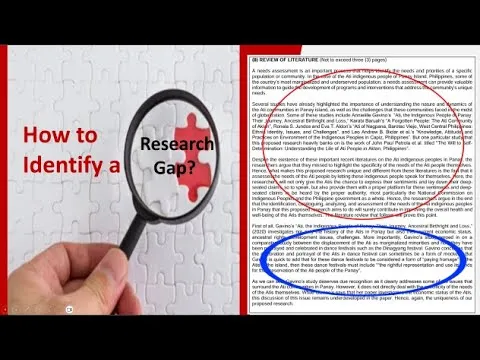
How to Identify a Research Gap
Based on Research-Hub's video on YouTube. If you like this content, support the original creators by watching, liking and subscribing to their content.
A research gap is the missing or unaddressed problem in the current state of knowledge, and it underpins the entire proposal.
Briefing
A research gap is the missing piece in what scholars already know—an unresolved problem that makes a proposed study necessary, timely, and original. In education research proposals and thesis defenses, that gap is not a decorative background detail; it’s the foundation reviewers look for first, because it determines what the study will actually try to answer. A clear research gap also protects a proposal from drifting into duplication of earlier work, which can trigger major revision requests or rejection.
The lecture frames a research gap as “what is not addressed” in the current state of knowledge. That missing element creates the rationale for the study: the gap establishes urgency (why it matters now), importance (why it matters at all), and necessity (why it must be studied rather than left alone). In the background of the study, researchers must articulate not only the problem but also the reason it demands attention—otherwise the work risks being seen as repeating what “famous scholars” have already covered.
A key distinction runs through the examples: a research aim (or goal) is not the same as the research problem (gap). Many inexperienced students mistakenly treat a broad aim as if it already were the gap. The lecture illustrates this with a scenario about senior high school teachers in Tacloban City who are forced to teach subjects outside their specialization under the K-12 program—such as a math graduate teaching “Introduction to Philosophy of the Human Person.” The stated aim might be to determine teachers’ lived experiences, but the actual problem/gap is deeper: the forced mismatch threatens mastery, jeopardizes instruction quality, risks producing “half-baked graduates,” and can negatively affect national development. The gap is what remains unaddressed in scholarship, not merely what the study intends to measure.
The second half explains how to identify a research gap using literature review. The process begins with choosing a topic that genuinely interests the researcher (“passionate” is treated as a practical requirement, not a motivational slogan). Next comes mapping “mega trends” and recent debates in the field, often supported by using literature from the last three to five years so the proposal signals timeliness. If the topic is not part of current debates, the study may look irrelevant or already solved.
After that, the lecture turns to the mechanics of gap spotting in a literature review. Researchers should read recent studies, extract dominant themes and arguments, and then compare what those works collectively address against what they omit. The example uses indigenous peoples in Southeast Asia—specifically the marginalization of the Agta/“diet people” in Borneo (as named in the transcript). Five scholars are summarized around themes like modernity, militarism, resilience, globalization, and rights recognition. The gap emerges when none of the reviewed works examines how the group resists marginalization. That omission becomes the basis for originality: the researcher can position themselves as “scholar number six,” contributing something new rather than duplicating existing discussions.
Ultimately, the lecture argues that originality and significant contribution hinge on clearly articulating the gap. When the background of the study communicates the missing problem effectively, reviewers can quickly judge whether the work is original, publishable, and worth attention—because the gap signals what the study will add to the body of knowledge. The same principles apply across disciplines, from education and psychology to natural sciences and engineering: passion for a topic, alignment with current debates, literature review to locate omissions, and then a research problem that makes the next steps coherent.
Cornell Notes
A research gap is the missing problem in the current body of knowledge—what scholars have not addressed. It matters because reviewers first look for a proposal’s gap and rationale, and a clear gap signals urgency, necessity, and originality. The lecture stresses a common mistake: confusing a research aim (goal) with the research problem (gap). To identify gaps through literature review, researchers should pick a topic they care about, map mega trends and recent debates (often using literature from the last three to five years), then synthesize key themes from recent studies and pinpoint what none of them covers. The gap then becomes the basis for a coherent research goal and a defensible claim of contribution.
What exactly counts as a “research gap,” and how does it differ from a research aim?
Why does the lecture treat urgency and necessity as essential parts of writing the background of the study?
How can literature review be used to locate a research gap step by step?
What role do “mega trends” and “recent debates” play in deciding whether a gap is worth pursuing?
How does the indigenous peoples example demonstrate “originality” in gap spotting?
Why does the lecture emphasize that reviewers look for the gap early, during thesis defenses or journal review?
Review Questions
- What are three concrete signals that a research gap has been clearly articulated in the background of a study?
- Describe the difference between a research aim and a research problem using the teacher-specialization example from the lecture.
- Using the “five scholars” method, how would you determine whether your topic is a duplication or a genuine gap?
Key Points
- 1
A research gap is the missing or unaddressed problem in the current state of knowledge, and it underpins the entire proposal.
- 2
The background of the study must connect the gap to urgency, importance, and necessity to avoid looking like duplication.
- 3
A research aim (goal) is not the same as the research problem (gap); confusing them is a common error.
- 4
To find gaps via literature review, choose a topic you care about, then map mega trends and recent debates using recent sources (often within three to five years).
- 5
Synthesize recent literature by extracting dominant themes and arguments, then identify what none of the reviewed studies covers.
- 6
Originality and significant contribution depend on clearly articulating the gap; reviewers use that to judge publishability and relevance.
- 7
The same gap-spotting logic applies across disciplines: passion → current debates → literature synthesis → identify omissions → formulate the research problem.