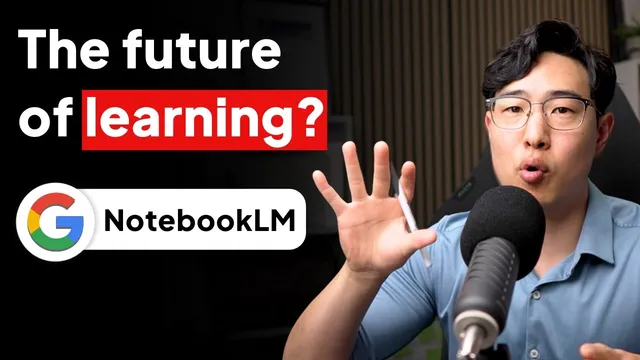
How to Learn FASTER With AI - Google NotebookLM
Based on Justin Sung's video on YouTube. If you like this content, support the original creators by watching, liking and subscribing to their content.
NotebookLM’s strongest value is time-saving for resource discovery and generating multimodal summaries, not replacing the learner’s own sense-making.
Briefing
NotebookLM’s multimodal “study mode” features are genuinely impressive—especially the video and audio overviews—but its biggest learning value is limited to saving time on resource gathering and basic comprehension. Where it falls short is the hardest part of learning: organizing and connecting information into a structure that feels intuitive and usable. That gap can create an “illusion of learning,” particularly for beginners who don’t yet know what they’re missing when key emphasis or conceptual pacing goes wrong.
The review frames learning around a win condition: not how fast content is consumed, but whether the learner can apply knowledge to reach a real objective—ranging from completing a task to building expertise and explaining complex ideas confidently. In that context, NotebookLM is positioned as Google’s all-in-one learning tool, consolidating source discovery, summaries, mind maps, flashcards, quizzes, and both audio and video overviews. In early testing, the interface stands out for ease of use: users can import vetted sources, turn generated content into notes, then chat with the material while it prompts higher-order, relational questions designed to push learners toward seeing connections.
For intensive study, on-the-go learning, and task-reactive use, the tool’s convenience is a clear strength. The mobile-responsive experience supports uninterrupted audio playback while switching tabs, and the quiz function can generate multiple-choice questions with explanations. The audio overview is described as surprisingly good, even offering an interactive “podcast” mode where users can “join” and ask questions mid-stream.
Yet the effectiveness score drops when the tool tries to replace the learner’s own sense-making process. The mind maps can become technically logical but not necessarily meaningful—especially in advanced domains where the categorization doesn’t match how a subject should be organized for real understanding. The audio/podcast format also tends to under-emphasize what’s truly complex or critical, sometimes moving on after a single sentence even when deeper explanation is needed. That matters because missing a key point can compound confusion later, feeding the overwhelm that learning science links to “multiple element interactivity”—the cognitive load of connecting many interacting pieces at once.
The most consequential critique is that AI tools excel at “small problems” that don’t move mastery much—collecting resources, generating summaries, and producing polished outputs—while struggling with the biggest bottleneck: the learner’s active work of organizing, connecting, and applying knowledge. NotebookLM can even make this harder by giving learners a ready-made structure (mind maps, overviews) that they must then fit themselves into, rather than building the structure through effortful thinking.
Still, the verdict isn’t “avoid it.” Effectiveness scales with the learner’s skill. Skilled learners can use NotebookLM without becoming dependent, while less skilled learners may still benefit but face a higher risk of shortcutting their way into shallow understanding. The practical recommendations are to enable NotebookLM’s “learning guide” setting (so it forces engagement instead of passive consumption), ask targeted questions to “earn” responses, and treat AI as a tool—not a savior. In the current state, NotebookLM is rated a “meh” for deep mastery, but a clear improvement for lower-level understanding and time-saving study workflows, with a stronger edge over Chatbot study mode at present.
Cornell Notes
NotebookLM delivers strong convenience and polished multimodal learning aids, especially video and audio overviews, plus quizzes and mind maps. The core limitation is not accuracy or usability; it’s effectiveness for deep learning. Learning at an expert level depends on the learner’s effort to organize and connect information into a personally meaningful structure, and NotebookLM can’t reliably replace that process. The audio/podcast format may also under-emphasize what’s most complex, which can worsen overwhelm later. Net result: it can be efficient for basic understanding and resource-heavy study, but it risks creating an illusion of learning for mastery—unless the user actively engages and uses features like Learning Guide.
What “win condition” should learners use to judge an AI study tool’s value?
Why does NotebookLM feel helpful at first but less effective over time?
Which NotebookLM features were praised, and what learning purpose do they serve?
What specific problems showed up in the mind map and audio/podcast formats?
Why are flash cards considered less useful in this setup?
How can users reduce the risk of “illusion of learning” with NotebookLM?
Review Questions
- When judging an AI learning tool, how would you measure success beyond time saved?
- What role does “multiple element interactivity” play in why AI outputs can increase overwhelm?
- How would enabling Learning Guide change the learning process compared with passive summaries?
Key Points
- 1
NotebookLM’s strongest value is time-saving for resource discovery and generating multimodal summaries, not replacing the learner’s own sense-making.
- 2
Deep learning depends on organizing and connecting information into a personally meaningful structure; AI outputs can’t reliably substitute for that effort.
- 3
Mind maps and podcast-style audio can be technically coherent yet still not match how a topic should be organized for real understanding.
- 4
The audio overview’s emphasis and pacing can skip or underplay what’s most complex, which can compound confusion later—especially for beginners.
- 5
Flash cards are less compelling because they lack export and spaced-repetition scheduling, making them redundant with quizzes for self-testing.
- 6
Effectiveness scales with learner skill: trained learners can use NotebookLM without becoming dependent, while less skilled users face higher risk of shallow learning.
- 7
To get better outcomes, use Learning Guide, ask targeted questions to “earn” answers, and avoid passive consumption by pausing to think and generate follow-ups.